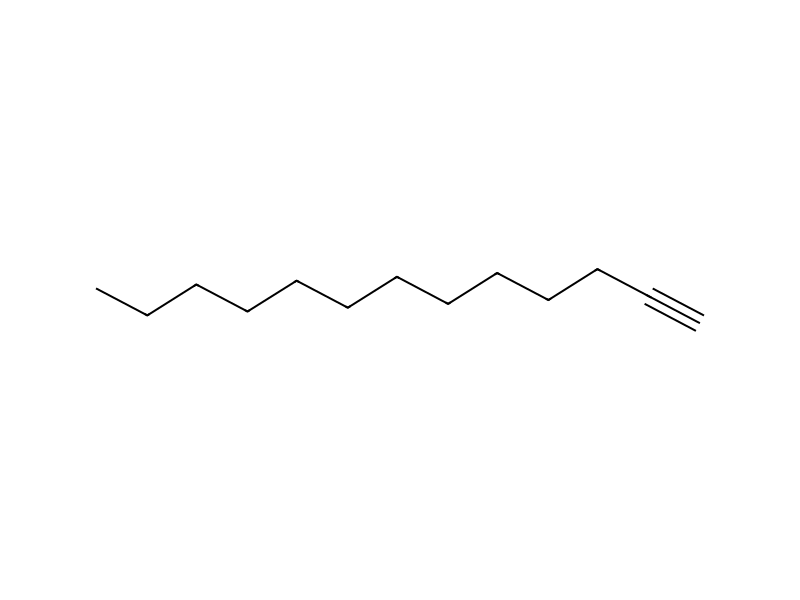
Br[C:2]1[CH:13]=[CH:12][C:5]([CH:6]=[CH:7][C:8]([O:10][CH3:11])=[O:9])=[CH:4][CH:3]=1.[CH:14]#[C:15][CH2:16][CH2:17][CH2:18][CH2:19][CH2:20][CH2:21][CH2:22][CH2:23][CH2:24][CH2:25][CH3:26]>C(N(CC)CC)C.C([O-])(=O)C.[Pd+2].C([O-])(=O)C.C1(P(C2C=CC=CC=2)C2C=CC=CC=2)C=CC=CC=1>[C:14]([C:2]1[CH:13]=[CH:12][C:5]([CH:6]=[CH:7][C:8]([O:10][CH3:11])=[O:9])=[CH:4][CH:3]=1)#[C:15][CH2:16][CH2:17][CH2:18][CH2:19][CH2:20][CH2:21][CH2:22][CH2:23][CH2:24][CH2:25][CH3:26]To a deaerated solution of methyl 4-bromocinnamate (9.64 g, 40 mmole) in dry triethylamine (120 ml) was added triphenylphosphine (308 mg) followed by 1-tridecyne (8.00 g, 45 mmole) and palladium (II) acetate (92 mg) under nitrogen. The mixture was heated to reflux for 24 hours, the reaction being followed by hplc. After this time the mixture was cooled and the precipitated triethylamine hydrobromide was filtered off and washed with a little triethylamine. The filtrate was evaporated to a red solid which was chromatographed on 220 g of silica eluting with petroleum ether [bp 60-80]-dichloromethane (3:2) to give 6.26 g (47%) of title compound as a pale yellow solid of mp (MeOH) 57°-59° C., υmax (mull) 1710, 1630, 1600, 1315, 1170, 1000, 830 cm-1, δ(CDCl3). 0.85 (3H, distorted t, terminal CH3), 1.28 (18H, m, alkylene chain), 2.38 (2 H, t, J 6.5 Hz, C≡C--CH2), 3.78 (3H, s, ester CH3), 6.37 (1H, d, J 16 Hz, =CHCO2), 7.42 (4H, near s, arom), 7.63 (1H, d, J 16 Hz, ArCH=)
Loading…