
4-エチルアニリン
4-Ethylaniline
データを補完しています。しばらくしてからページを更新すると最新の内容を表示できます
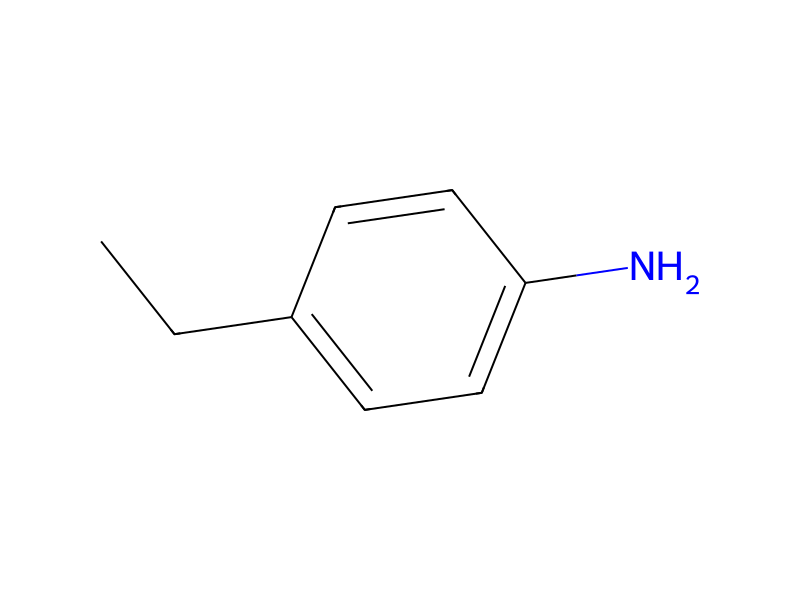
基本情報
- CAS
589-16-2- 標準SMILES
CCc1ccc(N)cc1- InChIKey
HRXZRAXKKNUKRF-UHFFFAOYSA-N- 分子式
- C8H11N
- 平均分子量
- 121.18 g/mol
- 単同位体質量
- 121.08914935
名称と識別子
- 優先名称
- 4-Ethylaniline
- IUPAC
- 4-ethylaniline
- 現地名
- 4-エチルアニリン
- 英語名
- 4-Ethylaniline
- 分子式
- C8H11N
- 分子量
- 121.18
名称と別名
4-ETHYLANILINE589-16-2Benzenamine, 4-ethyl-Aniline, 4-ethyl-4-ethylbenzenamineMHX72W1ZQVDTXSID0022066NSC-62015RefChem:522843DTXCID402066209-637-0p-Ethylaniline
名称をさらに表示
4-エチルアニリン4-エチル-1-ベンゼンアミンp-エチルアニリン4-エチルベンゼンアミンp-アミノエチルベンゼンP‐エチルアニリン4-ethyl-anilinaniline,4-ethyl-To ethyl anilinepara-EthylanilineAKOS BBS-00003560
4-Ethylphenylamine1-Amino-4-ethylbenzeneAniline, p-ethyl-p-Ethylaminobenzene4-Aminoethylbenzene4-ethyl anilineMFCD00007921NSC 62015
データベース識別子
- CAS
589-16-2- PubChem CID
- 11504
- DTXSID
DTXSID0022066- UNII
- MHX72W1ZQV
- EC Number
- 209-637-0
- Nikkaji
- J44.132E
物性
構造計算による物性補完中
- XLogP
- 2
- 極性表面積
- 26 Ų
- 水素結合供与体数
- 1
- 水素結合受容体数
- 1
- 回転可能結合数
- 1
- 重原子数
- 9
- 形式電荷
- 0
- 複雑度
- 72.6
実験および物理化学的性質
SpringerMaterials PropertiesBoiling point
物理化学的性質
- 融点
- -5 °C · -5 °C (lit.)
- 沸点
- 216 °C · 216 °C (lit.)
- 比重(密度)
- 0.975 g/mL · 0.975 g/mL at 25 °C (lit.)
- 屈折率
- 20 · n20/D 1.554(lit.)
- 闪点
- 185 °F · 185 °F
- 貯蔵温度
- Keep in dark place,Inert atmosphere,Room temperature
- 外見
- 液体
- 酸解離定数(Pka)
- 1 · pK1:5.00(+1) (25°C)
- 色
- 澄んだ黄色から赤褐色
- 水溶解度
- 混和しない
- BRN
- 774319 · 774319
- Henry's Law Constant
- 3.1 · 3.1×100 mol/(m3Pa) at 25℃, Mackay et al. (2006)
- InChI
- 1S/C8H11N/c1-2-7-3-5-8(9)6-4-7/h3-6H,2,9H2,1H3
- InChIKey
- HRXZRAXKKNUKRF-UHFFFAOYSA-N
- SMILES
- CCc1ccc(N)cc1
- CAS データベース
安全と法規制
安全情報は参考情報です。供給元の安全データシート(SDS)、適用法令、専門家による評価に代わるものではありません。
GHS分類
GHS Classification
Danger
H301+H311+H331 (38.2%): Toxic if swallowed, in contact with skin or if inhaled [Danger Acute toxicity, oral; acute toxicity, dermal; acute toxicity, inhalation]
P260, P261, P262, P264, P270, P271, P280, P301+P316, P302+P352, P304+P340, P316, P319, P321, P330, P361+P364, P403+P233, P405, and P501 (click each P-code to see the statement)
Aggregated GHS information provided per 76 reports by companies from 7 notifications to the ECHA C&L Inventory. Each notification may be associated with multiple companies.
危険有害性情報
Regulatory Information
Chemical: Benzenamine, 4-ethyl-
Benzenamine, 4-ethyl-: Does not have an individual approval but may be used under an appropriate group standard
Hazard Classes and CategoriesAcute Tox. 3 (97.4%)
安全データ
- wgk
- 3
- tsca
- TSCA listed
- rtecs
- BX9900000
- ridadr
- 1602
- hs_code
- 29214980
- risk_code
- 23/24/25-33
- 化審法
- (3)-206
- 消防法
- 危-4-3-III
- hazard_code
- T
- safety_code
- 36/37/39-45-36/37-28A
- hazard_class
- 6.1
- packing_group
- III
- Hazard Classifications
- Acute Tox. 3 DermalAcute Tox. 3 InhalationAcute Tox. 3 OralSTOT RE 2
化学と産業
用途と製造
General Manufacturing InformationBenzenamine, 4-ethyl-: ACTIVE
応用分野
使用4-Ethylaniline can be used as intermediates of liquid crystal.
調製方法
純化方法Dissolve p-ethylaniline in *benzene, then acetylate it. Recrystallise the acetyl derivative (m 93-94o, Hickinbottom & Waine J Chem Soc 1565 1930) from *C6H6/pet ether or EOH, and hydrolyse it by refluxing 50g with 500mL of H2O and 115mL of conc H2SO4 until the solution becomes clear. The amine sulfate is isolated, suspended in H2O and solid KOH is added to generate the free base, which separates. Dry it (KOH), and distil it from zinc dust in a vacuum [Berliner & Berliner J Am Chem Soc 76 6179 1954]. The picrate has m 171-172o (from 1,2-dichloroethane). [Beilstein 12 H 1090, 12 III 2380, 12 IV 2419.]
上流・下流製品情報
下流製品
関連反応
170 件


化合物ノート
読み込み中…