
HRID 65824反応物として
Dimethyladipate
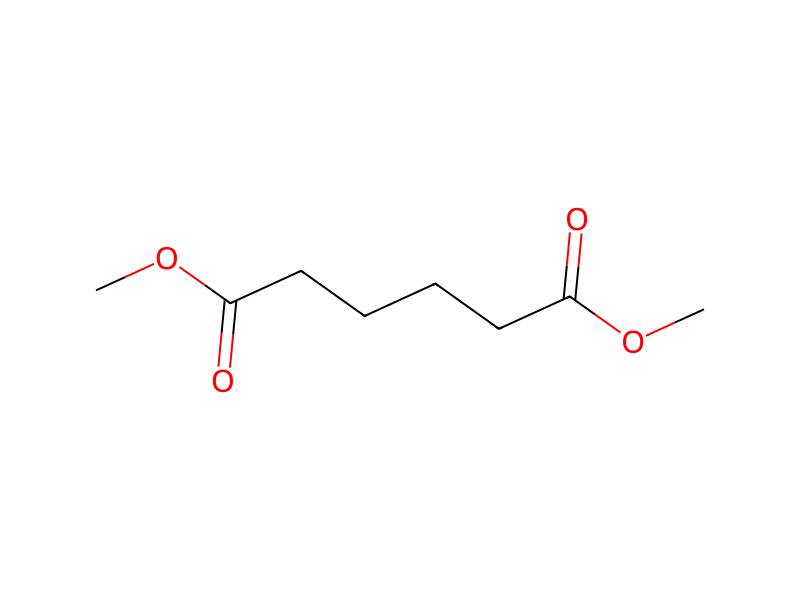
627-93-0COC(=O)CCCCC(=O)OCUDSFAEKRVUSQDD-UHFFFAOYSA-NDimethyl adipate is a colorless liquid. (USCG, 1999)
627-93-0DTXSID8025096CHEMBL1566491CHEBI:34715Cosmetic ingredients (Dimethyl Adipate) -> CIR (Cosmetic Ingredient Review)
Emollient; Plasticiser
log Kow= 1.03
1.030
1.03
1.063 (USCG, 1999) - Denser than water; will sink
1.0600 @ 20 °C/4 °C
1.062-1.066 (20 °C)
1.063
Sol in alc, ether, acetic acid
In water, 600 mg/l, temp not specified.
Insoluble
Very slightly soluble in water
安全情報は参考情報です。供給元の安全データシート(SDS)、適用法令、専門家による評価に代わるものではありません。
This chemical does not meet GHS hazard criteria for 64.2% (682 of 1062) of all reports.
Warning
H319 (32.4%): Causes serious eye irritation [Warning Serious eye damage/eye irritation]
P264+P265, P280, P305+P351+P338, and P337+P317 (click each P-code to see the statement)
Aggregated GHS information provided per 1062 reports by companies from 11 notifications to the ECHA C&L Inventory.
Chemical: Hexanedioic acid, dimethyl ester
Hexanedioic acid, 1,6-dimethyl ester is listed on the EPA's Chemical Data Reporting (CDR) system. Manufacturers and importers of Hexanedioic acid, 1,6-dimethyl ester are required to report information about their production and use of this chemical to the EPA under the Toxic Substances Control Act (TSCA). (40 eCFR Part 711)
REACH registered substance: Dimethyl adipate (EC: 211-020-6)
Dimethyl adipate: Does not have an individual approval but may be used under an appropriate group standard
DIMETHYL ADIPATE is an ester. Esters react with acids to liberate heat along with alcohols and acids. Strong oxidizing acids may cause a vigorous reaction that is sufficiently exothermic to ignite the reaction products. Heat is also generated by the interaction of esters with caustic solutions. Flammable hydrogen is generated by mixing esters with alkali metals and hydrides.
The metabolism of dibasic esters by rat nasal mucosal tissues was studied in-vitro. Homogenates of olfactory tissue from the ethmoturbinates and respiratory tissue from the nasoturbinates and maxilloturbinates of Crl:CDBR-rats were incubated with dimethyl succinate, dimethyl glutarate, or dimethyl adipate. Values of the reaction velocity at saturating substrate concentration (Vmax), the second order rate constant for binding and catalysis (V/K), the Michaelis constant (Km), and the dibasic ester concentration required to produce half maximal inhibition of the reaction rate (Ksi) were computed. The dibasic esters were hydrolyzed to their monomethyl esters by both the olfactory and respiratory mucosal homogenates. No diacid metabolites were detected. The rates of hydrolysis were always greater in the olfactory than in the respiratory homogenates. Vmaxs in olfactory tissue from male rats were 5 to 9 times higher than in respiratory tissue. In female rats, Vmaxs in the olfactory homogenates were 6 to 13 times those of the respiratory mucosa. V/Ks in male and female olfactory tissue were 4 to 11 and 6 to 10 times those in the corresponding respiratory tissue, respectively. When dimethyl glutarate was used as the substrate, V/Ks were similar for male and female olfactory tissue. In the case of dimethyl succinate and dimethyl adipate, V/K values for female olfactory tissue were 0.5 and 2 times those of the male tissues, respectively. The largest Km values in the olfactory tissues occurred when dimethyl adipate was used as the substrate, followed by dimethyl adipate and dimethyl glutarate in that order. The Ki values ranged from 24 to 46.5 millimolar. Female rats were pretreated with 1% bis-p-nitrophenyl phosphate, a carboxylesterase specific inhibitor. Bis-p-nitrophenyl phosphate decreased the rates of hydrolysis of dimethyl adipate, dimethyl glutarate, and dimethyl succinate in olfactory tissue by 79.8, 81, and 72%, respectively. The corresponding rates of hydrolysis in respiratory tissue were reduced by 87, 73, and 95%. The authors conclude that lesions induced in the nasal cavity of rodents by inhaled esters may be due to toxic acid metabolites.




Soluble (in ethanol)
225 °F (USCG, 1999)
107 °C
225 °F
228.2 to 230 °F at 14 mmHg (USCG, 1999)
115 °C @ 13 mm Hg
109.00 to 110.00 °C. @ 14.00 mm Hg
109-110 °C (14 mmHg)
228.2-230 °F at 14 mmHg
化学的特性Dimethyl adipate is a colorless liquid. It is a fatty acid methyl ester.
0.81 % (USCG, 1999)
0.81%
8.1 % (USCG, 1999)
8.1%
SRP: At the time of review, criteria for land treatment or burial (sanitary landfill) disposal practices are subject to significant revision. Prior to implementing land disposal of waste residue (including waste sludge), consult with environmental regulatory agencies for guidance on acceptable disposal practices.
The potential developmental effects of inhalation of dibasic esters (DBE) were investigated in the rat. The DBE mixture consisted of 65.12% dimethyl-glutarate, 17.75% dimethyl-succinate and 16.83% dimethyl-adipate. Starting at Day seven of gestation, pregnant Crl:CD-BR-rats were exposed whole body to dibasic esters at 0.16, 0.4 or 1.0 mg/l for 6 hours/day. On Day 21 of gestation, female rats were euthanized, and the fetuses were examined for external, visceral and skeletal alterations. Feed consumption during the first 6 days and body weight were reduced in pregnant rats in the 0.4 and 1.0 mg/l groups. Perinasal staining and wet fur were seen in the 1.0 mg/l group. Adverse reproductive effects of dibasic esters exposure were not detected, and there was no effect on fetal weight. No significant differences were seen in the incidences of external, visceral and skeletal alterations in exposed and control fetuses. The authors conclude that dibasic esters is not a developmental toxicant by inhalation in the rat at concentrations as high as 1.0 mg/l.
TERRESTRIAL FATE: Based on a classification scheme(1), an estimated Koc value of 11(SRC), determined from a structure estimation method(2), indicates that dimethyl adipate is expected to have very high mobility in soil(SRC). Volatilization of dimethyl adipate from moist soil surfaces is not expected to be an important fate process(SRC) given an estimated Henry's Law constant of 9.77X10⁻⁷ atm-cum/mole(4), determined from a fragment constant estimation method(4). Dimethyl adipate is not expected to volatilize from dry soil surfaces(SRC) based upon a vapor pressure of 0.06 mm Hg(3).
AQUATIC FATE: Based on a classification scheme(1), an estimated Koc value of 11(SRC), determined from an estimation method(2), indicates that dimethyl adipate is not expected to adsorb to suspended solids and sediment in water(SRC). Volatilization from water surfaces is not expected(3) based upon an estimated Henry's Law constant of 9.77X10⁻⁷ atm-cu m/mole(7), developed using a fragment constant estimation method(7). According to a classification scheme(4), an estimated BCF of 1.2(SRC), from a log Kow of 1.03(6) and a regression-derived equation(5), suggests the potential for bioconcentration in aquatic organisms is low. Dimethyl adipate is expected to undergo hydrolysis producing hexanedioic acid and methanol(SRC). Estimated hydrolysis half-lives are 2 years and 60 days at pH values of 7 and 8, respectively(8).
ATMOSPHERIC FATE: According to a model of gas/particle partitioning of semivolatile organic compounds in the atmosphere(1), dimethyl adipate, which has a vapor pressure of 0.06 mm Hg at 25 °C(3), is expected to exist solely as a vapor in the ambient atmosphere. Vapor-phase dimethyl adipate is degraded in the atmosphere by reaction with photochemically-produced hydroxyl radicals(SRC); the half-life for this reaction in air is estimated to be 4 days(SRC), calculated from its rate constant of 4X10-12 cu cm/molecule-sec at 25 °C(2). Dimethyl adipate may undergo direct photolysis in the environment, since this compound contains a functional group that can absorb light >290 nm(4).
The Koc of dimethyl adipate is estimated as 11(SRC), using a log Kow of 1.03(3) and a regression-derived equation(1). According to a classification scheme(2), this estimated Koc value suggests that dimethyl adipate is expected to have very high mobility in soil.
GENERAL TOXICITY OF /HIGHER-MOLECULAR-WT DIESTERS OF ADIPIC ACID/...IS SIMILAR IN MANY WAYS TO THAT OF PHTHALATE ESTERS &, IN SOME INSTANCES...MAY BE LESS. TOXICITY DATA ON ADIPATES...NOT QUITE AS EXTENSIVE AS FOR PHTHALATE ESTERS, & THUS CAUTION SHOULD BE TAKEN IN CONCLUDING THAT TOXIC EFFECTS...SIMILAR. /ADIPATE ESTERS/
An estimated BCF of 1.2 was calculated for dimethyl adipate(SRC), using a log Kow of 1.03(3) and a regression-derived equation(1). According to a classification scheme(2), this BCF suggests the potential for bioconcentration in aquatic organisms is low.
The Henry's Law constant for dimethyl adipate is estimated as 9.77X10⁻⁷ atm-cu m/mole(SRC) using a fragment constant estimation method(1). This Henry's Law constant indicates that dimethyl adipate is not expected to volatilize from water surfaces(2). Dimethyl adipate's Henry's Law constant(1) indicates that volatilization from moist soil surfaces is not expected to occur(SRC). Dimethyl adipate is not expected to volatilize from dry soil surfaces(SRC) based upon a vapor pressure of 0.06 mm Hg (3).
CIR ingredient: Dimethyl Adipate
Used as a plasticizer for cellulose type resins and a finish remover; [HSDB]
PLASTICIZER FOR CELLULOSE TYPE RESINS
Finish remover
Alternative solvent in remover formulas
ESTERIFICATION OF ADIPIC ACID WITH METHANOL IN THE PRESENCE OF AN ACID CATALYST
BASF has further developed the hydroesterification of butadiene to give dimethyl adipate.
The first CO route to make adipic acid is a BASF process employing CO and methanol in a two-step process producing dimethyl adipate.
EPA Safer Chemical Functional Use Classes -> Solvents
Safer Chemical Classes -> Green circle - The chemical has been verified to be of low concern
Fragrance Ingredients
Flavouring Agent -> FLAVOURING_AGENT -> JECFA Functional Classes
Flavoring Agents -> JECFA Flavorings Index
Cosmetics -> Emollient; Plasticiser
Printing and Related Support Activities
Hexanedioic acid, 1,6-dimethyl ester: ACTIVE
A NUMBER OF POLYVINYL CHLORIDE PRODUCTS UTILIZE ONE OF THE HIGHER-MOLECULAR-WT DIESTERS OF ADIPIC ACID. /ADIPIC ACID ESTERS/
用途有機合成原料。
説明Dimethyl adipate (DMA) is a colourless and flammable liquid. It is soluble in alcohol and ether but sparingly soluble in water. DMA is incompatible with strong oxidising agents, and on decomposition, it emits carbon monoxide, irritating and toxic fumes and gases, and carbon dioxide. DMA reacts with acids, alkalis, and strong oxidants. DMA is synthesised by the esterification of adipic acid. DMA is part of a dibasic ester (DBE) blend used as a major ingredient in several paint strippers, and the DBE blends used in paint stripping formulations contain a major portion (about 90%) of DMA. DMA is used as a chemical intermediate (polymers, agrochemicals), cellulose resins, a speciality solvent (inks, coatings, adhesives), and an emollient and can also be utilised as a paint remover and plasticiser.
使用Dimethyl adipate is used in cosmetics (in emollients and skin conditioning).It is used as a plasticizer for cellulose-type resins and a finish remover.It is also used in agrochemicals and dye as well as a precursor for the preparation of active pharmaceutical ingredients. Further, it serves as a polymer intermediate. In addition to this, it is employed as a solvent for paint stripping and resins.
一般的な説明Colorless liquid.
Dimethyl adipate is manufactured via esterification of adipic acid and methanol in the presence of an acid catalyst.
定義本品は、アジピン酸(*)とメチルアルコールのジエステルであり、次の化学式で表される。参照表示名称:アジピン酸