
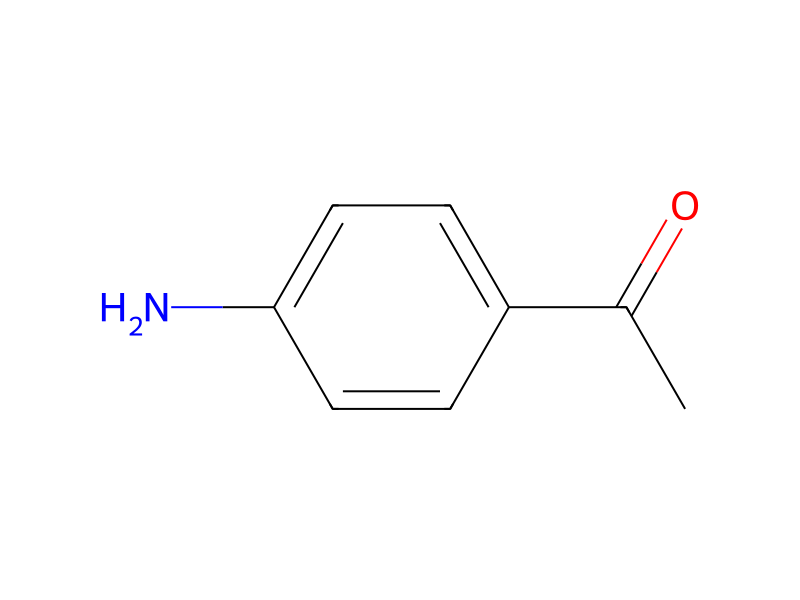
基本情報
- 標準SMILES
CC(=O)c1ccc(N)cc1- InChIKey
GPRYKVSEZCQIHD-UHFFFAOYSA-N- 分子式
- C8H9NO
- 平均分子量
- 135.16 g/mol
- 単同位体質量
- 135.06841391
名称と識別子
- 優先名称
- p-Aminoacetophenone
- IUPAC
- 1-(4-aminophenyl)ethanone
- 現地名
- 4'-アミノアセトフェノン
- 英語名
- 4-Aminoacetophenone
- 分子式
- C8H9NO
- 分子量
- 135.16
名称と別名
4'-Aminoacetophenone99-92-31-(4-Aminophenyl)ethanone4-Aminoacetophenonep-Aminoacetophenone4-ACETYLANILINEp-AcetylanilineEthanone, 1-(4-aminophenyl)-p-AminoacetylbenzeneAcetophenone, p-amino-USAF EK-631Acetophenone, 4-amino-
名称をさらに表示
4'-アミノアセトフェノン1-(4-アミノフェニル)エタノン1-アミノ-4-アセチルベンゼン4-アセチルアニリン1-アセチル-4-アミノベンゼンp-アミノアセトフェノン4-アセチルベンゼンアミン4′‐アミノアセトフェノンp-アミノアセトフェノン(4′-)P‐アミノアセトフェノンP-アミノアセトフェノン(4'-)4-アミノアセトフェノン4′-アミノアセトフェノンp-アセチルアニリン1-(4-アミノフェニル)エタン-1-オンClenbuterol EP Impurity D1-(4-aminophenyl)-ethanonNSC 3242usafek-631
1S58KH902INSC-3242DTXSID6052669para-aminoacetophenoneRefChem:97827DTXCID7031242202-801-21-(4-Aminophenyl)Ethan-1-One
データベース識別子
- CAS
99-92-3- PubChem CID
- 7468
- DTXSID
DTXSID6052669- ChEMBL
CHEMBL3278329- UNII
- 1S58KH902I
- EC Number
- 202-801-2
- Nikkaji
- J3.228J
物性
構造計算による物性
- XLogP
- 0.8
- 極性表面積
- 43.1 Ų
- 水素結合供与体数
- 1
- 水素結合受容体数
- 2
- 回転可能結合数
- 1
- 重原子数
- 10
- 形式電荷
- 0
- 複雑度
- 125
実験および物理化学的性質
LogPlog Kow = 0.83
OdorPleasant, characteristic odor
Color/Form
Yellow monoclinic prisms from alcohol
Yellow needles
Solubility
Soluble in hydrochloric acid
Very soluble in ether and ethanol
In water, 3.35X10+3 mg/L at 37 °C
Boiling Point294 °C; 195 °C at 15 mm Hg
Melting Point106 °C
Vapor Pressure0.00989 [mmHg]
Physical DescriptionYellow solid with a pleasant odor; [HSDB] Tan crystalline solid; [MSDSonline]
Dissociation ConstantspKa = 2.76 (conjugate acid)
Kovats Retention Index
1440
2181
Collision Cross Section125.0 Ų [M-H]- [CCS Type: DT; Buffer gas: N2; Ionization: ESI-; Dataset: TOXCAST; Source Identifier: DTXSID6052669]
物理化学的性質
- 融点
- 103 · 103-107 °C(lit.)
- 沸点
- 293 °C · 293 °C(lit.)
- 比重(密度)
- 0 · 0,77 g/cm
- 屈折率
- 1.57 · 1.5700 (estimate)
- 闪点
- 292 · 292-294°C
- 貯蔵温度
- 30 °C · Store below +30°C.
- 溶解性
- 6.5 g/リットル · 6.5g/リットル
- 外見
- 結晶性粉末
- 酸解離定数(Pka)
- 2.17 · 2.17±0.10(Predicted)
- 比重
- 0.77 · 0.77
- 色
- やや黄色~茶色
- 水溶解度
- 熱水、エタノール、エーテルに溶ける。
- Merck
- 14 · 14,413
- BRN
- 471493 · 471493
- Henry's Law Constant
- 2.2 · 2.2×103 mol/(m3Pa) at 25℃, HSDB (2015)
- InChI
- 1S/C8H9NO/c1-6(10)7-2-4-8(9)5-3-7/h2-5H,9H2,1H3
- InChIKey
- GPRYKVSEZCQIHD-UHFFFAOYSA-N
- SMILES
- CC(=O)c1ccc(N)cc1
- LogP
- 0.83 · 0.830
- CAS データベース
- 99 · 99-92-3(CAS DataBase Reference)
- NISTの化学物質情報
- 4 · Acetophenone, 4'-amino-(99-92-3)
- EPAの化学物質情報
- 4 · 4'-Aminoacetophenone (99-92-3)
化学的性質
化学的特性slightly yellow to brown crystalline powder
安全と法規制
GHS分類
GHS Classification
Warning
H302 (100%): Harmful if swallowed [Warning Acute toxicity, oral];H312 (67.1%): Harmful in contact with skin [Warning Acute toxicity, dermal];H315 (30.3%): Causes skin irritation [Warning Skin corrosion/irritation];H319 (30.3%): Causes serious eye irritation [Warning Serious eye damage/eye irritation];H332 (67.7%): Harmful if inhaled [Warning Acute toxicity, inhalation];H335 (29.7%): May cause respiratory irritation [Warning Specific target organ toxicity, single exposure; Respiratory tract irritation]
P261, P264, P264+P265, P270, P271, P280, P301+P317, P302+P352, P304+P340, P305+P351+P338, P317, P319, P321, P330, P332+P317, P337+P317, P362+P364, P403+P233, P405, and P501 (click each P-code to see the statement)
Aggregated GHS information provided per 155 reports by companies from 8 notifications to the ECHA C&L Inventory. Each notification may be associated with multiple companies.;Information may vary between notifications depending on impurities, additives, and other factors. The percentage value in parenthesis indicates the notified classification ratio from companies that provide hazard codes. Only hazard codes with percentage values above 10% are shown. For more detailed information, please visit ECHA C&L website.
危険有害性情報
Regulatory InformationChemical: Ethanone, 1-(4-aminophenyl)-
Hazards Summary
A strong inducer of methemoglobin in vivo; Emergency treatment: Aniline; [HSDB] Methemoglobinemia observed in oral lethal-dose study of dogs; [RTECS] An irritant; Toxic if swallowed; May be harmful by inhalation or skin absorption; [Aldrich MSDS] See Aniline.
Special ReportsMilman HA, Peterson C; Apparent Correlation Between Structure and Carcinogenicity of Phenylenediamines and Related Cmpds; Environ Health Perspectives 56: 261-73 (1984).
Hazard Classes and CategoriesAcute Tox. 4 (100%);Acute Tox. 4 (67.1%);Skin Irrit. 2 (30.3%);Eye Irrit. 2A (30.3%);Acute Tox. 4 (67.7%);STOT SE 3 (29.7%)
安全と保護具
Disposal Methods
SRP: The most favorable course of action is to use an alternative chemical product with less inherent propensity for occupational harm/injury/toxicity or environmental contamination. Recycle any unused portion of the material for its approved use or return it to the manufacturer or supplier. Ultimate disposal of the chemical must consider: the material's impact on air quality; potential migration in soil or water; effects on animal and plant life; and conformance with environmental and public health regulations.
The following wastewater treatment technologies have been investigated for acetophenone: concentration process: activated carbon. /Acetophenone/
The following wastewater treatment technologies have been investigated for acetophone: concentration process: resin adsorption. /Acetophenone/
毒性情報
Ecotoxicity Values
LD50; Species: Peromyscus maniculatus (Deer Mouse) wild, oral via capsule 1600 mg/kg
EC50; Species: Daphnia magna (Water flea) age 6-24 hr; Conditions: freshwater, static, 20 °C, pH > or =7.0; Concentration: 5000 ug/L for 48 hr (95% confidence interval: 2200-12000 ug/L); Effect: intoxication, immobilization /formulation/
Environmental Fate
TERRESTRIAL FATE: Based on a classification scheme(1), an estimated Koc value of 25(SRC), determined from a log Kow of 0.83(2) and a regression-derived equation(3), indicates that 4-acetylaniline is expected to have very high mobility in soil(SRC). However, aromatic amines are expected to bind strongly to humus or organic matter in soils due to the high reactivity of the aromatic amino group(4,5), suggesting that mobility may be much lower in some soils(SRC). Volatilization of 4-acetylaniline from moist soil surfaces is not expected to be an important fate process(SRC) given an estimated Henry's Law constant of 4.4X10⁻⁹ atm-cu m/mole(SRC), using a fragment constant estimation method(6). 4-Acetylaniline is not expected to volatilize from dry soil surfaces(SRC) based upon an estimated vapor pressure of 4.3X10⁻⁴ mm Hg at 25 °C(SRC), determined from a fragment constant method(7). Aerobic biodegradation data were not available(SRC, 2011). No biodegradation was observed when incubated in digester sludge under anaerobic conditions for 8 weeks(8).
AQUATIC FATE: Based on a classification scheme(1), an estimated Koc value of 25(SRC), determined from a log Kow of 0.83(2) and a regression-derived equation(3), indicates that 4-acetylaniline is not expected to adsorb to suspended solids and sediment(SRC). Volatilization from water surfaces is not expected(4) based upon an estimated Henry's Law constant of 4.4X10⁻⁹ atm-cu m/mole(SRC), developed using a fragment constant estimation method(5). According to a classification scheme(6), an estimated BCF of 3(SRC), from its log Kow(2) and a regression-derived equation(7), suggests the potential for bioconcentration in aquatic organisms is low(SRC). Aerobic biodegradation data were not available(SRC, 2011). No biodegradation was observed when incubated in digester sludge under anaerobic conditions for 8 weeks(8).
ATMOSPHERIC FATE: According to a model of gas/particle partitioning of semivolatile organic compounds in the atmosphere(1), 4-acetylaniline, which has an estimated vapor pressure of 4.3X10⁻⁴ mm Hg at 25 °C(SRC), determined from a fragment constant method(2), will exist in both the vapor and particulate phases in the ambient atmosphere. Vapor-phase 4-acetylaniline is degraded in the atmosphere by reaction with photochemically-produced hydroxyl radicals(SRC); the half-life for this reaction in air is estimated to be 3.6 hours(SRC), calculated from its estimated rate constant of 1.05X10⁻¹⁰ cu cm/molecule-sec at 25 °C(3). Particulate-phase 4-acetylaniline may be removed from the air by wet or dry deposition(SRC). 4-Acetylaniline (in alcohol solution) has UV absorption maximum at 316 nm(4) and therefore may be susceptible to direct photolysis by sunlight(SRC).
Adverse EffectsMethemoglobinemia - The presence of increased methemoglobin in the blood; the compound is classified as secondary toxic effect
Effluent Concentrations
4-Acetylaniline was detected in the effluent from a chemical manufacturing plant (sampling date in June 1973) in Newport, TN(1). The compound was detected not quantified in a raw sewage sample as part of an evaluation of the municipal sewage treatment systems in a treatment plant Harbin, China, May 2007(2).
Soil Adsorption/Mobility
The Koc of 4-acetylaniline is estimated as 25(SRC), using a log Kow of 0.83(1) and a regression-derived equation(2). According to a classification scheme(3), this estimated Koc value suggests that 4-acetylaniline is expected to have very high mobility in soil. However, aromatic amines are expected to bind strongly to humus or organic matter in soils due to the high reactivity of the aromatic amino group(4,5), suggesting that mobility may be much lower in some soils(SRC). The initial bonding reaction is followed by a slower and much less reversible reaction believed to represent the addition of the amine to quinoidal structures followed by oxidation of the product to give an amino-substituted quinone; these processes represent pathways by which aromatic amines may be converted to latent forms in the biosphere(6).
Artificial Pollution Sources4-Acetylaniline's production and use as a laboratory reagent(1) may result in its release to the environment through various waste streams(SRC).
Environmental BiodegradationANAEROBIC: In anaerobic biodegradation studies using a digester sludge inocula, 4-acetylaniline did not show any evidence of degradation after an 8-week incubation period(1).
Environmental Bioconcentration
An estimated BCF of 3 was calculated in fish for 4-acetylaniline(SRC), using a log Kow of 0.83(1) and a regression-derived equation(2). According to a classification scheme(3), this BCF suggests the potential for bioconcentration in aquatic organisms is low(SRC).
Volatilization from Water/Soil
The Henry's Law constant for 4-acetylaniline is estimated as 4.4X10⁻⁹ atm-cu m/mole(SRC) using a fragment constant estimation method(1). This Henry's Law constant indicates that 4-acetylaniline is expected to be essentially nonvolatile from water and moist soil surfaces(2). 4-Acetylaniline is not expected to volatilize from dry soil surfaces(SRC) based upon an estimated vapor pressure of 4.3X10⁻⁴ mm Hg(SRC), determined from a fragment constant method(3).
Non-Human Toxicity Excerpts
/LABORATORY ANIMALS: Acute Exposure/ P-AMINOACETOPHENONE ... /WAS/ TESTED IN 0.02 MOLAR AQ SOLN @ PH 6.5 BY DROPPING FOR 10 MIN ON RABBIT CORNEAS FROM WHICH EPITHELIUM HAD BEEN REMOVED. NO SIGNIFICANT CORNEAL OPACITY RESULTED & RECOVERY WAS COMPLETE WITHIN 5 DAYS.
Environmental Abiotic Degradation
The rate constant for the vapor-phase reaction of 4-acetylaniline with photochemically produced hydroxyl radicals has been estimated to be 1.05X10⁻¹⁰ cu cm/molecule-sec at 25 °C(1) which corresponds to an atmospheric half-life of about 3.6 hrs at an atmospheric concentration of 5X10+5 hydroxyl radicals per cu cm(SRC). Aromatic amines and ketones are generally resistant to aqueous environmental hydrolysis(2); therefore, 4-acetylaniline is not expected to hydrolyze in water(SRC). As a class, aromatic amines react relatively rapidly in sunlit natural water via reaction with photochemically produced hydroxyl radicals and peroxy radicals(3); typical half-lives for hydroxyl radical and peroxy radical reaction are on the order of 19-30 sunlight hours(3); however, rate data specific to 4-acetylaniline were not located(SRC). 4-Acetylaniline (in alcohol solution) has UV absorption maximum at 316 nm(4) and therefore is may be susceptible to direct photolysis by sunlight(SRC).
Probable Routes of Human ExposureOccupational exposure to 4-acetylaniline may occur through inhalation and dermal contact with this compound at workplaces where 4-acetylaniline is produced or used. (SRC)
法規制情報
Regulatory InformationChemical: Ethanone, 1-(4-aminophenyl)-
安全データ
- wgk
- 3
- tsca
- TSCA listed
- rtecs
- AM5500000
- 毒性
- LD50 orally in Rabbit: 381 mg/kg
- hs_code
- 29223900
- risk_code
- 22-36/37/38-20/21/22
- hazard_code
- Xn,Xi
- safety_code
- 26-36
- hazard_class
- IRRITANT-HARMFUL
- Hazard Classifications
- Acute Tox. 4 Oral
- ストレージクラス
- 11 - Combustible Solids
- 有毒物質データの
- 99-92-3(Hazardous Substances Data)
化学と産業
薬理情報
Mechanism of ActionP-AMINOACETOPHENONE IS KNOWN TO BE A POWERFUL METHEMOGLOBIN-FORMER IN VIVO.
用途と製造
Uses
Used as intermediate for flavaniline (basic dye), acetohexamide, and an oral hypoglycemic drug; [HSDB]
Laboratory reagent
... for treating intoxication with cyanogenic toxic substances
CHEMICAL INTERMEDIATE FOR FLAVANILINE (BASIC DYE), ACETOHEXAMIDE, AND AN ORAL HYPOGLYCEMIC DRUG.
Methods of ManufacturingTRANSFER HYDROGENATION OF P-NITROACETOPHENONE WITH PALLADIUM CATALYST AND CYCLOHEXENE HYDROGEN DONOR
General Manufacturing InformationEthanone, 1-(4-aminophenyl)-: ACTIVE
応用分野
使用4-Aminoacetophenone can be used as an organic reagent to synthesize a variety of organic substances, which is used in the field of anticancer drug preparation and analytical detection. Using it as a raw material, Schiff alkali palladium(II) complexes (cyclopalladiumated compounds) are synthesized by combining metals with carbon atoms. The drug inhibits and kills invasive melanoma cancer cell line (MDA-MB-435)[1]. Hydroxylamine hydrochloride and 4-aminoacetophenone synthesize 4-aminoacetophenone oxime (APO) by oximation reaction, which has a high sensitivity to Organophosphorus (OP)nerve agent mimic-diethylcyanophosphonate. APO can be used to prepare electrochemical sensors with high sensitivity and selectivity to detect OPs[2].
一般的な説明4′-Aminoacetophenone, commonly known as Clenbuterol Impurity D, is a related compound of sympathomimetic amine drug clenbuterol. Clenbuterol belongs to a group of compounds referred to as β-2-agonists and is generally used in the treatment of asthma.Pharmaceutical secondary standards for application in quality control, provide pharma laboratories and manufacturers with a convenient and cost-effective alternative to the preparation of in-house working standards.
調製方法
純化方法It is soluble in hot H2O. UV (EtOH) has max 403nm (log 4.42) [Johnson J Am Chem Soc 75 2720 1953]. [Vandenbelt Anal Chem 26 726 1954.] The 2,4-dinitrophenylhydrazone has m 266-267o (from CHCl3 or EtOH) with 403nm (log 4.42), and the max semicarbazone has m 193-194o(dec)(from MeOH). The hydrochloride has m 98o(dec)(from H2O). [Beilstein 14 IV 100.]
上流・下流製品情報
上流原料
下流製品
サプライヤー50 社
国药集团化学试剂有限公司86-21-63210123 · [email protected]
梯希爱(上海)化成工业发展有限公司021-67121386 · [email protected]
衢州润东化工有限公司0570-8789886 18892685668 · [email protected]
艾斯提克(山东)生物医药有限公司21-58999881 15623240527 · [email protected]
上海阿拉丁生化科技股份有限公司400-6206333 13167063860 · [email protected]
爱斯特(成都)生物制药股份有限公司+86-28-85122536 85324413 · [email protected]
上海如吉生物科技发展有限公司+86-21-65211385-8001 36031160 · [email protected]
韶远科技(上海)有限公司021-50795510 4000665055 · [email protected]
科瑞迪化学400-821-5857 021-64326257 · [email protected]
Syntechem Co.,Ltd[email protected]
上海迈瑞尔生化科技有限公司4006356688 18621169109 · [email protected]
北京华威锐科化工有限公司0757-86329057 18934348241 · [email protected]
阿法埃莎(中国)化学有限公司400-6106006 · [email protected]
太原市瑞和丰科贸有限公司+86 351 7031519 · [email protected]
安耐吉化学&3A(安徽泽升科技股份有限公司)400-0056266 · [email protected]
武汉凯威斯科技有限公司86-027-67849912 · [email protected]
常州康特医药技术有限公司0519-82813797 18994752886 · [email protected]
上海瀚鸿科技股份有限公司021-54306202 13764082696 · [email protected]
上海柯维化学技术有限公司021-64609169 18901607656 · [email protected]
上海景颜化工科技有限公司13817811078 · [email protected]
嘉兴市艾森化工有限公司0573-85285100 18627885956 · [email protected]
孝感深远化工有限公司15527621225; 15527621225 · [email protected]
Beckmann-Kenko GmbH+49 4241 9308 88 · [email protected]
山东西亚化学有限公司13355009207 13355009207 · [email protected]
玛雅试剂+86 (573) 82222445 (0)18006601000 452520369 · [email protected]
四川库利南科技有限公司400-1166-196 18981987031 · [email protected]
上海耐士化工科技有限公司400-188-0725 +86 21 34310725 13611771617
天津希恩思生化科技有限公司400 638 7771 · [email protected]
南京维奥化工有限公司Please Send Email 18652950785 · [email protected]
北京泰亚杰科技有限公司021-33690831-8001 13552411790;18616022633 · [email protected]
艾科试剂4008-755-333 18080918076 · [email protected]
上海思域化工科技有限公司86-21-34053660 · [email protected]
赛默飞世尔科技(中国)有限公司800-810-5118 · [email protected]
北京伊诺凯科技有限公司400-810-7969 010-59572699 · [email protected]
南京诺利斯医药科技有限公司13901585132 · [email protected]
上海健超生物科技有限公司150-2103-5486 18017383231 · [email protected]
TCI AMERICA800-4238616 · [email protected]
TOKYO CHEMICAL INDUSTRY CO., LTD.03-36680489 · [email protected]
TCI Europe320-37350700 · [email protected]
上海贤鼎生物科技有限公司4009209199 · [email protected]
深圳振强药物研发有限公司0755-66853366 13670046396 · [email protected]
深圳康特腾科技有限公司86-0755-86635001 · [email protected]
上海睿升化工科技有限公司+86-021-50935922
湖南复瑞生物医药技术有限责任公司15901640172,19275032510 15901640172 · [email protected]
Clearsynth Labs Limited+91-22-26355700 · [email protected]
上海皋翔化工有限公司021-57816257 18930243658 · [email protected]
北京环宇世纪化学科技有限公司hysj_bj.com
湖北鑫源顺医药化工有限公司13971561712, 13995564702, 027-50664929 · [email protected]
上海贺康生物技术有限公司17721021104 18939837085 · [email protected]
上海将来实业股份有限公司400-0066400 13621662912 · [email protected]
関連反応
2,313 件


関連ノート
読み込み中…