ホームMCPワークベンチSkills
ホームワークベンチ通知マイページ
llms.txt · MCPガイドプライバシーポリシー · 利用規約 · サポートv1.8.0
  1. ホーム
  2. /化合物

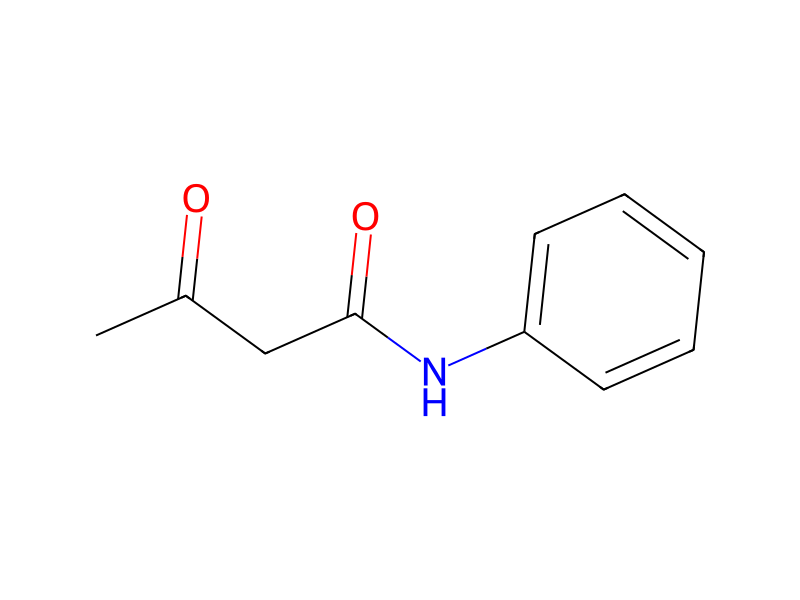
アセトアセトアニリド

Acetoacetanilide

HCID 7592
ノートを作成反応を作成見積依頼を出す
印刷プレビュー

データを補完しています。しばらくしてからページを更新すると最新の内容を表示できます
基本情報概要名称と識別子物性安全と法規制化学と産業関連反応化合物ノート
部分構造検索類似構造を探す

基本情報

CAS
102-01-2
標準SMILES
CC(=O)CC(=O)Nc1ccccc1
InChIKey
DYRDKSSFIWVSNM-UHFFFAOYSA-N
分子式
C10H11NO2
平均分子量
177.2 g/mol
単同位体質量
177.07897859

概要

Acetoacetanilide is a white crystalline solid. (NTP, 1992)

名称と識別子

優先名称
Acetoacetanilide
IUPAC
3-oxo-N-phenylbutanamide
現地名
アセトアセトアニリド
英語名
Acetoacetanilide
分子式
C10H11NO2
分子量
177.2

名称と別名

ACETOACETANILIDE102-01-23-Oxo-N-phenylbutanamideButanamide, 3-oxo-N-phenyl-Acetoacetic anilideAcetylacetanilideAcetoacetamidobenzeneN-PhenylacetoacetamideAcetoacetic acid anilideAcetoacetylanilineAcetoacetanilidN-(Acetylacetyl)aniline
名称をさらに表示
アセトアセトアニリドN-フェニル-3-オキソブタンアミドアセト酢酸アニリド3-オキソ-N-フェニルブチルアミド3-オキソ-N-フェニルブタンアミドN-フェニルアセトアセトアミド2-アセチルアセトアニリドN-フェニル-3-オキソブチルアミド2-アセチル-N-フェニルアセトアミドアセトアセト アニリドアセト酢酸アニリド, アセトアセトアニリドα-アセチルアセトアニリドAAAAANethyl 3-oxo-3-(phenylamino)propanoateLinazolusafek-1239Coupler 633
Acetanilide, 2-acetyl-USAF EK-1239beta-Ketobutyranilide1-(Phenylcarbamoyl)-2-propanoneAnilid kyseliny acetoctove((Acetoacetyl)amino)benzenealpha-Acetyl-N-phenylacetamideDTXSID0024397

データベース識別子

CAS
102-01-2、86349-51-1
PubChem CID
7592
DTXSID
DTXSID0024397
ChEMBL
CHEMBL1604429
UNII
W35JB9PY3X
EC Number
202-996-4
Nikkaji
J4.999I

物性

構造計算による物性補完中

XLogP
1.5
極性表面積
46.2 Ų
水素結合供与体数
1
水素結合受容体数
2
回転可能結合数
3
重原子数
13
形式電荷
0
複雑度
195

実験および物理化学的性質

Chemical ClassesNitrogen Compounds -> Other Aromatics (Nitrogen)
SpringerMaterials PropertiesCrystal structure
LogP1.04
Density · 2 件

1.26 at 68 °F (NTP, 1992) - Denser than water; will sink

1.26 g/ml at 20 °C

Color/Form · 2 件

WHITE CRYSTALLINE SOLID

PLATES OR NEEDLES FROM BENZENE OR PETROLEUM ETHER

Solubility · 4 件

less than 1 mg/mL at 70 °F (NTP, 1992)

SLIGHTLY SOL IN WATER; SOL IN ALC, CHLOROFORM, ETHER, HOT BENZENE, ACID, HOT PETROLEUM ETHER, ALKALI HYDROXIDE SOLN /KETO FORM/

SOL IN ALKALI

Soluble in oxygenated and chlorinated solvents.

Flash Point · 3 件

325 °F (NTP, 1992)

162.7 °C

365 °F; 185 °C (OPEN CUP)

Boiling Point · 2 件

Decomposes (NTP, 1992)

BOILING POINT: DECOMPOSES

DecompositionSEE ANILINE. ...WHEN HEATED TO DECOMP, IT EMITS HIGHLY TOXIC FUMES. /ANILINE/

安全と法規制

安全情報は参考情報です。供給元の安全データシート(SDS)、適用法令、専門家による評価に代わるものではありません。

GHS分類

GHS Classification · 5 件

This chemical does not meet GHS hazard criteria for 2.5% (12 of 477) of reports.

Warning

H302 (97.3%): Harmful if swallowed [Warning Acute toxicity, oral]

P260, P261, P264, P270, P271, P280, P301+P317, P302+P352, P304+P340, P317, P319, P321, P330, P362+P364, and P501 (click each P-code to see the statement)

Aggregated GHS information provided per 477 reports by companies from 13 notifications to the ECHA C&L Inventory. Each notification may be associated with multiple companies.

危険有害性情報

Regulatory Information · 4 件

Chemical: Butanamide, 3-oxo-N-phenyl-

Butanamide, 3-oxo-N-phenyl- is listed on the EPA's Chemical Data Reporting (CDR) system. Manufacturers and importers of Butanamide, 3-oxo-N-phenyl- are required to report information about their production and use of this chemical to the EPA under the Toxic Substances Control Act (TSCA). (40 eCFR Part 711)

REACH registered substance: Acetoacetanilide (EC: 202-996-4)

Acetoacetanilide: Does not have an individual approval but may be used under an appropriate group standard

Fire HazardsThis chemical is combustible. (NTP, 1992)
Fire PotentialFIRE HAZARD: SLIGHT, WHEN EXPOSED TO HEAT OR FLAME.
Health HazardsACUTE/CHRONIC HAZARDS: This compound is a weak allergen. When heated to decomposition it emits toxic fumes. (NTP, 1992)
Hazards Summary · 1 件

Reports of reversible eye burns in humans; Not irritating to skin and mildly irritating to eyes of rabbits; No evidence of skin sensitization in guinea pigs; Causes slight methemoglobinemia and significant formation of Heinz bodies in cats following single oral administration of 100 mg/kg; Hemolytic anemia and corresponding injury to liver, spleen, and kidneys observed in 28-day oral study of rats (850 mg/kg/day and, to some extent, at 100 mg/kg/day); Emergency treatment: Phenacetin; Phenacetin was used as a pain-relieving drug, but has not been available in the US since 1983. Can cause methemoglobinemia after ingestion >1 gram/day; Can cause renal papillary necrosis following ingestion of large doses for years; [HSDB] A weak allergen; [CAMEO] A mild skin irritant; Can be absorbed through skin; [Alfa Aesar MSDS]

化学と産業

用途と製造

Uses · 6 件

Used in rubber compounding and in manufacturing other chemicals (hansa yellow dyes, benzidine yellow pigments, the fungicides carboxin and methfuroxam, and pyrazolones and pyrimidines); [HSDB]

MFR OF YELLOW DYES, SUCH AS HANSA & BENZIDINE YELLOWS; IN RUBBER COMPOUNDING; IN ORG SYNTHESES

ACETOACETANILIDE IS USED AS THE INTERNAL STANDARD IN THIS METHOD.

Used as a chemical intermediate for the synthesis of: carboxin; Pigment Orange 15; Pigment Orange 16; Pigment Yellow 1; Pigment Yellow 4; Pigment Yellow 5; Pigment Yellow 12; Solvent Yellow 19.

Used in production of the fungicides carboxin and methfuroxam.

Intermediate for pyrazolones and pyrimidines; Hansa yellows; benzidine yellow pigments.

U.S. Production2023: 850,000 - <1,000,000 lb
Consumer UsesPigment
Industry UsesPigment
Methods of Manufacturing · 2 件

...BY REACTION OF KETENE DIMER WITH ANILINE: ...WILLIAMS, KRYNITSKY, ORG SYN 21, 4 (1941). BY REACTION OF ANILINE WITH ETHYL ACETOACETATE: ...KNORR, REUTER, BER 27, 1169 (1894).

ENOL FORM (UNSTABLE) PREPARED BY POURING ALKALINE SOLN OF KETO FORM IN COLD, DILUTE SULFURIC ACID.

Formulations/PreparationsGRADES: TECHNICAL.
General Manufacturing Information · 2 件

Synthetic Dye and Pigment Manufacturing

Butanamide, 3-oxo-N-phenyl-: ACTIVE

応用分野

使用Acetoacetanilide is used as intermediate for the manufacture of organic pigments and dyestuffs.

一般的な説明White crystalline solid.

関連反応

37 件
反応記録を作成
HRID 2850 の反応式
HRID 2850反応物としてuspto-grants-1998_03
HRID 26124 の反応式
HRID 26124反応物としてuspto-grants-1979_04
HRID 231126 の反応式
HRID 231126反応物としてuspto-grants-1989_07
HRID 317933 の反応式
HRID 317933反応物としてTraining data from https://doi.org/10.1039/C8SC04228D (8/10)
HRID 364927 の反応式
HRID 364927反応物としてuspto-grants-1986_08
HRID 462488 の反応式
HRID 462488反応物としてuspto-grants-1985_05
HRID 483165 の反応式
HRID 483165反応物としてuspto-grants-1986_03
HRID 488790 の反応式
HRID 488790反応物としてuspto-grants-2005_12
1 / 5 ページ

化合物ノート

読み込み中…

このページの内容基本情報概要名称と識別子物性安全と法規制化学と産業関連反応化合物ノート
その他の操作
ノートを作成反応を作成見積依頼を出す
Melting Point · 3 件

187 °F (NTP, 1992)

86 °C

GIVES VIOLET COLOR WITH FERRIC CHLORIDE; MELTING POINT: 85 °C /KETO FORM/

Vapor Pressure · 3 件

0.01 mmHg at 68 °F (NTP, 1992)

0.01 [mmHg]

5.2X10⁻⁵ mm Hg at 25 °C

Physical Description · 3 件

Acetoacetanilide is a white crystalline solid. (NTP, 1992)

CBI; Dry Powder

White solid; [Hawley] White, odorless crystalline powder; [Alfa Aesar MSDS]

物理化学的性質

融点
83 · 83-88 °C (lit.)
沸点
129 °C · 129°C 24mm
比重(密度)
1.26 · 1.26
蒸気密度
6.1 · 6.1 (vs air)
蒸気圧
0 · 0-0.013Pa at 20-50℃
屈折率
1.5168 · 1.5168 (estimate)
闪点
325 °F · 325 °F
貯蔵温度
Refrigerator
溶解性
クロロホルム(微量)、メタノール(微量)
酸解離定数(Pka)
12.21 · 12.21±0.46(Predicted)
外見
結晶性粉末
色
白い
由来生物
synthetic
水溶解度
5 g/L · 5g/L(20℃)
Merck
14 · 14,58
BRN
473419 · 473419
Henry's Law Constant
2.3 · 2.3×106 mol/(m3Pa) at 25℃, HSDB (2015)
安定性
安定。可燃性。強力な酸化剤とは相容れない。
InChI
1S/C10H11NO2/c1-8(12)7-10(13)11-9-5-3-2-4-6-9/h2-6H,7H2,1H3,(H,11,13)
InChIKey
DYRDKSSFIWVSNM-UHFFFAOYSA-N
SMILES
CC(=O)CC(=O)Nc1ccccc1
LogP
0.93 at · 0.93 at 23℃
CAS データベース
102 · 102-01-2(CAS DataBase Reference)
NISTの化学物質情報
3 · Butanamide, 3-oxo-N-phenyl-(102-01-2)
EPAの化学物質情報
Acetoacetanilide (102-01-2)

化学的性質

化学的特性White to off-white powder

Reactive GroupAmides and Imides
TSCA Requirements · 2 件

Section 8(a) of TSCA requires manufacturers of this chemical substance to report preliminary assessment information concerned with production, use, and exposure to EPA as cited in the preamble in 51 FR 41329.

Pursuant to section 8(d) of TSCA, EPA promulgated a model Health and Safety Data Reporting Rule. The section 8(d) model rule requires manufacturers, importers, and processors of listed chemical substances and mixtures to submit to EPA copies and lists of unpublished health and safety studies. Acetoacetanilide is included on this list.

Reactivity Profile · 1 件

Organic amides react with azo and diazo compounds to generate toxic gases. Flammable gases are formed by the reaction of organic amides with strong reducing agents. Amides are very weak bases (weaker than water). Mixing amides with dehydrating agents such as P2O5 or SOCl2 generates the corresponding nitrile. The combustion of these compounds generates mixed oxides of nitrogen (NOx). Ketones are reactive with many acids and bases liberating heat and flammable gases (e.g., H2). The amount of heat may be sufficient to start a fire in the unreacted portion of the ketone. Ketones react with reducing agents such as hydrides, alkali metals, and nitrides to produce flammable gas (H2) and heat. Ketones are incompatible with isocyanates, aldehydes, cyanides, peroxides, and anhydrides. They react violently with aldehydes, HNO3, HNO3 + H2O2, and HClO4.

Air and Water ReactionsWater insoluble.
NFPA Hazard Classification · 3 件

2 - Materials that, under emergency conditions, can cause temporary incapacitation or residual injury.

1 - Materials that must be preheated before ignition can occur. Materials require considerable preheating, under all ambient temperature conditions, before ignition and combustion can occur.

0 - Materials that in themselves are normally stable, even under fire conditions.

Hazard Classes and CategoriesAcute Tox. 4 (97.3%)
Hazardous Reactivities and IncompatibilitiesSEE ANILINE. ...CAN REACT VIGOROUSLY WITH OXIDIZING MATERIALS. /ANILINE/

安全と保護具

Fire FightingFires involving this material can be controlled with a dry chemical, carbon dioxide or Halon extinguisher. (NTP, 1992)
First Aid · 1 件

EYES: First check the victim for contact lenses and remove if present. Flush victim's eyes with water or normal saline solution for 20 to 30 minutes while simultaneously calling a hospital or poison control center. Do not put any ointments, oils, or medication in the victim's eyes without specific instructions from a physician. IMMEDIATELY transport the victim after flushing eyes to a hospital even if no symptoms (such as redness or irritation) develop.

Fire Fighting Procedures · 2 件

ALCOHOL FOAM, WATER MIST, CARBON DIOXIDE, DRY CHEMICAL.

"ALCOHOL" FOAM. WATER OR FOAM MAY CAUSE FROTHING.

Nonfire Spill Response · 1 件

SMALL SPILLS AND LEAKAGE: Should a spill occur while you are handling this chemical, FIRST REMOVE ALL SOURCES OF IGNITION, then you should dampen the solid spill material with 60-70% ethanol and transfer the dampened material to a suitable container. Use absorbent paper dampened with 60-70% ethanol to pick up any remaining material. Seal the absorbent paper, and any of your clothes, which may be contaminated, in a vapor-tight plastic bag for eventual disposal. Solvent wash all contaminated surfaces with 60-70% ethanol followed by washing with a soap and water solution. Do not reenter the contaminated area until the Safety Officer (or other responsible person) has verified that the area has been properly cleaned.

Disposal Methods · 1 件

SRP: At the time of review, criteria for land treatment or burial (sanitary landfill) disposal practices are subject to significant revision. Prior to implementing land disposal of waste residue (including waste sludge), consult with environmental regulatory agencies for guidance on acceptable disposal practices.

Personal Protective Equipment (PPE) · 1 件

RECOMMENDED RESPIRATOR: Where the neat test chemical is weighed and diluted, wear a NIOSH-approved half face respirator equipped with an organic vapor/acid gas cartridge (specific for organic vapors, HCl, acid gas and SO2) with a dust/mist filter. (NTP, 1992)

毒性情報

Environmental Fate · 3 件

TERRESTRIAL FATE: Based on a recommended classification scheme(1), an estimated Koc value of 12(SRC), determined from a structure estimation method(2), indicates that acetoacetanilide will have high mobility in soil(SRC). Volatilization of acetoacetanilide from moist soil surfaces is not expected to occur(SRC) given an estimated Henry's Law constant of 4.2X10⁻¹² atm-cu m/mole(SRC), using a fragment constant estimation method(3). The potential for volatilization of acetoacetanilide from dry soil surfaces may not exist(SRC) based on an extrapolated vapor pressure of 5.2X10⁻⁵ mm Hg(4,SRC).

AQUATIC FATE: Based on a recommended classification scheme(1), an estimated Koc value of 12(SRC), determined from a structure estimation method(2), indicates that acetoacetanilide is not expected to adsorb to suspended solids and sediment in water(SRC). Acetoacetanilide is not expected to volatilize from water surfaces(1,SRC) based on an estimated Henry's Law constant of 4.2X10⁻¹² atm-cu m/mole(SRC), developed using a fragment constant estimation method(3). According to a classification scheme(5), an estimated BCF value of 3.4(1,SRC), from an estimated log Kow(4,SRC), suggests that bioconcentration in aquatic organisms is low(SRC).

ATMOSPHERIC FATE: According to a model of gas/particle partitioning of semivolatile organic compounds in the atmosphere(1), acetoacetanilide, which has an extrapolated vapor pressure of 5.2X10⁻⁵ mm Hg at 25 °C(2,SRC), will exist in both the vapor and particulate phases in the ambient atmosphere. Vapor-phase acetoacetanilide is degraded in the atmosphere by reaction with photochemically-produced hydroxyl radicals(SRC); the half-life for this reaction in air is estimated to be about 1.2 days(3,SRC). Particulate-phase acetoacetanilide may be physically removed from the air by wet and dry deposition(SRC).

Adverse EffectsOccupational hepatotoxin - Secondary hepatotoxins: the potential for toxic effect in the occupational setting is based on cases of poisoning by human ingestion or animal experimentation.
Soil Adsorption/Mobility · 1 件

Using a structure estimation method based on molecular connectivity indices(1), the Koc for acetoacetanilide can be estimated to be about 12(SRC). According to a recommended classification scheme(2), this estimated Koc value suggests that acetoacetanilide has very high mobility in soil(SRC).

TSCA Test Submissions · 5 件

Acetoacetanilide (CAS# 102-01-2) was evaluated for acute oral toxicity. The test substance was administered by oral gavage to 10 rats (strain not specified) at a dose-range of 200-3200 mg/kg b.w. Clinical signs at dose levels greater than 800 mg/kg included slight to moderate weakness, vasodilation, tremors and a possible methemoglobin response. At 3200 mg/kg, clinical signs included prostration and rapid heart rates. The LD50 was determined to be 1600 mg/kg for males, and 1130 mg/kg for females. The test substance was determined to be slightly toxic.

Acetoacetanilide (CAS# 102-01-2) was evaluated for acute oral toxicity. The test substance was administered by oral gavage to 10 mice (strain and sex not specified) at a dose-range of 200-3200 mg/kg of body weight. Clinical signs included a dose-related increase in weakness, dark eyes, vasodilation, rough coat, prostration, gasping, and yellow-brown urine. The LD50 was determined to be in a range between 800-1600 mg/kg.

Acetoacetanilide (CAS# 102-01-2) was evaluated for acute intraperitoneal toxicity. The test substance was administered by intraperitoneal injection to 10 mice (strain and sex not specified) at a dose-range of 200-3200 mg/kg of body weight. Clinical signs included a dose-related increase in weakness, dark eyes, vasodilation, rough coat, prostration, gasping, and yellow-brown urine. The LD50 was determined to be in a range between 800-1600 mg/kg.

Acetoacetanilide (CAS# 102-01-2) was evaluated for acute dermal toxicity. The test substance was applied to the cuff of 4 guinea pigs (strain and sex not specified) at a dose-range of 0.25-1.0 g/kg of body weight. Clinical signs included slight edema and erythema and a small blister-like spot. Desquamation and sparse hair was noted at one week, with desquamation persisting to the 2nd week. The LD50 was determined to be in a range between 0.5 and 1.0 g/kg b.w.

For more TSCA Test Submissions (Complete) data for ACETOACETANILIDE (8 total), please visit the HSDB record page.

Human Toxicity Excerpts · 5 件

IT IS WELL KNOWN TO PRODUCE CYANOSIS IN SOME HUMANS WHEN TAKEN REPEATEDLY, POSSIBLY DUE TO FORMATION OF SULFHEMOGLOBIN. LARGE DOSES IN ACUTE POISONING PRODUCE METHEMOGLOBIN... /ACETANILIDE/

.../"COAL TAR ANALGETICS" INCL ACETANILIDE/ ARE DEPRESSANTS OF CNS. SYMPTOMS OF NAUSEA & VOMITING, VERTIGO & RINGING IN EARS...OCCUR WITH LARGE DOSES OR IN... SENSITIVE INDIVIDUALS WITH THERAPEUTIC DOSES. SWEATING MAY BE PROFUSE. LARGE DOSES LEAD TO MENTAL CONFUSION, MUSCULAR INCOORDINATION & COMA. /ACETANILIDE/

CIRCULATORY COLLAPSE, WITH COLD EXTREMITIES, PALENESS...FEEBLE RAPID PULSE & DYSPNEA, & COMA, WITH FIXED, SEMI-DILATED PUPILS, IS CHARACTERISTIC FINDING IN ACUTE ACETANILIDE POISONING. /ACETANILIDE/

IT MAY...CAUSE CONTACT DERMATITIS & INHALATION OR INGESTION MAY CAUSE AN ECZEMATOUS ERUPTION OF THE SKIN. /ACETANILIDE/

For more Human Toxicity Excerpts (Complete) data for ACETOACETANILIDE (9 total), please visit the HSDB record page.

Artificial Pollution Sources · 1 件

Acetoacetanilide's production and use as a chemical intermediate in organic syntheses and rubber compounding(1), and in the production of dyes and fungicides(2,3) may result in its release to the environment through various waste streams(SRC).

Environmental Biodegradation · 1 件

Biodegradation studies of acetoacetanilide based on COD measurements, using an activated sludge seed indicate that acetoacetanilide is biodegradable(1,2). One study used an initial concentration of acetoacetanilide of 248 ppm and reported an 18 percent COD removal over a period of 24 hours(1). A second study used an initial concentration of 100 ppm acetoacetanilide and reported an 87 percent COD removal over a 24 hour period(2).

Environmental Bioconcentration · 1 件

An estimated BCF value of 3.4 was calculated for acetoacetanilide(SRC), using an estimated log Kow of 1.0(1,SRC) and a recommended regression-derived equation(2). According to a classification scheme(3), this BCF value suggests that bioconcentration in aquatic organisms is low(SRC).

Volatilization from Water/Soil · 1 件

The Henry's Law constant for acetoacetanilide is estimated as 4.2X10⁻¹² atm-cu m/mole(SRC) using a fragment constant estimation method(1). This value indicates that acetoacetanilide will be essentially nonvolatile from water surfaces(2,SRC). Acetoacetanilide's Henry's Law constant(1,SRC) indicates that volatilization from moist soil surfaces is not expected to occur(SRC). The potential for volatilization of acetoacetanilide from dry soil surfaces may not exist(SRC) based on the extrapolated vapor pressure of 5.2X10⁻⁵ mm Hg(3,SRC).

Non-Human Toxicity Excerpts · 4 件

... The admin of a single oral dose of 100 mg/kg/body wt to cats resulted in a slight methemoglobin development and marked formation of Heinz bodies. Following oral admin of 850 mg/kg/body wt/day and, to a lesser extent, 100 mg/kg/body wt/day to rats for 28 days, acetoacetanilide has lead primarily to hemolytic anemia with associated damage to the liver, spleen and kidneys.

... In rabbits, acetoacetanilide is not irritating to the skin and slightly irritating to the eyes. There is no indications of skin sensitizing potential in guinea pigs. ...

... Acetoacetanilide is not mutagenic in the Salmonella/microsome test or in the spot test in Escherichia coli. ...

... Fertility and offspring viability were impaired in mice in a combined subchronic feeding and fertility study (10,000, 5,000 and 1,000 ppm in the diet; ca 1230, 650 and 130 mg/kg body wt). ...

Environmental Abiotic Degradation · 1 件

The rate constant for the vapor-phase reaction of acetoacetanilide with photochemically-produced hydroxyl radicals has been estimated as 1.3X10⁻¹¹ cu cm/molecule-sec at 25 °C(SRC) using a structure estimation method(1,SRC). This corresponds to an atmospheric half-life of about 1.2 days at an atmospheric concentration of 5X10+5 hydroxyl radicals per cu cm(1,SRC). Acetoacetanilide is not expected to undergo hydrolysis in the environment due to the lack of functional groups to hydrolyze. Acetoacetanilide may undergo direct photolysis based on its weak absorption of UV light between 290-320 nm in methanol(2).

Probable Routes of Human Exposure · 1 件

NIOSH (NOES Survey 1981-1983) has statistically estimated that 1100 workers are potentially exposed to acetoacetanilide in the US(1). Occupational exposure to acetoacetanilide may occur through dermal contact with this compound at workplaces where it is produced or used(SRC).

法規制情報

TSCA Requirements · 2 件

Section 8(a) of TSCA requires manufacturers of this chemical substance to report preliminary assessment information concerned with production, use, and exposure to EPA as cited in the preamble in 51 FR 41329.

Pursuant to section 8(d) of TSCA, EPA promulgated a model Health and Safety Data Reporting Rule. The section 8(d) model rule requires manufacturers, importers, and processors of listed chemical substances and mixtures to submit to EPA copies and lists of unpublished health and safety studies. Acetoacetanilide is included on this list.

安全データ

wgk
WGK 3
tsca
TSCA listed
rtecs
AK4200000
毒性
LD50 orl-rat: 5400 mg/kg LONZA# 08FEB79
hs_code
2921419000
risk_code
21/22
化審法
(3)-110
安衛法
変異原性物質
hazard_code
Xn
safety_code
36
自然発火温度
843 °F
ストレージクラス
11 - Combustible Solids
有毒物質データの
102-01-2(Hazardous Substances Data)

調製方法

純化方法Crystallise the anilide from H2O, aqueous EtOH or pet ether (b 60-80o). [Williams & Krynitsky Org Synth Coll Vol III 10 1955.]

上流・下流製品情報

上流原料

ジケテンAnhydrous benzeneFlow CellアニリンThree-necked flaskメタンcarbon monoxide

下流製品

4-メチルカルボスチリルSolvent Yellow 19Disperse Yellow S-3GL2-[4-[[1-[[(2-メトキシフェニル)アミノ]カルボニル]-2-オキソプロピル]アゾ]-3-スルホフェニル]-6-メチル-7-ベンゾチアゾールスルホン酸二ナトリウム5,5'-ジメチル-4,4'-ビス[[2-オキソ-1-[(フェニルアミノ)カルボニル]プロピル]アゾ]-1,1'-ビフェニル-2,2'-ジスルホン酸二ナトリウムC.I.アシッドイエロー116Acid Yellow 1282-クロロ-3-オキソ-N-フェニルブタンアミド4,4'-ビス[[1-(2,4-ジメチルフェニルアミノ)-1,3-ジオキソブタン-2-イル]アゾ]-3,3'-ジクロロ-1,1'-ビフェニルハンザエローSolvent Orange 452-[(2-ニトロフェニル)アゾ]-3-オキソ-N-フェニルブタンアミドSeedavay(Uniroyal)レピジン2,2'-[(3,3'-ジクロロ-1,1'-ビフェニル-4,4'-ジイル)ビス(アゾ)]ビス(3-オキソ-N-フェニルブタンアミド)5,6-ジヒドロ-2-メチル-N-フェニル-1,4-オキサチイン-3-カルボアミドビス[2-[(4,5-ジヒドロ-3-メチル-5-オキソ-1-フェニル-1H-ピラゾール-4-イル)アゾ]ベンゾアト(2-)]-クロム酸(1-)塩アシッドイエロー99Solvent Yellow 19