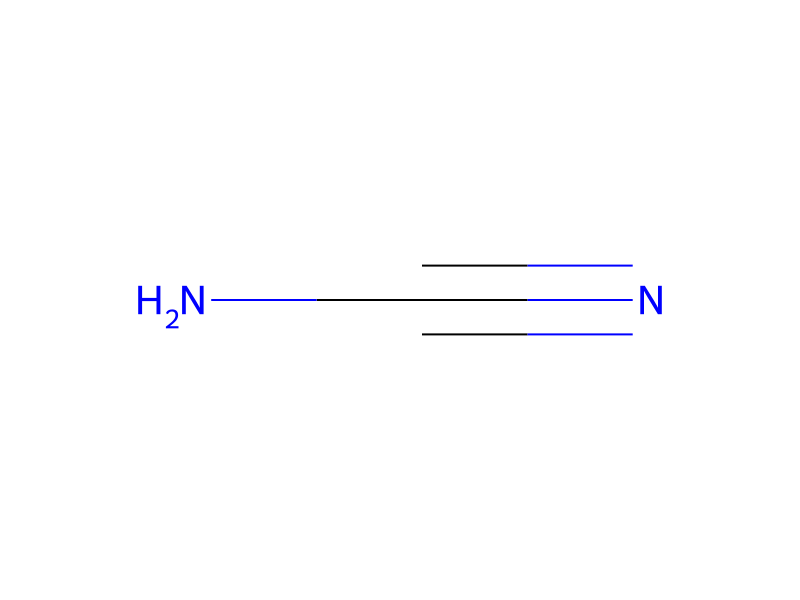
Sodium (370 mg., 15.5 mmoles) was dissolved in 25 ml. of absolute ethanol at room temperature under a nitrogen atmosphere and to this was added 2.7 g. (15 mmoles) of 1-(2-ethylamino-4-pyridyl)-1-ethanone oxime (Example IIB). The reaction mixture was stirred until homogeneous (5 minutes), then 3.0 g. (16 mmoles) of p-toluenesulfonyl chloride was added, and the mixture was stirred at room temperature under nitrogen for one hour. The mixture was subsequently added to a solution of potassium ethoxide (prepared by dissolving 630 mg. of potassium in 25 ml. of absolute ethanol) and the resulting mixture was stirred at room temperature under nitrogen for one hour. The resulting gelatinous suspension was diluted with 200 ml. of diethyl ether and filtered. The ether filtrate was extracted with (4×25 ml.) 2 N hydrochloric acid and the combined acid extracts concentrated to dryness. The residue was dissolved in 20 ml. of water, 1.35 g. (32 mmoles) of cyanamide was added and the mixture brought to pH 4.5 by the dropwise addition of 2 N sodium hydroxide solution. The mixture was heated at steam bath temperature for 1 hour, and was then cooled and made basic with concentrated ammonium hydroxide. The reaction mixture was concentrated to dryness and extracted with i-propanol. Removal of the i-propanol gave an oil which was taken up in 25 ml. of acetonitrile. Addition of diethyl ether to the acetonitrile solution resulted in the formation of a precipitate. Filtration and recrystallization of the solids from i-propanol gave 1.55 g. (52%) of the desired product, m.p. 200°-202° C.