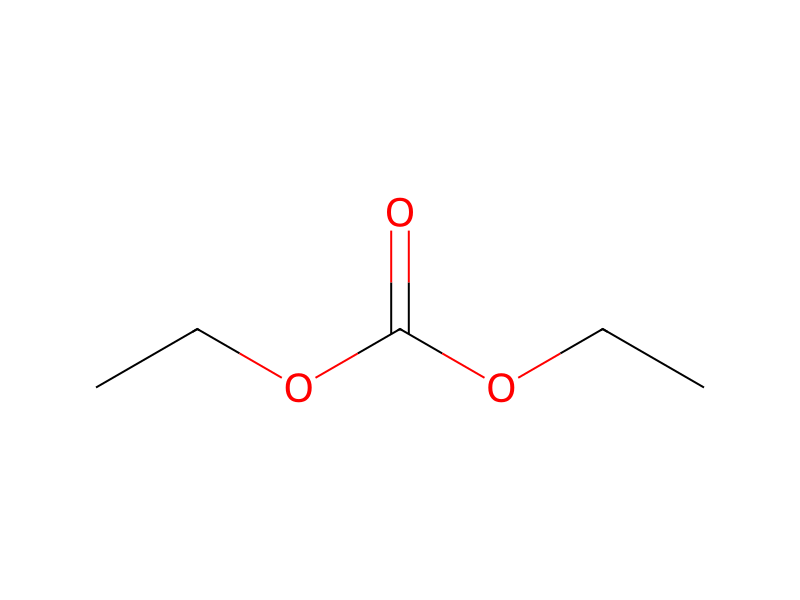
[CH3:1][O:2][C:3]1[CH:11]=[CH:10][CH:9]=[CH:8][C:4]=1[C:5](Cl)=O.C=[CH:13][C:14]1[CH:19]=[CH:18][CH:17]=[CH:16][CH:15]=1.C(N(CCCC)CCCC)CCC>C(=O)(OCC)OCC.C([O-])(=O)C.[Pd+2].C([O-])(=O)C>[CH3:1][O:2][C:3]1[CH:11]=[CH:10][CH:9]=[CH:8][C:4]=1[CH:5]=[CH:13][C:14]1[CH:19]=[CH:18][CH:17]=[CH:16][CH:15]=1The procedure described in Example 1 is followed, except that 17.1 g (0.1 mol) of 2-methoxybenzoyl chloride, 13 g (0.125 mol) of styrene, 23.2 g (0.125 mol) of tri-n-butylamine and 0.225 g (0.001 mol) of palladium acetate are used. After a reaction time of 3 hours at a bath temperature of 140° C., in 100 ml of diethyl carbonate as the solvent, 10.3 g (0.049 mol) of 2-methoxystilbene, corresponding to a yield of 49% of theory, are obtained; melting point 69°-70° C.