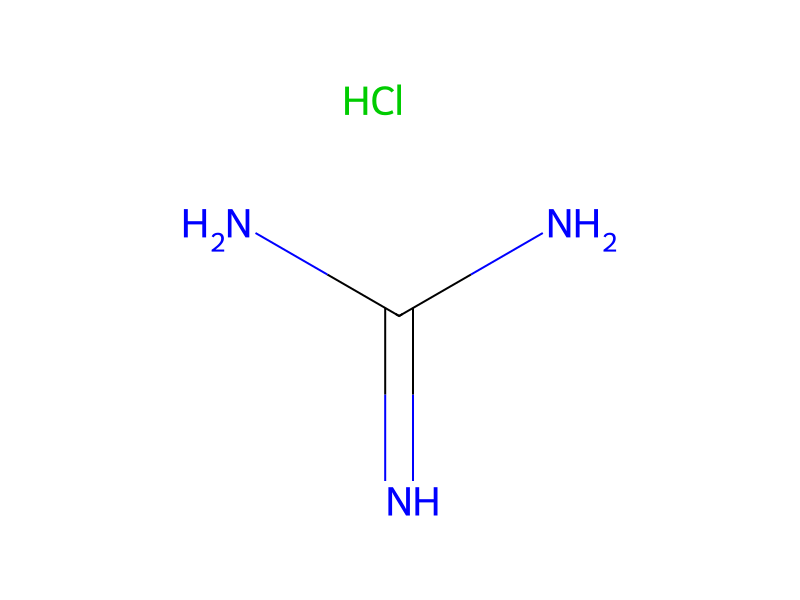
Oxalyl chloride (1.1 mL, 13 mmol) was added to a solution of 5-(1-methyl-1H-pyrazol-4-yl)-2-naphthoic-acid (1.19 g, 4.71 mmol) in anhydrous dichloromethane (200 mL (which was added in portions during the reaction to effect dissolution)) containing dimethylformamide (2 drops) under nitrogen and the mixture was stirred at room temperature for 4.25 hours. The reaction mixture was then heated for 1 hour at 40° C., before being concentrated under reduced pressure. The resulting crude acid chloride was suspended in anhydrous tetrahydrofuran (50 mL) and this mixture was added dropwise to a solution of guanidine hydrochloride (2.09 g, 21.9 mmol) in 2M aqueous sodium hydroxide (15 mL, 30 mmol) and the reaction mixture was then stirred for 30 minutes. The organic phase was separated, and the aqueous phase was extracted with chloroform (3×30 mL) followed by ethyl acetate (3×30 mL). The combined organic extracts were washed sequentially with 1M aqueous sodium hydroxide (60 mL) and water (40 mL), then dried Na2SO4) and concentrated in vacuo to give a glassy solid (1.45 g after dying under high vacuum). This solid was dissolved in dichloromethane which was then allowed to evaporate slowly to give 5-(1-methyl-1H-pyrazol-4-yl)-2-naphthoylguanidine as a yellow solid (1.15 g, 83%).