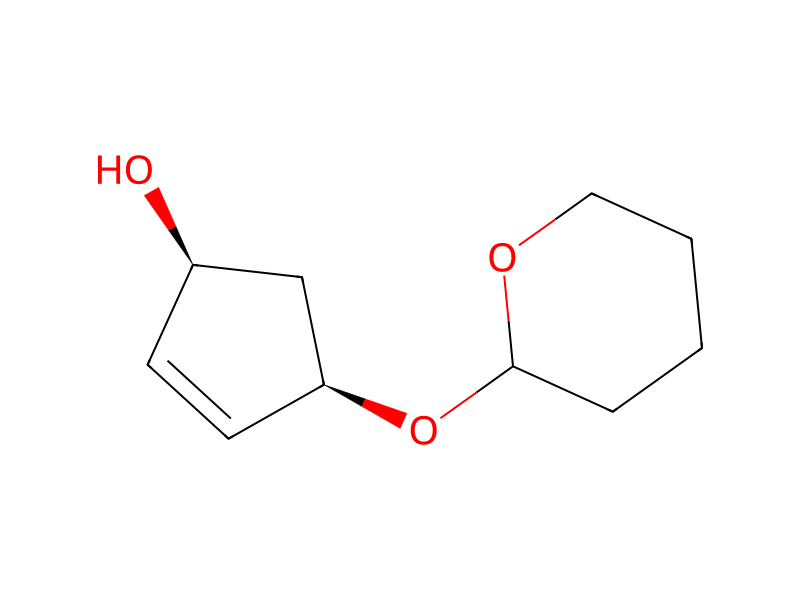
To a solution of 5.0 g of 2-cyclopentene-1,4-diol in 300 ml of methylene chloride was added 5 ml of a solution of p-toluenesulfonic acid in tetrahydrofuran (1 millimole/100 ml). A solution of 4.2 g of 2,3-dihydropyran in 30 ml of methylene chloride was then added dropwise with stirring over a period of 1 hour. After stirring overnight at room temperature, 8 drops of pyridine were added. The methylene chloride was evaporated and the residue was dissolved in diethyl ether, washed with water and dried. The residual obtained by evaporating the solvent was chromatographed on silica gel (200 g) using chloroform as an eluent. First, the diether product flowed out. The subsequent effluent was treated in a customary manner to afford 6.6 g of cis-4-tetrahydropyranyloxy 2-cyclopentenol as colorless oily substance boiling at 84° C. (0.7 mmHg).