5'-Atp → L-Tryptophan
反応式

[CH2:1](OP(O)(O)=O)[C@H:2]1O[C@H:5](OP(OP(O)(O)=O)(O)=O)[C@H:4](O)[C@@H:3]1O.P(OC[C@H]1O[C@@H](N2C3N=CN=C(N)C=3N=C2)[C@H](O)[C@@H]1O)(OP(OP(O)(O)=O)(O)=O)(=O)O.[NH2:54][C@H:55]([C:62]([OH:64])=[O:63])[CH2:56][C:57]1N=[CH:60][NH:59][CH:58]=1>>[NH2:54][C@H:55]([C:62]([OH:64])=[O:63])[CH2:56][C:57]1[C:5]2[C:60](=[CH:1][CH:2]=[CH:3][CH:4]=2)[NH:59][CH:58]=1参加物
4


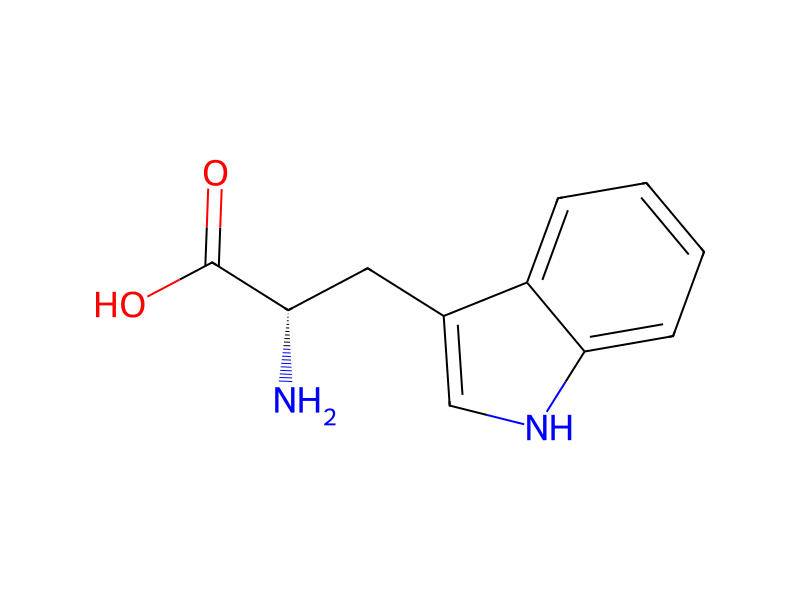
実験手順
5-Phosphoribosyl-α-1-pyrophosphate (hereinafter, “PRPP”) and adenosine-5′-triphosphate (hereinafter, “ATP”) are the initial substrates in histidine biosynthesis. PRPP can sometimes induce the histidine biosynthesis to follow divergent pathways, resulting in the biosynthesis of pyrimidine nucleotides, purine nucleotides, pyridine nucleotides, and tryptophan (Escherichia coli and Salmonella, Second Edition, Editor in Chief: F. C. Neidhardt, ASM Press, Washington D.C., 1996).