
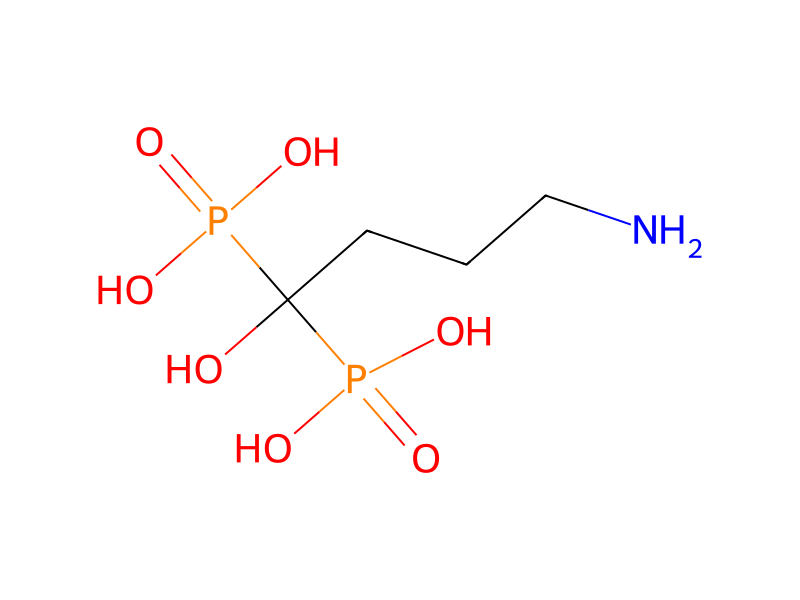
기본 정보
- 표준 SMILES
NCCCC(O)(P(=O)(O)O)P(=O)(O)O- InChIKey
OGSPWJRAVKPPFI-UHFFFAOYSA-N- 분자식
- C4H13NO7P2
- 평균 분자량
- 249.1 g/mol
- 단동위원소 질량
- 249.01672502
개요
Alendronic acid is a 1,1-bis(phosphonic acid) that is methanebis(phosphonic acid) in which the two methylene hydrogens are replaced by hydroxy and 3-aminopropyl groups. It has a role as an EC 2.5.1.1 (dimethylallyltranstransferase) inhibitor and a bone density conservation agent. It is a primary amino compound and a 1,1-bis(phosphonic acid). It is a conjugate acid of an alendronate(1-).
이름 및 식별자
- 우선 이름
- Alendronic Acid
- IUPAC
- (4-amino-1-hydroxy-1-phosphonobutyl)phosphonic acid
- 영어명
- Alendronic acid
- 분자식
- C4H13NO7P2
- 분자량
- 249.1
이름 및 동의어
ALENDRONIC ACIDalendronate66376-36-1Acido alendronicoAcide alendronique(4-amino-1-hydroxy-1-phosphonobutyl)phosphonic acidArendalAcidum alendronicum(4-Amino-1-hydroxybutylidene)bisphosphonic acidABDP(4-amino-1-hydroxybutane-1,1-diyl)bis(phosphonic acid)4-Amino-1-hydroxybutane-1,1-diphosphonic Acid
이름 더 보기
Alendronate Sodium HydrateBisphosphonateR3-RM2OnclastAledronatealendronicaciAlendronic Acid >
Phosphonic acid, (4-amino-1-hydroxybutylidene)bis-MK 217X1J18R4W8P4-Amino-1-hydroxybutylidene-1,1-bis(phosphonic acid)CHEBI:2567DTXSID5022568alpha-hydroxy-delta-aminobutylidenediphosphonic acidPhosphonic acid, P,P'-(4-amino-1-hydroxybutylidene)bis-
데이터베이스 식별자
- CAS
66376-36-1- PubChem CID
- 2088
- DTXSID
DTXSID5022568- ChEMBL
CHEMBL870- ChEBI
CHEBI:2567- UNII
- X1J18R4W8P
- EC Number
- 613-929-7、689-696-0
- Nikkaji
- J363.022F
물성
구조 계산 물성
- XLogP
- -6.5
- 극성 표면적
- 161 Ų
- 수소 결합 공여자 수
- 6
- 수소 결합 수용자 수
- 8
- 회전 가능 결합 수
- 5
- 무거운 원자 수
- 14
- 형식 전하
- 0
- 복잡도
- 257
실험 및 물리화학적 성질
Drugs
Pharmaceuticals -> Listed in ZINC15
Pharmaceuticals
Color/FormFine white powder
Human DrugsBreast Feeding; Lactation; Bisphosphonates; Bone Density Conservation Agents; Diphosphonates
Melting Point
233-235 °C (decomposes)
MP: 257-262.5 °C. Soluble in water; very slightly soluble in alcohol. Practically insoluble in chloroform. /Alendronic acid, monosodium salt trihydrate/
Physical DescriptionSolid
Dissociation Constants
2.72 (at 25 °C)
pKa1 = 2.72; pKa2 = 8.73; pKa3 = 10.5; pKa4 = 11.6 (all at 25 °C)
물리화학적 성질
- 녹는점
- 230 · 230-235°C
- 끓는 점
- 616.7 · 616.7±65.0 °C(Predicted)
- 밀도
- 1.857 · 1.857±0.06 g/cm3(Predicted)
- 저장 조건
- -20 °C · Store at -20°C
- 수용성
- 물에 불용성
- 용해도
- Aqueous Base (Sparingly), Methanol (Slightly), Water (Very Slightly)
- 산도 계수 (pKa)
- 1 · pK1 2.72 ±0.05; pK2 8.73 ±0.05; pK3 10.5 ±0.1; pK4 11.6 ±0.1 at 25°, (0.1M KCl)
- 물리적 상태
- powder to crystal
- 색상
- 흰색에서 밝은 노란색
- Merck
- 14 · 14,229
- 안정성
- 흡습성
- EPA
- Phosphonic acid, P,P'-(4-amino-1-hydroxybutylidene)bis- (66376-36-1)
안전 및 규제
GHS 분류
GHS Classification
This chemical does not meet GHS hazard criteria for 16.7% (1 of 6) of reports.
Danger
H290 (16.7%): May be corrosive to metals [Warning Corrosive to Metals]
P203, P234, P260, P264, P264+P265, P270, P280, P301+P317, P301+P330+P331, P302+P352, P302+P361+P354, P304+P340, P305+P351+P338, P305+P354+P338, P308+P316, P316, P317, P318, P321, P330, P332+P317, P337+P317, P362+P364, P363, P390, P405, P406, and P501 (click each P-code to see the statement)
Aggregated GHS information provided per 6 reports by companies from 5 notifications to the ECHA C&L Inventory. Each notification may be associated with multiple companies.
Warning
유해성 정보
Hazard Classes and Categories
Met. Corr. 1 (16.7%)
Skin Irrit. 2 (100%)
안전 및 보호
Storage ConditionsStore at 20 to 25 °C (68 to 77 °F); excursions permitted to 15 to 30 °C (59 to 86 °F).
Disposal Methods
SRP: At the time of review, regulatory criteria for small quantity disposal are subject to significant revision, however, household quantities of waste pharmaceuticals may be managed as follows: Mix with wet cat litter or coffee grounds, double bag in plastic, discard in trash.
SRP: Expired or waste pharmaceuticals shall carefully take into consideration applicable DEA, EPA, and FDA regulations. It is not appropriate to dispose by flushing the pharmaceutical down the toilet or discarding to trash. If possible return the pharmaceutical to the manufacturer for proper disposal being careful to properly label and securely package the material. Alternatively, the waste pharmaceutical shall be labeled, securely packaged and transported by a state licensed medical waste contractor to dispose by burial in a licensed hazardous or toxic waste landfill or incinerator.
독성 정보
Interactions
Intravenous ranitidine was shown to double the bioavailability of oral alendronate. The clinical significance of this increased bioavailability and whether similar increases will occur in patients given oral H2-antagonists is unknown.
In healthy subjects, oral prednisone (20 mg three times daily for five days) did not produce a clinically meaningful change in the oral bioavailability of alendronate (a mean increase ranging from 20 to 44%).
It is likely that calcium supplements, antacids, and some oral medications will interfere with absorption of alendronate sodium. Therefore, patients must wait at least one-half hour after taking alendronate sodium before taking any other oral medications.
Concomitant administration of alendronate with coffee or orange juice reduced bioavailability by approximately 60%.
For more Interactions (Complete) data for Alendronic acid (8 total), please visit the HSDB record page.
Environmental Fate
TERRESTRIAL FATE: Based on a classification scheme(1), an estimated Koc value of 10(SRC), determined from a structure estimation method(2), indicates that alendronic acid is expected to have very high mobility in soil(SRC). The pKa values of alendronic acid are pKa1 2.72, pKa2 8.73, pKa3 10.5 and pKa4 11.6(3), indicating that this compound will almost entirely exist in the anion form in the environment and anions generally do not adsorb more strongly to soils containing organic carbon and clay than their neutral counterparts(4). Volatilization from moist soil is not expected because the compound exists as an anion and anions do not volatilize. Alendronic acid is not expected to volatilize from dry soil surfaces(SRC) based upon an estimated vapor pressure of 4.9X10⁻¹³ mm Hg at 25 °C(SRC), determined from a fragment constant method(5). Biodegradation data in soil were not available(SRC, 2011).
AQUATIC FATE: Based on a classification scheme(1), an estimated Koc value of 10(SRC), determined from a structure estimation method(2), indicates that alendronic acid is not expected to adsorb to suspended solids and sediment(SRC). The pKa values of alendronic acid are pKa1 2.72, pKa2 8.73, pKa3 10.5 and pKa4 11.6(3) indicate alendronic acid will exist almost entirely in the anion form at pH values of 5 to 9 and therefore volatilization from water surfaces is not expected to be an important fate process. According to a classification scheme(4), an estimated BCF of 5(SRC), from an estiamted log Kow of -0.50(5) and a regression-derived equation(6), suggests the potential for bioconcentration in aquatic organisms is low(SRC). Biodegradation data in water were not available(SRC, 2011).
ATMOSPHERIC FATE: According to a model of gas/particle partitioning of semivolatile organic compounds in the atmosphere(1), alendronic acid, which has an estimated vapor pressure of 4.9X10⁻¹³ mm Hg at 25 °C(SRC), determined from a fragment constant method(2), is expected to exist solely in the particulate phase in the ambient atmosphere. Particulate-phase alendronic acid may be removed from the air by wet or dry deposition(SRC). Alendronic acid does not contain chromophores that absorb at wavelengths >290 nm(3), and therefore is not expected to be susceptible to direct photolysis by sunlight(SRC).
Adverse Effects
The most common adverse effects of alendronate include transient hypocalcemia, transient hypophosphatemia, and GI symptoms, such as abdominal pain, heartburn, nausea, constipation, diarrhea, flatulence, and esophagitis. Other reported adverse events include myalgia, joint pain, headache, dizziness, peripheral edema, back pain, and weakness. Although infrequent, additionally reported adverse effects of alendronate encompass toxic epidermal necrolysis and oropharyngeal ulceration.
Bisphosphonates are generally well tolerated, with most adverse effects being non-severe. Reports exist of some serious adverse effects with bisphosphonate use, but these are extremely rare.
Exposure Routes
Relative to an intravenous (IV) reference dose, the mean oral bioavailability of alendronate in women was 0.7% for doses ranging from 5 to 40 mg when administered after an overnight fast and two hours before a standardized breakfast. Oral bioavailability of the 10 mg tablet in men (0.59%) was similar to that in women (0.78%) when administered after an overnight fast and 2 hours before breakfast.
Toxicity Summary
To date, there have been no reported toxicities associated with the use of alendronate. Although certain post-marketing reports indicated an association with significant esophageal and gastric mucosal toxicity, subsequent studies have established that alendronate does not cause predictable mucosal damage when used as directed.
The action of Alendronate on bone tissue is based partly on its affinity for hydroxyapatite, which is part of the mineral matrix of bone. Alendronate also targets farnesyl pyrophosphate (FPP) synthase. Nitrogen-containing bisphosphonates (such as pamidronate, alendronate, risedronate, ibandronate and zoledronate) appear to act as analogues of isoprenoid diphosphate lipids, thereby inhibiting FPP synthase, an enzyme in the mevalonate pathway. Inhibition of this enzyme in osteoclasts prevents the biosynthesis of isoprenoid lipids (FPP and GGPP) that are essential for the post-translational farnesylation and geranylgeranylation of small GTPase signalling proteins. This activity inhibits osteoclast activity and reduces bone resorption and turnover. In postmenopausal women, it reduces the elevated rate of bone turnover, leading to, on average, a net gain in bone mass.
Signs and SymptomsAlendronate can damage the esophagus both by toxicity from the medication itself and by nonspecific irritation secondary to contact between the pill and the esophageal mucosa, similar to other cases of "pill esophagitis."
Soil Adsorption/Mobility
Using a structure estimation method based on molecular connectivity indices(1), the Koc of alendronic acid can be estimated to be 10(SRC). According to a classification scheme(2), this estimated Koc value suggests that alendronic acid is expected to have very high mobility in soil. The pKa values of alendronic acid are pKa1 2.72, pKa2 8.73, pKa3 10.5 and pKa4 11.6(3), indicating that this compound will almost entirely exist in the anion form in the environment and anions generally do not adsorb more strongly to soils containing organic carbon and clay than their neutral counterparts(4).
Human Toxicity Excerpts
/HUMAN EXPOSURE STUDIES/ ... The aim of this study was to investigate whether alendronate and naproxen are synergistic as causes of gastric ulcers. /Investigaors/ performed an endoscopist-blind, randomized, crossover, single-center comparison of 10 mg/d of alendronate sodium, 500 mg of naproxen sodium twice daily, or the combination taken orally for 10 days in volunteers aged 30 years or older. Videoendoscopy was used to evaluate the presence and degree of mucosal damage to the esophagus, stomach, or duodenal bulb before and after each treatment. There was a 1- to 4-week washout between evaluations. Twenty-six healthy volunteers participated (18 women and 8 men), aged 30 to 50 years. Gastric ulcers were present in 2 subjects receiving alendronate (8%), in 3 receiving naproxen (12%), and in 10 receiving both (38%) (P<0.05 for the combination vs either drug alone). Both alendronate and naproxen can cause gastric ulcers. The combination appears synergistic. Alendronate should be used with caution in those who simultaneously require nonsteroidal anti-inflammatory drugs.
/CASE REPORTS/ Alendronate sodium, an aminobiphosphonate used primarily to treat osteoporosis in postmenopausal women, is known to cause esophagitis. A 71-year-old woman experienced severe, acute esophagitis and severe stricture of the esophagus due to oral alendronate therapy. Unlike in previous cases, she had taken alendronate for 10 months before the onset of complications and the stricture proved resistant to dilation.
/CASE REPORTS/ ... A 63-year-old woman started medical therapy with alendronate in a dose of 10 mg daily. After a period of one month of medical treatment with this drug she began to complain of dysphagic symptoms and abdominal pain. She was submitted to endoscopic examination that showed an esophageal ulceration, an enteric ulceration of the anastomosis and an esophageal stenosis. Medical treatment with alendronate was discontinued and the symptom of abdominal pain disappeared. The intensity of dysphagia has decreased. The ulcerated lesion remitted although esophageal stenosis did not. The patient was subsequently treated with esophagus-enteric anastomosis dilation. She improved in her general state and nowadays she is free of symptoms. Alendronate sodium could cause lesions of the inferior esophageal portion or in distal segments of the gastrointestinal tube, in patients with a fast gastrointestinal transit. Special attention must be given to gastrectomized patients that use this drug because of the possibility to develop mucosal lesions in the enteric anastomosed part and its fearful complications as stenosis.
/CASE REPORTS/ ... /Investigators/ present a 74-year-old woman with a stage 0 chronic lymphocytic leukemia who developed acute renal failure following the initiation of alendronate. The renal biopsy revealed an acute granulomatous interstitial nephritis. Infectious and inflammatory etiologies were ruled out. Hemodialysis was required despite discontinuation of all medications. Partial recovery of renal function occurred after 6 weeks of prednisone therapy and cyclophosphamide. This report describes a unique case of acute granulomatous interstitial nephritis and leukemic cell kidney infiltration by CLL.
For more Human Toxicity Excerpts (Complete) data for Alendronic acid (15 total), please visit the HSDB record page.
Artificial Pollution SourcesAlendronic acid's production and use as a bone resorption inhibitor(1) may result in its release to the environment through various waste streams(SRC).
Carcinogen ClassificationNo indication of carcinogenicity to humans (not listed by IARC).
Drug Induced Liver Injury
Benchmark Dataset for the Liver Toxicity Knowledge Base (LTKB)
alendronate
Fosamax®
Bisphosphonates
Not Applicable
no-DILI-concern
Environmental Bioconcentration
An estimated BCF of 3 was calculated in fish for alendronic acidl(SRC), using an estimated log Kow of -0.50(1) and a regression-derived equation(2). According to a classification scheme(3), this BCF suggests the potential for bioconcentration in aquatic organisms is low(SRC).
안전 데이터
- rtecs
- SZ6521833
- ridadr
- 1759
- HS 번호
- 2931.90.9051
- 포장분류
- III
- 위험 등급
- 8
- 유해 물질 데이터
- 66376-36-1(Hazardous Substances Data)
화학 및 산업
약리 정보
ATC Code
M05BA04
M - Musculo-skeletal system
QM - Musculo-skeletal system
Protein Binding78%. Studies in rats show that plasma protein binding increases with decreasing alendronic acid plasma concentration and increasing pH.
PharmacodynamicsAlendronic acid tablets have a very low oral bioavialability. After administration it distributes into soft tissue and bone or is excreted in the urine. Alendronic acid does not undergo metabolism.
Mechanism of Action
Alendronic acid binds to bone hydroxyapatite. Bone resorption causes local acidification, releasing alendronic acid which is that taken into osteoclasts by fluid-phase endocytosis. Endocytic vesicles are acidified, releasing alendronic acid to the cytosol of osteoclasts where they induce apoptosis. Inhibition of osteoclasts results in decreased bone resorption which is shown through decreased urinary calcium, deoxypyridinoline and cross-linked N-telopeptidases of type I collagen.
Animal studies have indicated the following mode of action. At the cellular level, alendronate shows preferential localization to sites of bone resorption, specifically under osteoclasts. The osteoclasts adhere normally to the bone surface but lack the ruffled border that is indicative of active resorption. Alendronate does not interfere with osteoclast recruitment or attachment, but it does inhibit osteoclast activity. Studies in mice on the localization of radioactive (3)H-alendronate in bone showed about 10-fold higher uptake on osteoclast surfaces than on osteoblast surfaces. Bones examined 6 and 49 days after (3)H-alendronate administration in rats and mice, respectively, showed that normal bone was formed on top of the alendronate, which was incorporated inside the matrix. While incorporated in bone matrix, alendronate is not pharmacologically active. Thus, alendronate must be continuously administered to suppress osteoclasts on newly formed resorption surfaces. Histomorphometry in baboons and rats showed that alendronate treatment reduces bone turnover (i.e., the number of sites at which bone is remodeled). In addition, bone formation exceeds bone resorption at these remodeling sites, leading to progressive gains in bone mass.
Alendronate (alendronate sodium hydrate) is a nitrogen-containing bisphosphonate, which combines with the bone surface and reduces osteoclast-mediated bone resorption. It is a third-generation bisphosphonate compound, specifically distributed on the surface of bone resorption and taken into osteoclasts. Under the closed circumstances which is formed with osteoclast and the bone surface, alendronate becomes detached from the bone surface and taken into osteoclast since acid released from osteoclast leads to pH decrease (acidified). The uptaken alendronate blocks the pathway of mevalonic acid synthesis, which is cholesteric synthesis, inhibits the prenylation of GTP binding protein, and decreases the osteoclast's function by influencing the cytoskeleton. This restraint of alendronate in bone resorption against osteoclasts is reversible, showing no cytotoxicity at more than hundredfold concentration level at which action occurs. ...
The differences that exist among individual BPs in terms of mineral binding and biochemical actions may explain differences in their clinical behavior and effectiveness. The classical pharmacological effects of bisphosphonates (BPs) appear to be the result of two key properties: their affinity for bone mineral and their inhibitory effects on osteoclasts. There is new information about both properties. Mineral binding affinities differ among the clinically used BPs and may influence their differential distribution within bone, their biological potency, and their duration of action. The antiresorptive effects of the nitrogen-containing BPs (including alendronate, risedronate, ibandronate, and zoledronate) appear to result from their inhibition of the enzyme farnesyl pyrophosphate synthase (FPPS) in osteoclasts. FPPS is a key enzyme in the mevalonate pathway, which generates isoprenoid lipids utilized for the post-translational modification of small GTP-binding proteins that are essential for osteoclast function. Effects on other cellular targets, such as osteocytes, may also be important. BPs share several common properties as a drug class. However, as with other families of drugs, there are obvious chemical, biochemical, and pharmacological differences among the individual BPs. Each BP has a unique profile that may help to explain potential clinical differences among them, in terms of their speed and duration of action, and effects on fracture reduction.
Biological Half-Life
Due to alendronic acid being incorporated into the skeleton, the terminal half life is estimated to be over 10 years.
The terminal half-life in humans is estimated to exceed 10 years, probably reflecting release of alendronate from the skeleton. Based on the above, it is estimated that after 10 years of oral treatment with alendronate sodium (10 mg daily) the amount of alendronate released daily from the skeleton is approximately 25% of that absorbed from the gastrointestinal tract.
Metabolism/Metabolites
Urinary excretion is the sole method of elimination of alendronic acid and no metabolites are detected upon urine collection.
There is no evidence that alendronate is metabolized in animals or humans.
There is no evidence that alendronate is metabolized in humans or animals. Route of Elimination: Following a single IV dose of [14C]alendronate, approximately 50% of the radioactivity was excreted in the urine within 72 hours and little or no radioactivity was recovered in the feces. Half Life: >10 years
FDA Pharmacological Classification
X1J18R4W8P
ALENDRONIC ACID
Established Pharmacologic Class [EPC] - Bisphosphonate
Chemical Structure [CS] - Diphosphonates
Alendronic acid is a Bisphosphonate.
MeSH Pharmacological ClassificationAgents that inhibit BONE RESORPTION and/or favor BONE MINERALIZATION and BONE REGENERATION. They are used to heal BONE FRACTURES and to treat METABOLIC BONE DISEASES such as OSTEOPOROSIS.
Absorption, Distribution and Excretion
Mean oral bioavailability of alendronic acid in women is 0.64% and in men is 0.59%. Bioavailability of alendronic acid decreases by up to 40% if it is taken within an hour of a meal.
Administration of radiolabeled alendronic acid results in 50% recovery in urine within 72 hours. No alendronic acid is recovered in the feces. Men excrete less alendronic acid than women, though race and advanced age do not affect elimination.
28L.
71mL/min.
Relative to an intravenous iv reference dose, the mean oral bioavailability of alendronate in women was 0.64% for doses ranging from 5 to 70 mg when administered after an overnight fast and two hours before a standardized breakfast. Oral bioavailability of the 10 mg tablet in men (0.59%) was similar to that in women when administered after an overnight fast and 2 hours before breakfast.
Alendronate sodium 70 mg oral solution and alendronate sodium 70 mg tablet are equally bioavailable.
Tissue LocationsIntestine
Cellular LocationsCytoplasm
Metabolite PathwaysAlendronate Action Pathway
용도 및 제조
Uses
MEDICATION
Use (kg; approx.) in Germany (2009): >1000
For the treatment and prevention of osteoporosis in women and Paget's disease of bone in both men and women.
Methods of Manufacturing
Orthophosphorous acid is heated with 4-aminobutyric acid in an atmosphere of nitrogen and phosphorous trichloride is added to the melt. Finally, water is added, the solution is decolorized with charcoal, and diluted with methanol to precipitate the free acid which is treated with one equivalent of sodium hydroxide. /Alendronate sodium/
Formulations/PreparationsAlendronate Sodium preparations: (AHFS, 2011)
제조 방법
Synthesis of Alendronic Acid: 1 mol of 4-aminobutyric acid was added to 1.5 mol of molten phosphoric acid at 95°C, followed by dropwise addition of 2 mol of phosphorus trihalide over 60 minutes. After the reaction mixture hardened, heating was continued for an additional 3 hours. The mixture was then hydrolyzed by adding 300 mL of water. Following cooling, the solution was poured into 1500 mL of methanol, and the resulting precipitate was collected to yield alendronic acid in 64.6% yield.
상·하류 제품 정보
상류 원료
공급사50 곳
河北凡博医药科技有限公司15588346797
北京华美互利生物化工010-56205725 · [email protected]
梯希爱(上海)化成工业发展有限公司021-67121386 · [email protected]
上海阿拉丁生化科技股份有限公司400-6206333 13167063860 · [email protected]
盐城通铭生物科技有限公司15195160625 · [email protected]
广州佳途科技股份有限公司81960175 18933936954 · [email protected]
上海毕得医药科技股份有限公司400-1647117 13681763483 · [email protected]
湖北海克斯生化有限公司17362916295; 17362916295 · [email protected]
普善实业(陕西)有限公司029-81310890 18165209495 · [email protected]
湖北云镁科技有限公司027-59206672 18995657604 · [email protected]
爱斯特(成都)生物制药股份有限公司+86-28-85122536 85324413 · [email protected]
上海仲因实业有限公司2537653158 16621191650 · [email protected]
Dayang Chem (Hangzhou) Co.,Ltd.+86-0571-88938639 17705817739 · [email protected]
南京世洲生物科技有限公司025-025-85560043 17301488900 · [email protected]
陕西德莱维特生物科技有限公司15780788769 18292741956 · [email protected]
LGM Pharma1-(800)-881-8210 · [email protected]
湖北辰心化工有限公司18696113233 · [email protected]
Syntechem Co.,Ltd[email protected]
上海迈瑞尔生化科技有限公司4006356688 18621169109 · [email protected]
Hangzhou Sage Chemical Co., Ltd.+86057186818502 13588463833 · [email protected]
上海德默医药科技有限公司400-021-7337 2355568890 · [email protected]
安耐吉化学&3A(安徽泽升科技股份有限公司)400-0056266 · [email protected]
武汉嘉凯隆科技发展有限公司027-88422011
梯希爱(上海)化工贸易有限公司021-61109150 · [email protected]
上海瀚鸿科技股份有限公司021-54306202 13764082696 · [email protected]
北京博奥森生物技术有限公司400-901-9800 18611424007 · [email protected]
Pure Chemistry Scientific Inc.001-857-928-2050 or 1-888-588-9418 · [email protected]
上海泰坦科技股份有限公司400-6009262 15618770481 · [email protected]
上海梅凯科技有限公司021-68689288 15300790979 · [email protected]
武汉丰泰威远科技有限公司+86-27-8746-5837 +86-18627785180 · [email protected]
武汉丰泰威远科技有限公司027-87465837 19945049750 · [email protected]
山东西亚化学有限公司13355009207 13355009207 · [email protected]
天津希恩思生化科技有限公司400 638 7771 · [email protected]
TargetMol 中国(陶术生物)400-821-0310 15002144251 · [email protected]
TCI AMERICA800-4238616 · [email protected]
TOKYO CHEMICAL INDUSTRY CO., LTD.03-36680489 · [email protected]
TCI Europe320-37350700 · [email protected]
天津普西唐生物医药科技有限公司010-60605840 · [email protected]
上海鑫圭生物科技有限公司15121041756 · [email protected]
上海麦克林生化科技股份有限公司15221275939 15221275939 · [email protected]
常州翔龙医药科技有限公司18915873328 18915873328 · [email protected]
上海孚一生物科技有限公司+86 (21) 61124340
池州凯隆进出口贸易有限公司[email protected]
长沙晶康新材料科技有限公司0733-0731-85118349 18229890050 · [email protected]
TargetMol中国(陶术生物)021-021-33632979 15002134094 · [email protected]
上海陶术生物科技股份有限公司+1-781-999-5354; +1-00000000000 · [email protected]
上海波以尔化工有限公司021-50182298 021-50180596 · [email protected]
九鼎化学(上海)科技有限公司4009209199 · [email protected]
韶远科技(上海)有限公司021-50795510 4000665055 · [email protected]
厦门志信化学有限公司+86-5922680277 +86-13806087780 · [email protected]
추가 설명
정의ChEBI: Alendronic acid is a 1,1-bis(phosphonic acid) that is methanebis(phosphonic acid) in which the two methylene hydrogens are replaced by hydroxy and 3-aminopropyl groups. It has a role as an EC 2.5.1.1 (dimethylallyltranstransferase) inhibitor and a bone density conservation agent. It is a 1,1-bis(phosphonic acid) and a primary amino compound. It is a conjugate acid of an alendronate(1-).
관련 반응
26건


연결된 노트
불러오는 중…