
HRID 177287반응물로
1,4-Bis(3-aminopropyl)piperazine
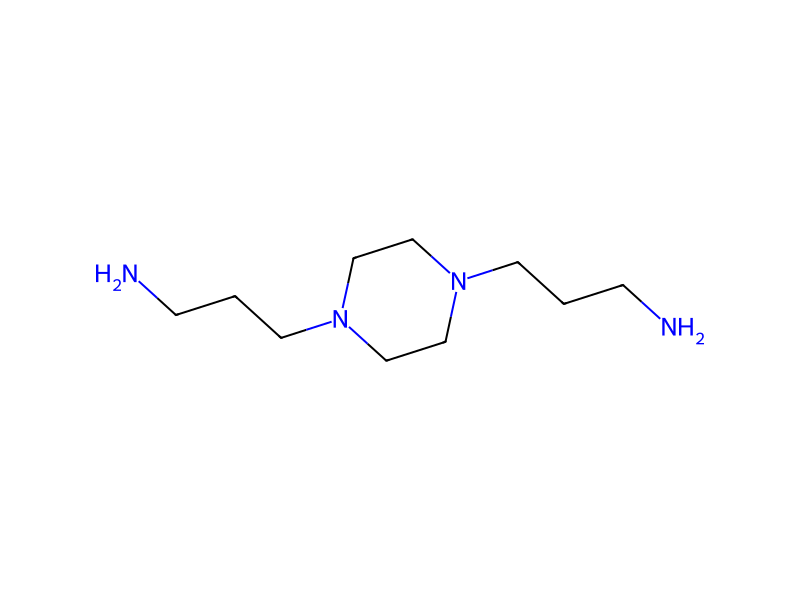
7209-38-3NCCCN1CCN(CCCN)CC1XUSNPFGLKGCWGN-UHFFFAOYSA-Nstructure in first source
7209-38-3DTXSID8022246CHEMBL41307안전 정보는 참고용이며, 공급업체의 물질안전보건자료(SDS), 관련 법규 및 전문가 평가를 대체하지 않습니다.
Danger
H302 (58.3%): Harmful if swallowed [Warning Acute toxicity, oral]
P260, P264, P264+P265, P270, P273, P280, P301+P317, P301+P330+P331, P302+P361+P354, P304+P340, P305+P354+P338, P316, P317, P321, P330, P363, P405, and P501 (click each P-code to see the statement)
Aggregated GHS information provided per 206 reports by companies from 10 notifications to the ECHA C&L Inventory. Each notification may be associated with multiple companies.
Chemical: 1,4-Piperazinedipropanamine
1,4-Piperazinedipropanamine is listed on the EPA's Chemical Data Reporting (CDR) system. Manufacturers and importers of 1,4-Piperazinedipropanamine are required to report information about their production and use of this chemical to the EPA under the Toxic Substances Control Act (TSCA). (40 eCFR Part 711)
REACH registered substance: N,N'-bis(3-aminopropyl)piperazine (EC: 230-589-1)
1,4-Bis(3-aminopropyl)piperazine: Does not have an individual approval but may be used as a component in a product covered by a group standard. It is not approved for use as a chemical in its own right.
The New Jersey Worker and Community Right to Know Act requires public and private employers to provide information about hazardous substances at their workplaces. (N.J.S.A. 34:5A-1 et. seq.)
Acute Tox. 4 (58.3%)
Corrosives
Adhesive Manufacturing
1,4-Piperazinedipropanamine: ACTIVE
용도1,4-Bis(3-aminopropyl)piperazine was used to functionalize natural montmorillonite (M) and synthetic kanemite (K)1.
일반 설명The thermodynamic parameters for protonation of 1,4-bis(3-aminopropyl)-piperazine (BAPP) were studied in aqueous solution using a potentiometric technique.


colorless to yellow liquid