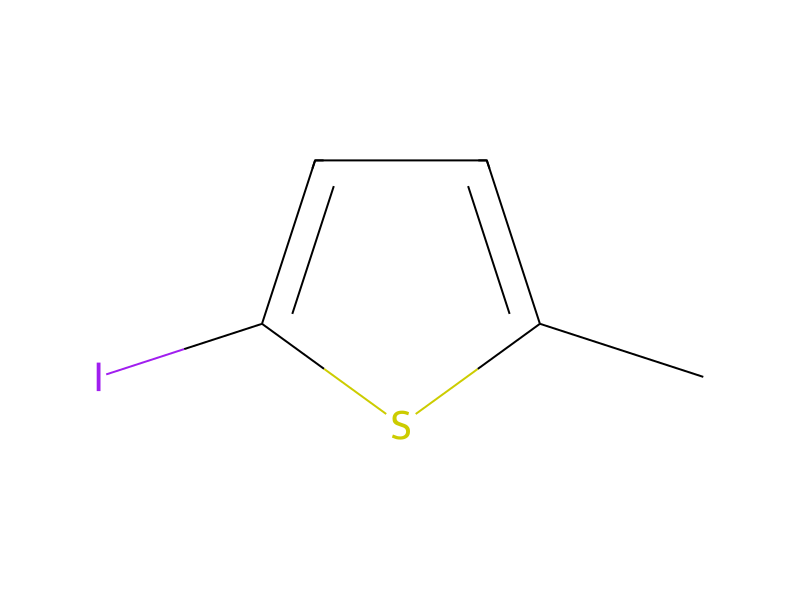
I[C:2]1[S:3][C:4]([CH3:7])=[CH:5][CH:6]=1.C1(P(C2C=CC=CC=2)C2C=CC=CC=2)C=CC=CC=1.[CH2:27]([OH:30])[C:28]#[CH:29].C(N(C(C)C)CC)(C)C>[Cu]I.C1C=CC(/C=C/C(/C=C/C2C=CC=CC=2)=O)=CC=1.C1C=CC(/C=C/C(/C=C/C2C=CC=CC=2)=O)=CC=1.C1C=CC(/C=C/C(/C=C/C2C=CC=CC=2)=O)=CC=1.C(Cl)(Cl)Cl.[Pd].[Pd].O.O1CCCC1>[CH3:7][C:4]1[S:3][C:2]([C:29]#[C:28][CH2:27][OH:30])=[CH:6][CH:5]=1A mixture of 2-iodo-5-methylthiophene (5.00 g), copper(I) iodide (82 mg), triphenylphosphine (286 mg), tris(dibenzylideneacetone)dipalladium(0) chloroform adduct (445 mg), propargyl alcohol (1.91 ml), diisopropylethylamine (15.1 ml) and tetrahydrofuran (30 ml) was stirred at room temperature for 20 hr. The reaction mixture was added to water, and the mixture was extracted with ethyl acetate, washed with saturated brine, and dried over anhydrous magnesium sulfate. The solvent was evaporated under reduced pressure. The residue was purified by silica gel column chromatography (hexane:ethyl acetate=3:1-2:1) to give the object product (1.48 g) as a brown oil.