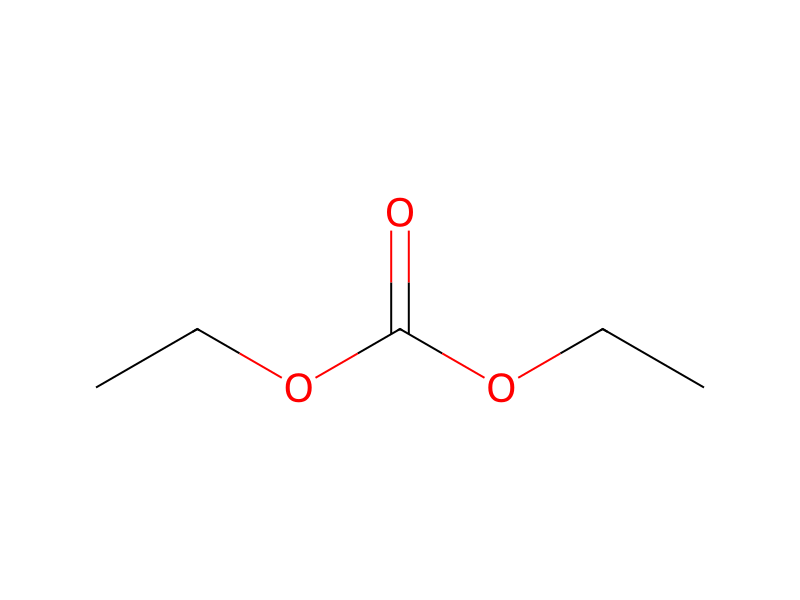
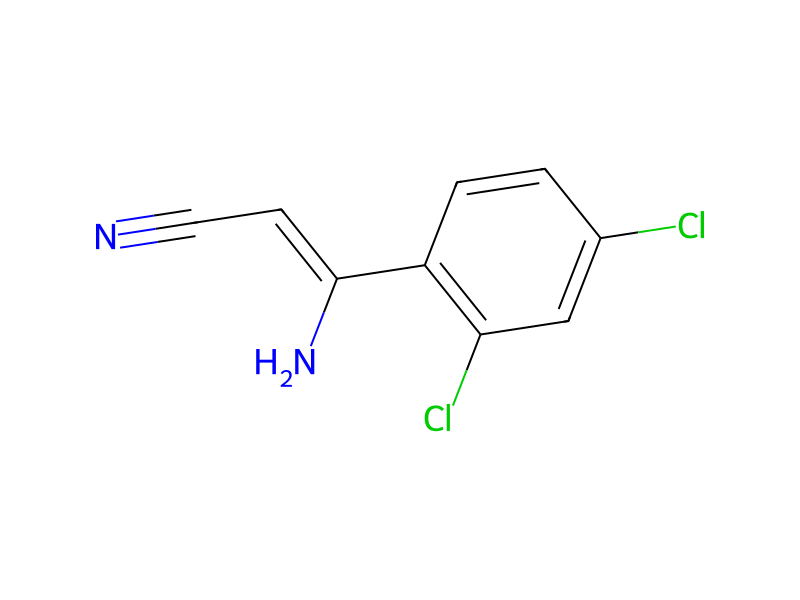
[Na].[NH2:2][C:3]([C:7]1[CH:12]=[CH:11][C:10]([Cl:13])=[CH:9][C:8]=1[Cl:14])=[CH:4][C:5]#[N:6].[C:15](=O)([O:19]CC)[O:16][CH2:17][CH3:18].Cl>C(O)C.O.C(OCC)(=O)C>[C:5]([CH:4]=[C:3]([NH:2][C:15](=[O:19])[O:16][CH2:17][CH3:18])[C:7]1[CH:12]=[CH:11][C:10]([Cl:13])=[CH:9][C:8]=1[Cl:14])#[N:6]4.85 g (211 mmol) of sodium are dissolved in ethanol (260 ml), 30.0 g (141 mmol) of 3-amino-3-(2,4-dichlorophenyl)acrylonitrile and 36.59 g (310 mmol) of diethyl carbonate are added, and the reaction solution is stirred under reflux for 4 h. Ethyl acetate and water are added to the reaction mixture, and the pH is adjusted to pH=5 with concentrated hydrochloric acid. The organic phase is separated off, dried over magnesium sulphate and concentrated in a rotary evaporator. The residue is chromatographed on silica gel (mobile phase cyclohexane/ethyl acetate 7:1 to 1:1); the product has Rf=0.5 in cyclohexane/ethyl acetate 1:1. 17.1 g (43% of theory) of the product are obtained.