홈MCP워크벤치Skills
홈워크벤치알림마이페이지
llms.txt · MCP 가이드개인정보처리방침 · 이용약관 · 지원v1.8.3
  1. 홈
  2. /반응

Hydrochloric Acid → 2-Phenylpyrimidine-5-carbaldehyde

HRID 2274478
인쇄

반응식

HRID 2274478 반응식
C1(P(C2C=CC=CC=2)C2C=CC=CC=2)C=CC=CC=1.Br[C:21]1[CH:22]=[N:23][C:24]([C:27]2[CH:32]=[CH:31][CH:30]=[CH:29][CH:28]=2)=[N:25][CH:26]=1.C([Sn](CCCC)(CCCC)[C:38]([O:40]CC)=C)CCC.Cl.C(=O)(O)[O-].[Na+]>O1CCOCC1.C([O-])(=O)C.[Pd+2].C([O-])(=O)C>[C:27]1([C:24]2[N:23]=[CH:22][C:21]([CH:38]=[O:40])=[CH:26][N:25]=2)[CH:32]=[CH:31][CH:30]=[CH:29][CH:28]=1
참가 물질반응 조건실험 절차후처리출처 및 근거반응 노트

참가 물질

8

반응물 5

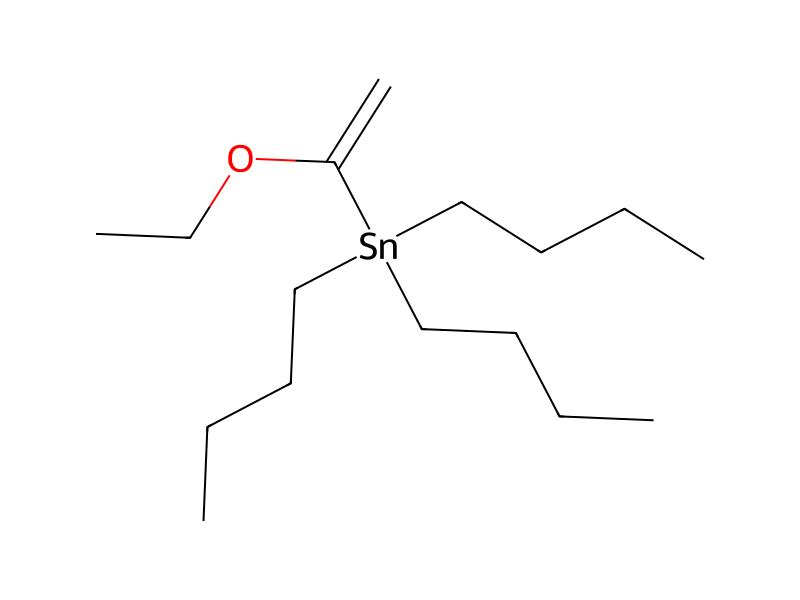
HCID 313Hydrochloric AcidHCID 11776TriphenylphosphineHCID 516892Sodium BicarbonateHCID 619414Stannane, tributyl(1-ethoxyethenyl)-HCID 143877455-Bromo-2-phenylpyrimidine

생성물 1

HCID 8201352-Phenylpyrimidine-5-carbaldehyde수율 36.4%

시약·촉매·용매

2
HCID 167845palladium(II) acetate촉매HCID 312751,4-Dioxane용매2회

반응 조건

온도
80 °C

실험 절차

A stirring mixture consisting of palladium(II) acetate (215 mg, 0.32 mmol) and triphenylphosphine (335 mg, 1.28 mmol) in 1,4-dioxane (25 mL) was heated at 80° C. for 30 minutes. The dark reaction mixture was cooled to room temperature, and to this reaction mixture was added a solution consisting of 5-bromo-2-phenylpyrimidine (Example 1A, 3.0 g, 13 mmol) and tributyl(1-ethoxyvinyl)tin (4.74 mL, 14.0 mmol) in 1,4-dioxane (63 mL). The reaction mixture was stirred and heated at 75° C. overnight and was subsequently cooled to room temperature. The reaction progress was monitored by thin layer chromatography (95:5 v/v hexanes-ethyl acetate) until completion. The reaction mixture was treated with 1 N hydrochloric acid (19 mL) for one hour at room temperature and poured into a saturated aqueous sodium bicarbonate solution. The organic material was extracted two times with a mixture of ethyl acetate and hexanes, and the combined organic phase was washed sequentially with water and brine, and was dried over anhydrous magnesium sulfate, filtered through a well packed pad of magnesium sulfate, and concentrated under reduced pressure. The residue was dissolved in dichloromethane (30 mL) and diluted with hexanes (30 mL). The resulting precipitate was filtered to give the title intermediate (872 mg). The filtrate was applied to a 80-g silica column eluted with 1:1:9 v/v/v ethyl acetate-dichloromethane-hexanes to afford 1.01 g of additional title intermediate (1.88 g total, 74%); R1 0.23 with 9:1 v/v hexanes-ethyl acetate solvent system; 1H-NMR (400 MHz; DMSO-d6) δ 9.4 (s, 2H), 8.45-8.50 (m, 2H), 7.5-7.7 (m, 3H), 2.68 (s, 3H); MS (ESI+) m/z 199 (M+1).


후처리

  1. customThe dark reaction mixture
  2. temperaturewas cooled to room temperature
  3. additionto this reaction mixture was added a solution
  4. temperatureheated at 75° C. overnight
  5. temperaturewas subsequently cooled to room temperature
  6. extractionThe organic material was extracted two times
  7. additionwith a mixture of ethyl acetate and hexanes
  8. washthe combined organic phase was washed sequentially with water and brine
  9. dry with materialwas dried over anhydrous magnesium sulfate
  10. filtrationfiltered through a well packed pad of magnesium sulfate
  11. concentrationconcentrated under reduced pressure
  12. dissolutionThe residue was dissolved in dichloromethane (30 mL)
  13. additiondiluted with hexanes (30 mL)
  14. filtrationThe resulting precipitate was filtered

출처 및 근거

ORD 기록
ord-75463831b1f649fc8e3937fda1441001
출처 데이터셋
uspto-grants-2015_09
DOI
10.6084/m9.figshare.5104873.v1
특허 번호
US09126973B2

반응 노트

이 페이지에서참가 물질반응 조건실험 절차후처리출처 및 근거반응 노트