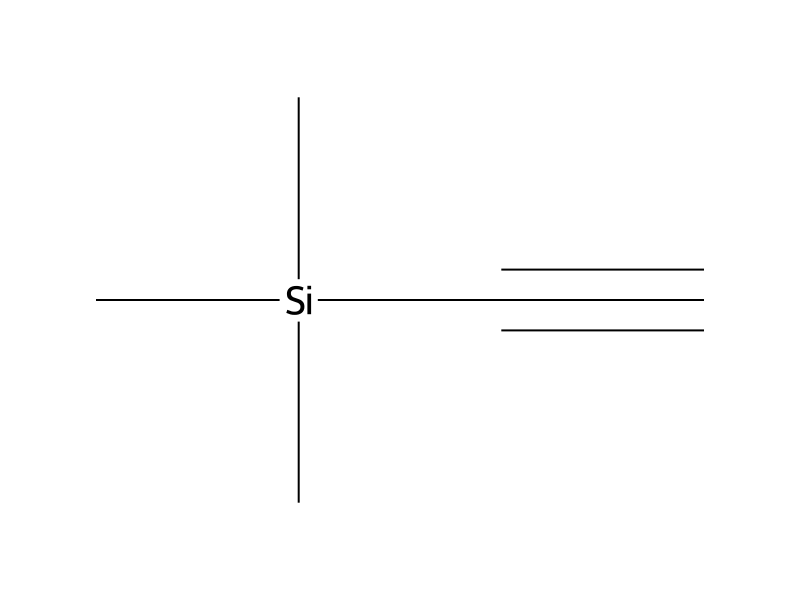
In a 250 ml round bottom flask equipped with a stir bar and reflux condenser added 4-chloro-2-bromo-1-fluoro-benzene (5 g, 23.9 mmol), triphenylphosphine (250 mg, 0.10 mmol), (trimethylsilyl)acetylene (5.2 ml, 36.5 mmol)and triethylamine (60 ml). The reaction mixture was purged with argon, followed by addition of palladium (II) acetate (108 mg, 0.05 mmol). The resulting mixture was left stirring at reflux under argon, overnight. The reaction mixture was filtered through a pad of celite using ethyl acetate and the filterate was concentrated in-vacuo. The isolated residue was absorbed on silica gel and filtered using hexanes. The filterate was concentrated in-vacuo to isolate the title compound as brown oil (5.42 g). Step 2: 4-Chloro-2-ethynyl-1-fluoro-benzene: In a 250 ml round bottom flask equipped with stir bar added (5-chloro-2-fluoro-phenylethynyl)-trimethyl-silane (5.42 g, 23.9 mmol), potassium carbonate (16.5 g, 120 mmol) and methanol (60 ml). The reaction mixture was left stirring at room temperature for 1 h. Diluted the reaction mixture with hexanes (200 ml) and washed with water (250 ml). The aqueous phase was extracted with hexanes (2×100 ml). Combined organic phase was washed with brine (200 ml), dried (sodium sulfate), filtered and concentrated in-vacuo to isolate the desired compound as brown oil (3.56 g). 1H-NMR (CDCl3), d (ppm): 7.47 (dd, 1H), 7.30 (m, 1H), 7.05 (t, 1H), 3.36 (s, 1H). Step 3: Chloro-hydroxyimino-acetic acid ethyl ester: In 1 L round bottom flask equipped with stir bar added amino-acetic acid ethyl ester hydrochloride (20 g, 143 mmol) and water (30 ml). The solution was cooled down to 0° C. followed by sequential addition of concentrated hydrochloric acid (11.8 ml, 143 mmol) and dropwise addition of sodium nitrite (9.89 g, 143 mmol) solution in water (15 ml). After 10 min added another equivalent each of concentrated hydrochloric acid and sodium nitrite solution in water. The reaction mixture was left stirring at 0° C . for 1 h. Reaction mixture was extracted with ether (4×100 ml). Combined organic phase was dried (sodium sulfate), filtered and concentrated in-vacuo to isolate a lemon yellow solid. The solid was recrystallized from hexanes to isolate a white solid (11 g, 51%). 1H-NMR (CDCl3), d (ppm): 9.98 (bs, 1H), 4.40 (q, 2H), 1.38 (t, 3H). Step 4: 5-(5-Chloro-2-fluoro-phenyl)-isoxazole-3-carboxylic acid ethyl ester: In a 250 ml round bottom flask equipped with stir bar added 4-chloro-2-ethynyl-1-fluoro-benzene (2 g, 12.9 mmol), chloro-hydroxyimino-acetic acid ethyl ester (3.92 g, 25.9 mmol), sodium bicarbonate (7.07 g, 84.1 mmol) and toluene (50 ml). Reaction mixture was left stirring at room temperature for 48 h, after which it was concentrated in-vacuo. Residue was taken up in ethyl acetate (200 ml), sequentially washed with water (150 ml), brine (150 ml), dried (sodium sulfate), filtered and concentrated in-vacuo. The crude residue was purified on silica gel using 3% acetone in hexanes to isolate the title compound as an off-white solid (1.56 g). 1H-NMR (CDCl3), d (ppm): 8.00 (dd, 1H), 7.43 (m, 1H), 7.18 (m, 2H), 4.51 (q, 2H), 1.47 (t, 3H). Step 5: [5-(5-Chloro-2-fluoro-phenyl)-isoxazol-3-yl]-methanol: In a 50 ml round bottom flask equipped with stir bar and drying tube added 5-(5-chloro-2-fluoro-phenyl)-isoxazole-3-carboxylic acid ethyl ester (0.78 g, 2.89 mmol) and tetrahydrofuran (10 ml). To this stirred solution added solution of lithium aluminum hydride (0.12 g, 2.89 mmol) in tetrahydrfuran (2 ml). The resulting mixture was left stirring at room temperature for 1 h. Reaction was quenched using sodium sulfate decahydrate. The resulting mixture was stirred at 63° C. for 15 min after which it was filtered through a celite pad. The filterate was concentrated in-vacuo to isolate the title compound as yellow solid (0.65 g, 99%). 1H-NMR (CDCl3), d (ppm): 7.73 (dd, 1H), 7.27 (m, 1H), 7.24 (t, 1H), 6.73 (d, 1H), 4.77 (s, 2H), 4.45 (bs, 1H).