Triphenylphosphine → HCID 10609721, compound
Reaction equation

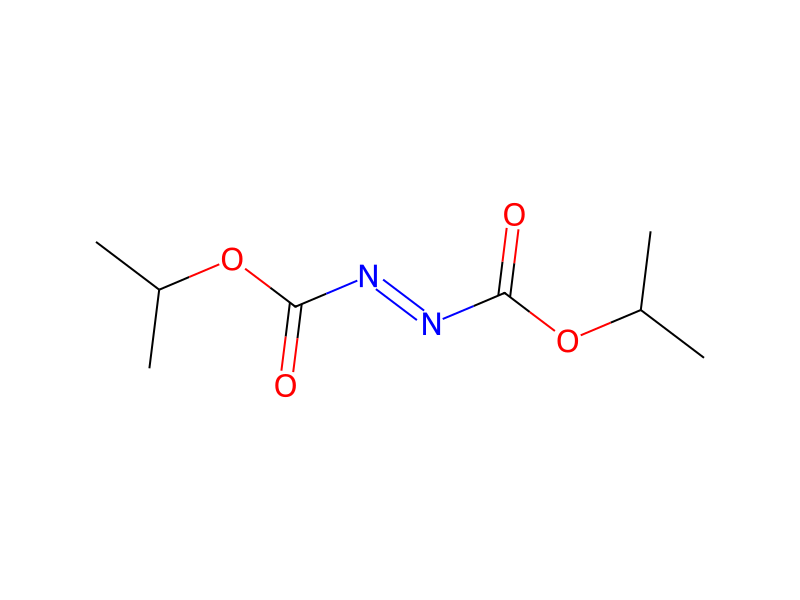
CC(OC(/N=N/C(OC(C)C)=O)=O)C.C1(P(C2C=CC=CC=2)C2C=CC=CC=2)C=CC=CC=1.[F:34][C:35]1[CH:42]=[C:41]([OH:43])[CH:40]=[CH:39][C:36]=1[C:37]#[N:38].[S:44]1[C:48]([CH2:49]O)=[CH:47][N:46]=[CH:45]1>O1CCCC1>[F:34][C:35]1[CH:42]=[C:41]([O:43][CH2:49][C:48]2[S:44][CH:45]=[N:46][CH:47]=2)[CH:40]=[CH:39][C:36]=1[C:37]#[N:38]Participants





Conditions
- Temperature
- 0 °C
Procedure
Diisopropylazodicarboxylate (4.0 g) was dissolved in a little anhydrous tetrahydrofuran (about 10 ml) and added dropwise to a stirred solution of triphenylphosphine (5.2 g) in anhydrous tetrahydrofuran (150 ml) at 0° C. under nitrogen. After stirring at 0° C. for 15 minutes, during which time a white precipitate formed, a mixture of 2-fluoro-4-hydroxybenzonitrile (S. M. Kelly, Helv.Chim.Acta. 1984, Volume 67, P.1572-1579) (2.0 g) and thiazole-5-methanol (2.3 g) in anhydrous tetrahydrofuran (20 ml) was added dropwise whilst maintaining the temperature at or below 5° C. The reaction mixture was stirred in the cooling bath for a further 2 hours then allowed to warm slowly to room temperature. After standing at room temperature overnight the reaction mixture was partitioned between ethyl acetate (200 ml) and saturated aqueous ammonium chloride solution (200 ml). The layers were separated and the organic phase washed with water (100 ml), dried over magnesium sulphate and evaporated. The residue was purified by flash chromatography on silica eluting with a mixture of ethyl acetate and cyclohexane (1:1, v/v). Fractions homogenous in the required product were combined and evaporated affording the title compound as a pale yellow solid (2.0 g).
Workup
- customformed
- temperaturewhilst maintaining the temperature at or below 5° C
- stirringThe reaction mixture was stirred in the cooling bath for a further 2 hours
- temperatureto warm slowly to room temperature
- waitAfter standing at room temperature overnight
- customthe reaction mixture was partitioned between ethyl acetate (200 ml) and saturated aqueous ammonium chloride solution (200 ml)
- customThe layers were separated
- washthe organic phase washed with water (100 ml)
- dry with materialdried over magnesium sulphate
- customevaporated
- customThe residue was purified by flash chromatography on silica eluting with a mixture of ethyl acetate and cyclohexane (1:1
- customevaporated
Sources & evidence
- ORD record
- ord-9500468b6e614e3f9964eb81cad30c2a
- Source dataset
- uspto-grants-2000_04
- Patent number
- US06048893
Reaction notes
Loading…