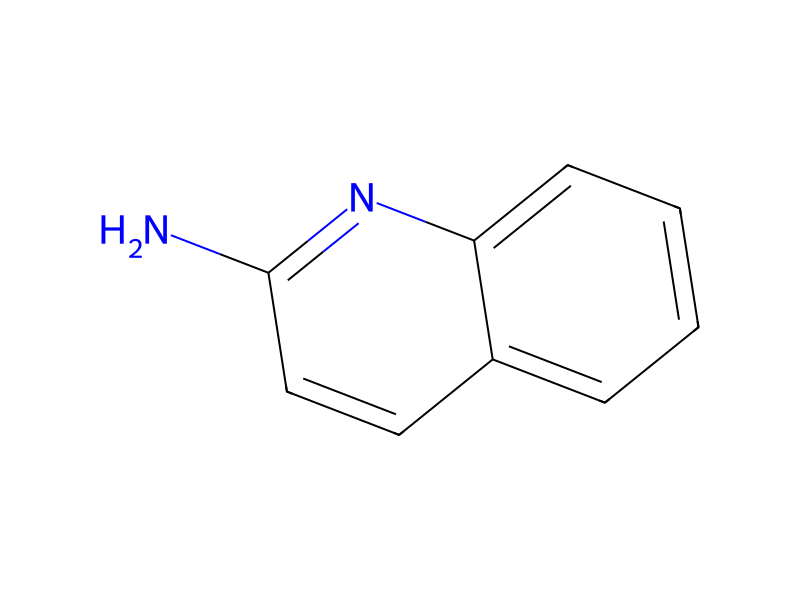
Ethanol → 2-Aminoquinoline
Reaction equation

Cl[C:2]1[C:11]2[C:6](=[CH:7][C:8](OC)=[CH:9][CH:10]=2)[N:5]=[CH:4][CH:3]=1.C(O)C.[Cl-].[Li+].[I-].[Na+].[N:21]1C=CC=CC=1>CN1CCCC1=O>[NH2:21][C:4]1[CH:3]=[CH:2][C:11]2[C:6](=[CH:7][CH:8]=[CH:9][CH:10]=2)[N:5]=1Participants
7
Reactant 5





Product 1
Reagents, catalysts & solvents 1

Procedure
The conversion of (4-chloroquinolin-7-yl)methyl ether B to compound IA is accomplished with an appropriate amine at temperatures between 0-200° C. optionally in a sealed tube and/or under microwave irradiation, either using a large excess of the amine without solvent, or on reaction with a 2-20-fold excess, in a suited solvent such as ethanol or 1-methylpyrrolidin-2-one, optionally in the presence of lithium chloride or sodium iodide and pyridine. In the case of R30=halogen, the isomeric 2-aminoquinoline derivative, which may result as a side product, is separated from the desired 4-aminoquinoline, e.g., by chromatography or crystallization.
Workup
- customunder microwave irradiation
- customon reaction with a 2-20-fold excess
Sources & evidence
- ORD record
- ord-8b58158badee4125854bb6d2ff266e10
- Source dataset
- uspto-grants-2004_09
- Patent number
- US06787558B2
Reaction notes
Loading…