Acetic Anhydride → 1-(5-Nitro-1H-indazol-1-yl)ethan-1-one
Reaction equation

[N+:1]([C:4]1[CH:5]=[C:6]2[C:10](=[CH:11][CH:12]=1)[NH:9][N:8]=[CH:7]2)([O-:3])=[O:2].C(N(CC)CC)C.[C:20](OC(=O)C)(=[O:22])[CH3:21].CCOC(C)=O>C1COCC1>[N+:1]([C:4]1[CH:5]=[C:6]2[C:10](=[CH:11][CH:12]=1)[N:9]([C:20](=[O:22])[CH3:21])[N:8]=[CH:7]2)([O-:3])=[O:2]Participants
Reactant 4



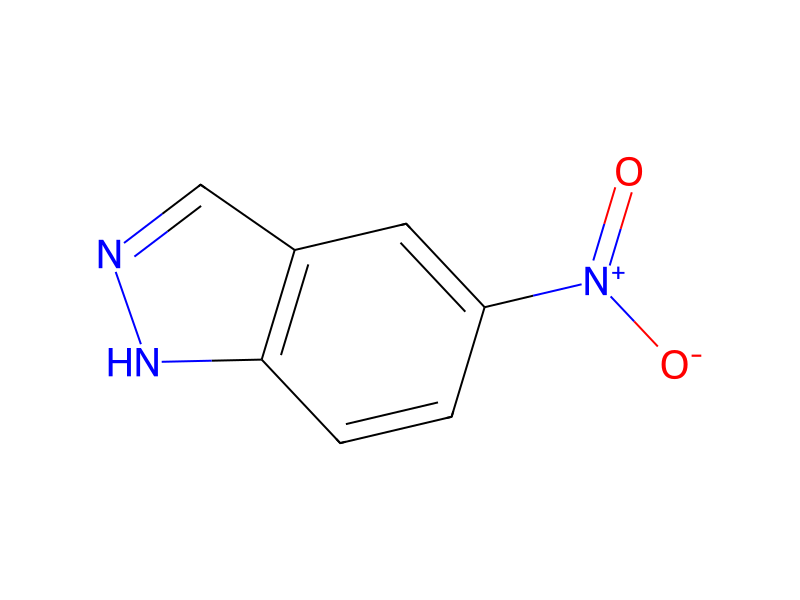
Product 1

Reagents, catalysts & solvents 1

Procedure
Step 1) Dissolve commercially available 5-nitroindazole (100 g, 613 mmoles) in 2 L of THF and then add triethylamine (260 mL; 1.87 moles). Stir the solution at room temp until all the solid went into the solution, and then add acetic acid anhydride (94 g; 927 mmoles). After 2 h at room temperature, add 2 L of EtOAc and extract the mixture with 1 N HCl (2×800 mL). Wash the organic layer with aqueous sodium bicarbonate followed by saturated aqueous NaCl. Dry the organic layer with magnesium sulfate and concentrate to a thick slurry. Add t-Butyl methyl ether (300 mL) and filter the slurry. Collect the solid, rinse with t-butyl methyl ether, and dry under vacuum to afford 113 g (90%) of 1-(5-nitro-indazol-1-yl)-ethanone a pale yellow solid. 1H NMR (500 MHz, CDCl3) δ 8.70 (d, 1H, J=2.0 Hz), 8.58 (d, 1H, J=9.5 Hz), 8.44 (dd, 1H J=7.0, 2.0 Hz), 8.31 (s, 1H), 2.84 (s, 1H).
Workup
- extractionextract the mixture with 1 N HCl (2×800 mL)
- washWash the organic layer with aqueous sodium bicarbonate
- dry with materialDry the organic layer with magnesium sulfate
- concentrationconcentrate to a thick slurry
- filtrationAdd t-Butyl methyl ether (300 mL) and filter the slurry
- customCollect the solid
- washrinse with t-butyl methyl ether
- customdry under vacuum
Sources & evidence
- ORD record
- ord-697b58bbbea44315b296205f50e5367f
- Source dataset
- uspto-grants-2011_07
- Patent number
- US07981918B2
Reaction notes
Loading…