3-Cyanophenol → HCID 10733955, compound
Reaction equation

[H-].[Na+].[C:3]([C:5]1[CH:6]=[C:7]([OH:11])[CH:8]=[CH:9][CH:10]=1)#[N:4].F[C:13]1[CH:18]=[CH:17][CH:16]=[C:15](F)[N:14]=1>CN(C)C=O>[N:14]1[C:15]([O:11][C:7]2[CH:6]=[C:5]([CH:10]=[CH:9][CH:8]=2)[C:3]#[N:4])=[CH:16][CH:17]=[CH:18][C:13]=1[O:11][C:7]1[CH:6]=[C:5]([CH:10]=[CH:9][CH:8]=1)[C:3]#[N:4]Participants
5
Reactant 3
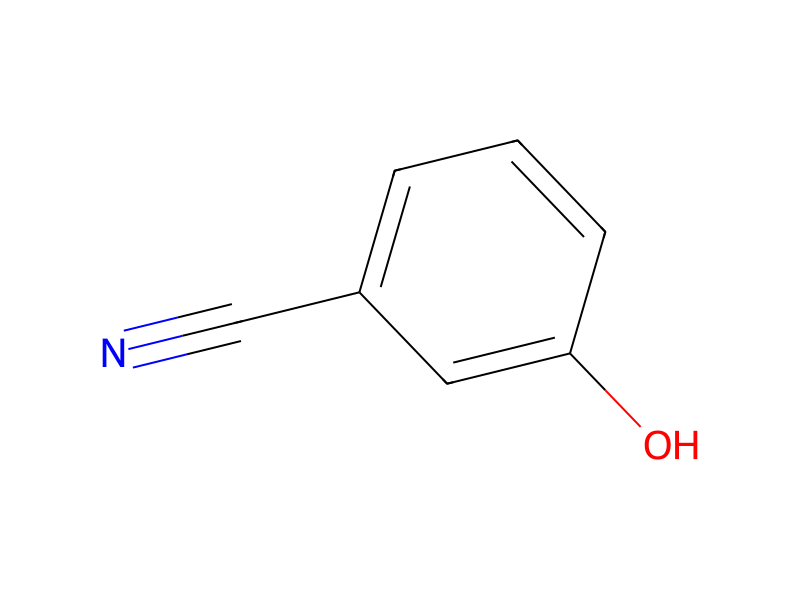


Product 1

Reagents, catalysts & solvents 1

Conditions
- Temperature
- 100 °C
Procedure
To sodium hydride (0.38 g, 9.5 mmol) in N,N-dimethylformamide (3 mL) was added 3-cyanophenol (1.1 g, 8.9 mmol) and 2,6-difluoropyridine (10.4 mL, 4.4 mmol). After heating in an oil bath at 100° C. for 15 hours the reaction was partitioned with ethyl acetate and water. The organic layer was separated, washed with water, dried (Na2SO4), and the solvent was removed in vacuo. The residue was chromatographed on silica gel (50 g) with methylene chloridelhexane (3/1) to give 3,3′-[2,6-pyridinediylbis(oxy)]bis(benzonitrile). Recrystallization from ethyl acetate/hexane gave pure 3,3′-[2,6-pyridinediylbis(oxy)]bis(benzonitrile); NMR (CDCl3) 7.79 (t, 1), 7.45 (m, 4), 7.32 (m, 4), 6.72 (d, 2) ppm.
Workup
- customwas partitioned with ethyl acetate and water
- customThe organic layer was separated
- washwashed with water
- dry with materialdried (Na2SO4)
- customthe solvent was removed in vacuo
- customThe residue was chromatographed on silica gel (50 g) with methylene chloridelhexane (3/1)
Sources & evidence
- ORD record
- ord-aade1362710a4a9c8cd4c0f4dc5a6495
- Source dataset
- uspto-grants-2002_11
- Patent number
- US06479485B2
Reaction notes
Loading…