Water → HCID 60611463, compound
Reaction equation

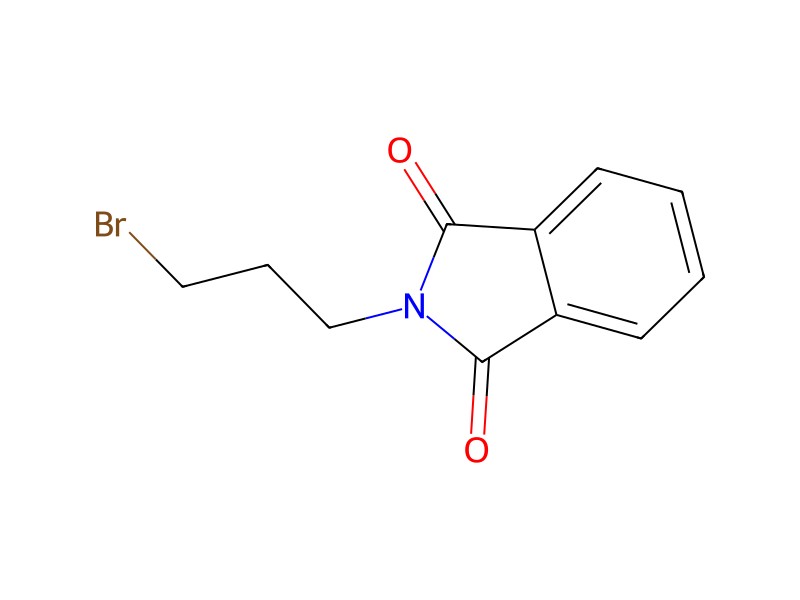
[Cl:1][C:2]1[CH:7]=[CH:6][CH:5]=[C:4]([Cl:8])[C:3]=1[OH:9].Br[CH2:11][CH2:12][CH2:13][N:14]1[C:18](=[O:19])[C:17]2=[CH:20][CH:21]=[CH:22][CH:23]=[C:16]2[C:15]1=[O:24].C(=O)([O-])[O-].[K+].[K+].O>CN(C)C=O>[Cl:1][C:2]1[CH:7]=[CH:6][CH:5]=[C:4]([Cl:8])[C:3]=1[O:9][CH2:11][CH2:12][CH2:13][N:14]1[C:18](=[O:19])[C:17]2=[CH:20][CH:21]=[CH:22][CH:23]=[C:16]2[C:15]1=[O:24]Participants
Reactant 4



Product 1

Reagents, catalysts & solvents 1

Conditions
- Temperature
- 100 °C
Procedure
A mixture of 2,6-dichlorophenol (2.0 g, 12 mmol), N-(3-bromopropyl)phthalimide (3.29 g, 12 mmol) and potassium carbonate (1.69 g, 12 mmol) in anhydrous N,N-dimethylformamide (40 ml) was stirred at 100° C. for 4 hours under an atmosphere of nitrogen. The mixture was then poured into 200 ml of distilled water to give a white precipitate, which was filtered and washed with distilled water. The solid was dried in a vacuum desiccator to yield 4.17 g of N-[3(2,6-dichlorophenoxy)propyl] phthalimide which was dissolved in absolute ethanol (75 ml) and hydrazine hydrate (3 ml, 73 mmol) was added and the mixture refluxed for one hour. After cooling to room temperature, the precipitate was filtered off and the filtrate was concentrated. The residue was chromatographed on silica gel column and eluted with dichloromethane/methanol/ammonium hydroxide (9:2:0.2) to yield 3.2 g of 3-(2,6-dichorophenoxy)propylamine.
Workup
- customto give a white precipitate, which
- filtrationwas filtered
- washwashed with distilled water
- customThe solid was dried in a vacuum desiccator
Sources & evidence
- ORD record
- ord-1336848b57cb48909f1b2987d063f88f
- Source dataset
- uspto-grants-2014_05
- Patent number
- US08716528B2
Reaction notes
Loading…