Azepane → 2-(3-(Azepan-1-yl)propyl)isoindoline-1,3-dione
Reaction equation

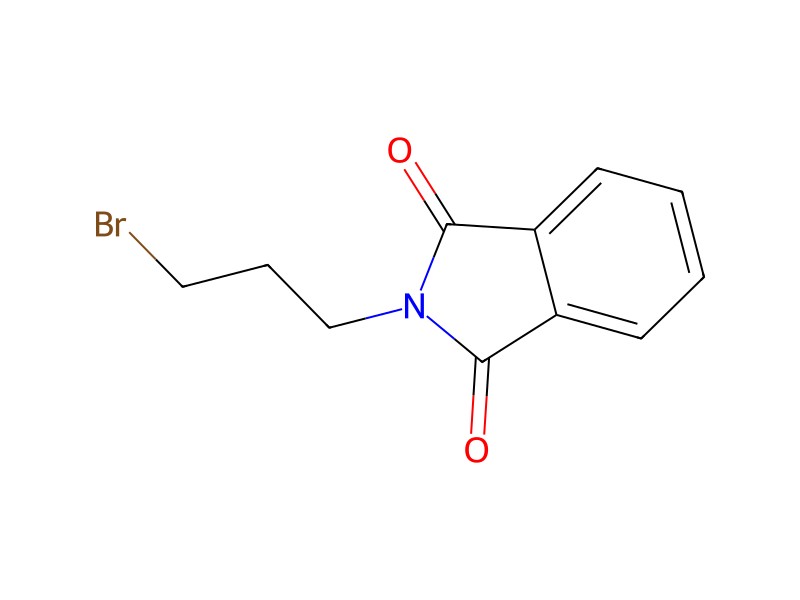
[NH:1]1[CH2:7][CH2:6][CH2:5][CH2:4][CH2:3][CH2:2]1.Br[CH2:9][CH2:10][CH2:11][N:12]1[C:20](=[O:21])[C:19]2[C:14](=[CH:15][CH:16]=[CH:17][CH:18]=2)[C:13]1=[O:22].C(=O)([O-])[O-].[K+].[K+]>CC(C)=O>[N:1]1([CH2:9][CH2:10][CH2:11][N:12]2[C:20](=[O:21])[C:19]3[C:14](=[CH:15][CH:16]=[CH:17][CH:18]=3)[C:13]2=[O:22])[CH2:7][CH2:6][CH2:5][CH2:4][CH2:3][CH2:2]1Participants
5
Reactant 3


Product 1

Reagents, catalysts & solvents 1

Procedure
The mixture of Azepane (2.3 mL), 2-(3-bromopropyl)isoindoline-1,3-dione (5.4 g) and potassium carbonate (5.5 g) in acetone (50 mL) was stirred at room temperature overnight. The solid was filtered and the filtrate was concentrated to provide 2-(3-(azepan-1-yl)propyl)isoindoline-1,3-dione, used without purification.
Workup
- filtrationThe solid was filtered
- concentrationthe filtrate was concentrated
Sources & evidence
- ORD record
- ord-3e57c933f8194d9ab5f985bd39c5b928
- Source dataset
- uspto-grants-2014_05
- Patent number
- US08729081B2
Reaction notes
Loading…