Indole → 1-(3-Bromopropyl)indole
Reaction equation

[OH-].[K+].[NH:3]1[C:11]2[C:6](=[CH:7][CH:8]=[CH:9][CH:10]=2)[CH:5]=[CH:4]1.[Br:12][CH2:13][CH2:14][CH2:15]Br.CN(C)C=O>O>[Br:12][CH2:13][CH2:14][CH2:15][N:3]1[C:11]2[C:6](=[CH:7][CH:8]=[CH:9][CH:10]=2)[CH:5]=[CH:4]1Participants
6
Reactant 4
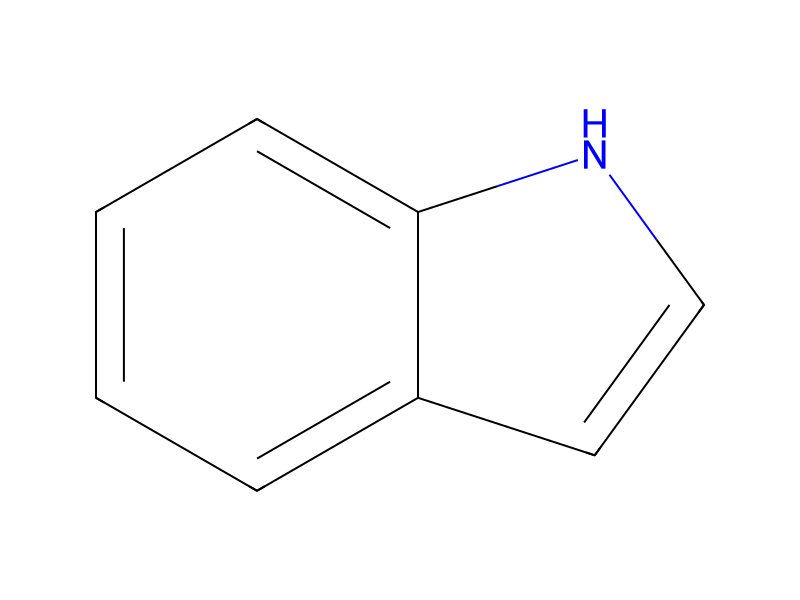



Product 1

Reagents, catalysts & solvents 1

Conditions
- Temperature
- 70 °C
Procedure
9.58 g of potassium hydroxide (KOH) and 20.00 g of indole were added to 110.58 g of 1,3-dibromopropane and 450 mL of N,N-dimethylformamide (DMF), and the mixture was stirred at 70° C. for 8 hours. After cooling to room temperature, 1 L of distilled water was added to the reaction solution, and the resulting solution was extracted with 1 L of ethyl acetate. The organic layer was washed with 500 mL of distilled water five times, then concentrated and purified by column chromatography to obtain 27.24 g of N-(3-bromopropyl)-indole. Compounds (p-9) and (p-10) having a bromopropyl group shown below were also synthesized in the same manner.
Workup
- temperatureAfter cooling to room temperature
- extractionthe resulting solution was extracted with 1 L of ethyl acetate
- washThe organic layer was washed with 500 mL of distilled water five times
- concentrationconcentrated
- custompurified by column chromatography
Sources & evidence
- ORD record
- ord-932ecd867fc84d1e91ecce733a5d9ae3
- Source dataset
- uspto-grants-2014_05
- Patent number
- US08735048B2
Reaction notes
Loading…