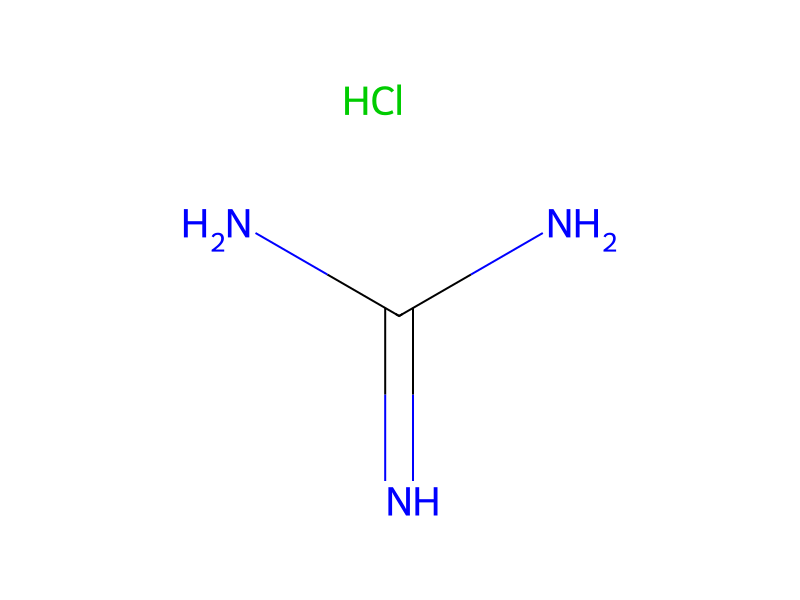
Guanidine Hydrochloride → HCID 178508872, compound
Reaction equation

C[O:2][C:3]([CH:5]1[CH2:12][CH2:11][CH2:10][CH2:9][C:8]2[CH:13]=[CH:14][CH:15]=[CH:16][C:7]=2[C:6]1=O)=O.Cl.[NH2:19][C:20]([NH2:22])=[NH:21].C([O-])([O-])=O.[K+].[K+]>CN(C=O)C>[NH2:22][C:20]1[N:21]=[C:3]([OH:2])[C:5]2[CH2:12][CH2:11][CH2:10][CH2:9][C:8]3[CH:13]=[CH:14][CH:15]=[CH:16][C:7]=3[C:6]=2[N:19]=1Participants
5
Reactant 3


Product 1

Reagents, catalysts & solvents 1

Procedure
A mixture of Example 20A (1.49 g, 6.4 mmol), guanidine hydrochloride (2.1 g, 22 mmol) and K2CO3 (3.26 g, 24 mmol) in anhydrous DMF (20 mL) was heated at 120° C. for 8 hours under a nitrogen atmosphere. The mixture was cooled to room temperature and partitioned between EtOAc (200 mL) and H2O (150 mL). The aqueous layer was extracted with EtOAc three times. The organic layers were combined, washed with brine, dried (MgSO4), filtered and concentrated to provide a residue. The residue was chromatographed on silica gel eluting with MeOH:EtOAc:CHCl3 (10:45:45) to provide the title compound.
Workup
- custompartitioned between EtOAc (200 mL) and H2O (150 mL)
- extractionThe aqueous layer was extracted with EtOAc three times
- washwashed with brine
- dry with materialdried (MgSO4)
- filtrationfiltered
- concentrationconcentrated
- customto provide a residue
- customThe residue was chromatographed on silica gel eluting with MeOH:EtOAc:CHCl3 (10:45:45)
Sources & evidence
- ORD record
- ord-2e53afa629ea47f69d89ca158f18b3d4
- Source dataset
- uspto-grants-2014_05
- Patent number
- US08735411B2
Reaction notes
Loading…