Ethyl Acetate → HCID 13535401, compound
Reaction equation

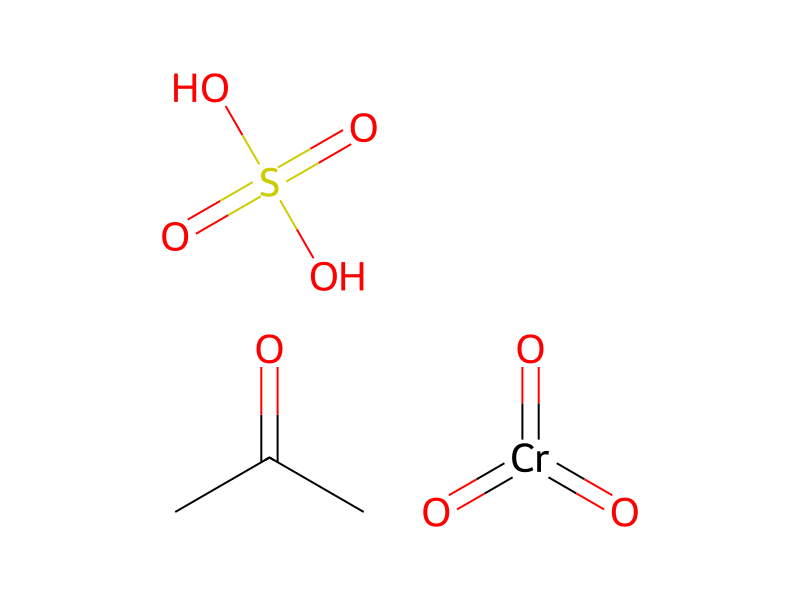
[Cl:1][C:2]1[CH:17]=[CH:16][C:5]([O:6][CH2:7][CH:8]([OH:15])[CH2:9][N:10]2[CH:14]=[N:13][CH:12]=[N:11]2)=[CH:4][CH:3]=1.CC(C)=O.OS(O)(=O)=O.O=[Cr](=O)=O.C(OCC)(=O)C.C(=O)(O)[O-].[Na+]>CC(C)=O>[Cl:1][C:2]1[CH:3]=[CH:4][C:5]([O:6][CH2:7][C:8](=[O:15])[CH2:9][N:10]2[CH:14]=[N:13][CH:12]=[N:11]2)=[CH:16][CH:17]=1Participants
Reactant 4



Product 1

Reagents, catalysts & solvents 1

Procedure
The 1-(4-chlorophenoxy) 3-(1,2,4-triazol-1-yl)propan-2 ol (3.0g) was dissolved in acetone (100ml) and treated with Jones reagent (3ml) for 3 h. To complete the oxidation, two subsequent additions of Jones reagent (0.5ml) were added. After cooling, ethyl acetate (150ml) was added and the reaction was neutralised by the addition of a saturated solution of sodium bicarbonate. The organic phase was separated, washed with water, dried and concentrated to dryness under reduced pressure. The residue was purified by chromatography on silica using 2% by volume methenol in chloroform as eluent, to give 1-(4-chlorophenoxy)-3-(1,2,4-triazol -1-yl)propan-2-one as a gum, NMR in deuteriochloroform: δ4.7(2H,s), 5.38(2H,s), 6.85(2H,d), 7.3(2H,d), 8.01(1H,s), 8.17(1H,s).
Workup
- additionwere added
- temperatureAfter cooling
- customThe organic phase was separated
- washwashed with water
- customdried
- concentrationconcentrated to dryness under reduced pressure
- customThe residue was purified by chromatography on silica using 2% by volume methenol in chloroform as eluent
Sources & evidence
- ORD record
- ord-7a597c39ab75403fbe3ada72f8528b32
- Source dataset
- uspto-grants-1990_09
- Patent number
- US04957934
Reaction notes
Loading…