Diisopropylethylamine → Indole
Reaction equation

NC1C=C(C=CC=1)C([C:7]1[C:15]2[C:10](=[CH:11][CH:12]=[CH:13][CH:14]=2)[NH:9][CH:8]=1)=O.C(N(C(C)C)CC)(C)C.C(C1C=CC(C(C2C=CC(CC(C)C)=CC=2)Cl)=CC=1)C(C)C>CN(C)C=O>[NH:9]1[C:10]2[C:15](=[CH:14][CH:13]=[CH:12][CH:11]=2)[CH:7]=[CH:8]1Participants
5
Reactant 3



Product 1
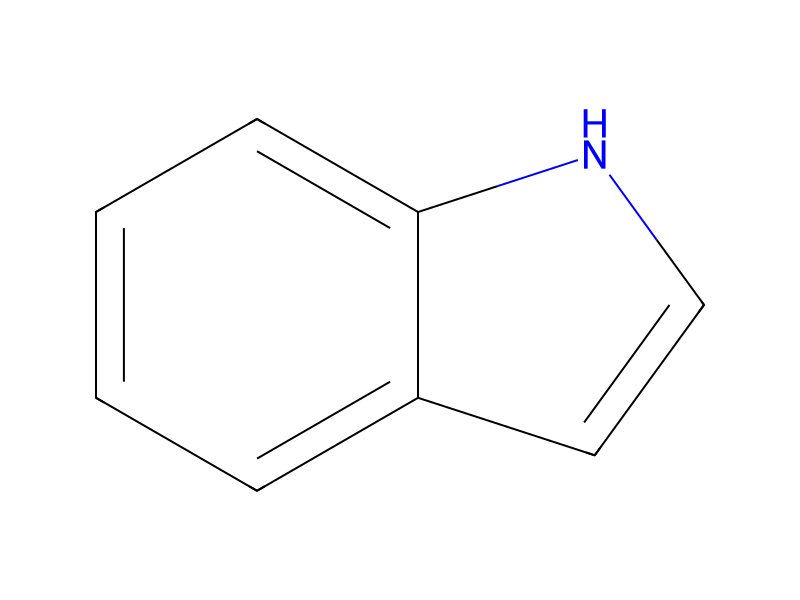
Reagents, catalysts & solvents 1

Procedure
To a solution of 3-(3-aminobenzoyl)indole (1.2 g) in N,N-dimethylformamide (12 ml) were added diisopropylethylamine (1.77 ml) and a solution of bis(4-isobutylphenyl)chloromethane (1.92 g) in N,N-dimethylformamide (5 ml) at 25° C., and the mixture was allowed to stand at the same temperature for 14 hours. The reaction mixture was partitioned between ethyl acetate and water, and the organic layer was washed with water and brine, dried over magnesium sulfate, and evaporated- The residue was chromatographed on silica gel (50 g) eluting with a mixture of ethyl acetate and chloroform (1:20) to give 3-[3-bis(4-isobutylphenyl)methylamino]benzoyl]indole (1.25 g) as pale yellow amorphous powder.
Workup
- customat 25° C.
- customThe reaction mixture was partitioned between ethyl acetate and water
- washthe organic layer was washed with water and brine
- dry with materialdried over magnesium sulfate
- customevaporated- The residue was chromatographed on silica gel (50 g)
- washeluting with a mixture of ethyl acetate and chloroform (1:20)
Sources & evidence
- ORD record
- ord-6f78c8eed4e34ceabd3ed34d20984f40
- Source dataset
- uspto-grants-1994_05
- Patent number
- US05312829
Reaction notes
Loading…