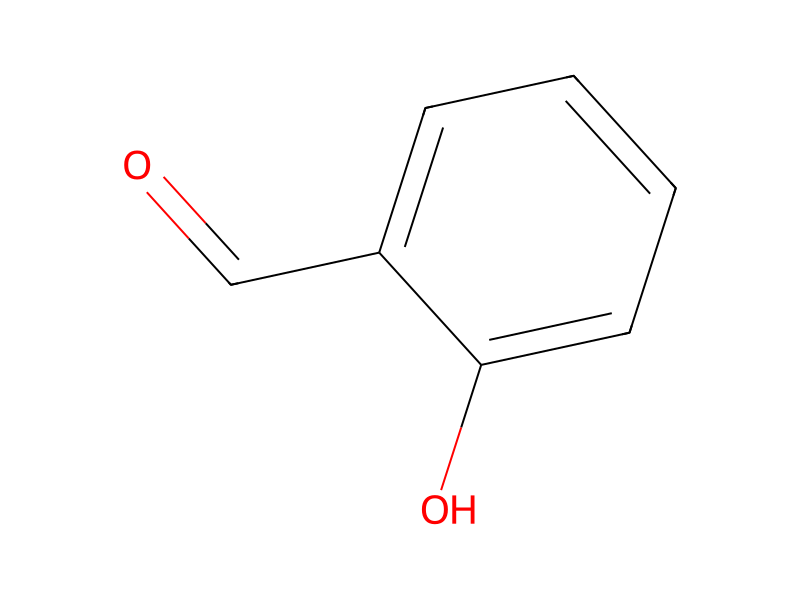
Salicylaldehyde → 2-(5-Chloropentyloxy)benzaldehyde
Reaction equation

[CH:1](=[O:9])[C:2]1[C:3](=[CH:5][CH:6]=[CH:7][CH:8]=1)[OH:4].Br[CH2:11][CH2:12][CH2:13][CH2:14][CH2:15][Cl:16].C(=O)([O-])[O-].[K+].[K+]>CC(O)C>[Cl:16][CH2:15][CH2:14][CH2:13][CH2:12][CH2:11][O:4][C:3]1[CH:5]=[CH:6][CH:7]=[CH:8][C:2]=1[CH:1]=[O:9]Participants
Reactant 3


Product 1

Reagents, catalysts & solvents 1

Procedure
To a solution of 100 g (0.82 mol) of salicylaldehyde in 2000 ml of iPrOH was added 228 g (1.23 mol) of 1-bromo-5-chloro-pentane, followed by 113 g (0.82 mol) of potassium carbonate. The reaction was refluxed under nitrogen and followed by TLC. After cooling to room temperature, the mixture was filtered and the filtrate was concentrated under reduced pressure to remove all solvent. The liquid residue was purified by fractional distillation under reduced pressure: 1st fraction: 45°-50° C., 0.4 mm Hg [Br(CH2)5Cl] 2nd fraction: 159.8 g (86% yield), 145°-150° C., 0.3 mm Hg colorless liquid product. The remaining residue proved to a dialdehyde by-product. TLC: Starting aldehyde Rf=0.46 (30% ether/pet. ether). Desired aldehyde: Rf=0.35. By-product: Rf=0.15.
Workup
- temperatureThe reaction was refluxed under nitrogen
- filtrationthe mixture was filtered
- concentrationthe filtrate was concentrated under reduced pressure
- customto remove all solvent
- distillationThe liquid residue was purified by fractional distillation under reduced pressure
- custom45°-50° C., 0.4 mm Hg [Br(CH2)5Cl] 2nd fraction
- custom159.8 g (86% yield), 145°-150° C., 0.3 mm Hg colorless liquid product
Sources & evidence
- ORD record
- ord-3747b3fef54f4a5e92bdc4bd4812bd6d
- Source dataset
- uspto-grants-1994_05
- Patent number
- US05314887
Reaction notes
Loading…