Hydrogen Peroxide → 2-Oxaspiro[3.5]nonane-7-methanol
Reaction equation

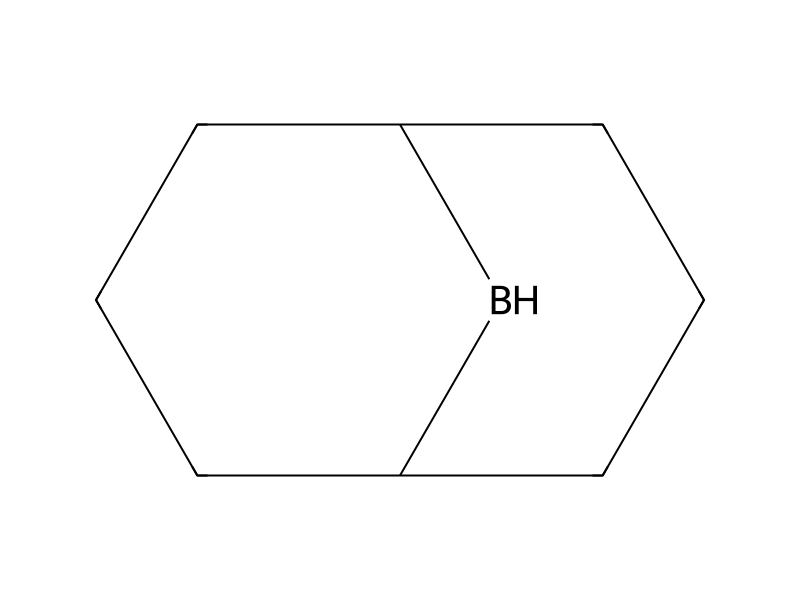
[O:1]1[CH2:5]CC[CH2:2]1.[CH:6]12B[CH:10]([CH2:11][CH2:12][CH2:13]1)[CH2:9][CH2:8]C2.[OH-:15].[Na+].OO>C(O)C>[CH2:2]1[C:12]2([CH2:11][CH2:10][CH:9]([CH2:8][OH:15])[CH2:6][CH2:13]2)[CH2:5][O:1]1Participants
Reactant 4



Product 1

Reagents, catalysts & solvents 1

Procedure
To a 25 mL round-bottomed flask was added EXAMPLE 351E (568 mg) and EXAMPLE 351F tetrahydrofuran (4.11 mL) to give a colorless solution. 9-Borabicyclo[3.3.1]nonane (0.5 M in tetrahydrofuran, 24.7 mL) was added and the reaction was allowed to stir for 2 hours at room temperature. Ethanol (11 mL) was added followed by aqueous NaOH (5M, 4.11 mL) and then hydrogen peroxide (2.1 mL) was added. The reaction was heated at 50° C. for 2 hours. The mixture was concentrated by rotary evaporation, and diluted with water and ethyl acetate. The aqueous layer was extracted with ethyl acetate (3×) and the combined organics were dried (Na2SO4), filtered and concentrated by rotary evaporation. The residue was purified by regular phase flash column chromatography (Analogix, 80 g Grace, 0-70% hexanes/ethyl acetate).
Workup
- customto give a colorless solution
- temperatureThe reaction was heated at 50° C. for 2 hours
- concentrationThe mixture was concentrated by rotary evaporation
- additiondiluted with water and ethyl acetate
- extractionThe aqueous layer was extracted with ethyl acetate (3×)
- dry with materialthe combined organics were dried (Na2SO4)
- filtrationfiltered
- concentrationconcentrated by rotary evaporation
- customThe residue was purified by regular phase flash column chromatography (Analogix, 80 g Grace, 0-70% hexanes/ethyl acetate)
Sources & evidence
- ORD record
- ord-ed07245e5bc142cc84c627283f74b24f
- Source dataset
- uspto-grants-2013_10
- Patent number
- US08546399B2
Reaction notes
Loading…