Hydrochloric Acid → (3-(Benzyloxy)-4-chlorophenyl)boronic acid
Reaction equation

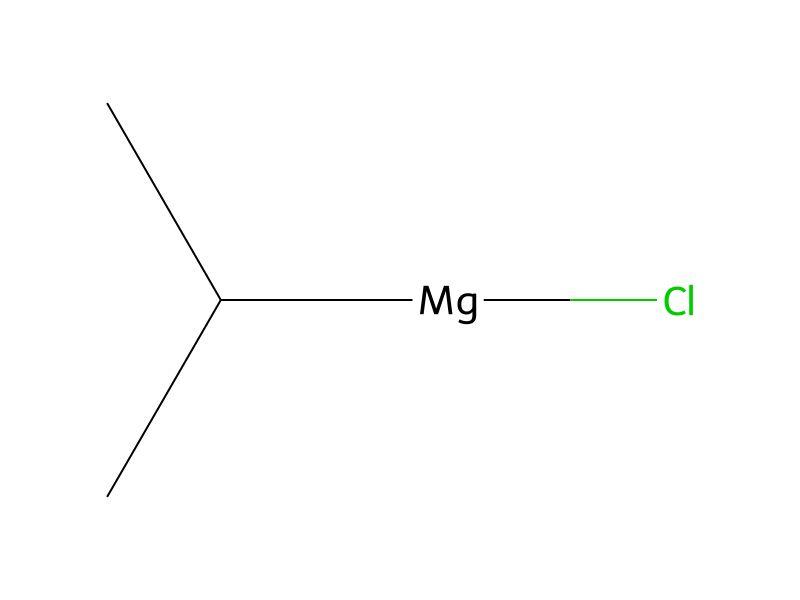
C([Mg]Cl)(C)C.[CH2:6]([O:13][C:14]1[CH:19]=[C:18](I)[CH:17]=[CH:16][C:15]=1[Cl:21])[C:7]1[CH:12]=[CH:11][CH:10]=[CH:9][CH:8]=1.[B:22](OC(C)C)([O:27]C(C)C)[O:23]C(C)C.Cl>C1COCC1>[CH2:6]([O:13][C:14]1[CH:19]=[C:18]([B:22]([OH:27])[OH:23])[CH:17]=[CH:16][C:15]=1[Cl:21])[C:7]1[CH:12]=[CH:11][CH:10]=[CH:9][CH:8]=1Participants





Conditions
- Temperature
- -50 °C
Procedure
Add dropwise 374 mL (748 mmol) of a solution of iPrMgCl 2N in THF to a solution of 198 g (575 mmol) of 2-(benzyloxy)-1-chloro-4-iodobenzene in 1.2 L of anhydrous THF under argon and stirred at −50° C., maintaining the temperature between −40 and −50° C. Allow the reaction mixture to return to −10° C. and continue stirring for 1 h. Then add 172 mL (748 mmol) of triisopropyl borate and leave the reaction mixture to return slowly to RT. After stirring for 2 h, treat the mixture with 1 L of aqueous solution of HCl 5N, then extract with ether (2×600 mL). Wash the organic phase with 2×1 L of water, dry over Na2SO4 then concentrate under reduced pressure. Solidify the residue obtained in pentane, filter on a frit and wash with pentane. We thus obtain 113 g of [3-(benzyloxy)-4-chlorophenyl]boronic acid in the form of a white solid.
Workup
- temperaturemaintaining the temperature between −40 and −50° C
- customto return to −10° C.
- stirringcontinue stirring for 1 h
- customleave the reaction mixture
- customto return slowly to RT
- stirringAfter stirring for 2 h
- extractionextract with ether (2×600 mL)
- washWash the organic phase with 2×1 L of water
- dry with materialdry over Na2SO4
- concentrationthen concentrate under reduced pressure
- customobtained in pentane
- filtrationfilter on a frit
- washwash with pentane
Sources & evidence
- ORD record
- ord-b8ea8b964eaf4ba7b72b87d3a3f07796
- Source dataset
- uspto-grants-2013_10
- Patent number
- US08552201B2
Reaction notes
Loading…