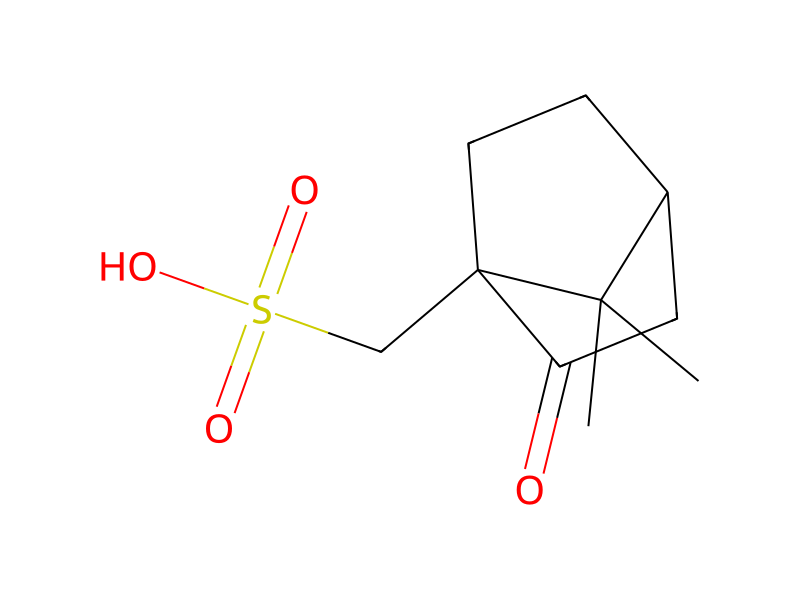
Bicyclo[2.2.1]heptane-1-methanesulfonic acid, 7,7-dimethyl-2-oxo-, (1S)- → HCID 66830125, compound
Reaction equation

Cl[CH:2]1[N:7](Cl)[CH:6]=[C:5]([C:9]([F:12])([F:11])[F:10])[CH:4]=[N:3]1.[NH2:13][C:14]1[C:30]([O:31][CH3:32])=[CH:29][C:17]2[CH2:18][CH2:19][N:20]([CH2:23][C:24]([N:26]([CH3:28])[CH3:27])=[O:25])[CH2:21][CH2:22][C:16]=2[CH:15]=1.C(N(CC)C(C)C)(C)C.[CH3:42][CH:43]([S:45]([C:48]1[CH:53]=[CH:52][CH:51]=[CH:50][C:49]=1[NH2:54])(=[O:47])=[O:46])[CH3:44].C12(CS(O)(=O)=O)C(C)(C)C(CC1)CC2=O>C(O)(C)C.O>[CH3:32][O:31][C:30]1[C:14]([NH:13][C:2]2[N:7]=[C:6]([NH:54][C:49]3[CH:50]=[CH:51][CH:52]=[CH:53][C:48]=3[S:45]([CH:43]([CH3:44])[CH3:42])(=[O:47])=[O:46])[C:5]([C:9]([F:12])([F:11])[F:10])=[CH:4][N:3]=2)=[CH:15][C:16]2[CH2:22][CH2:21][N:20]([CH2:23][C:24]([N:26]([CH3:28])[CH3:27])=[O:25])[CH2:19][CH2:18][C:17]=2[CH:29]=1Participants
Reactant 5



Product 1

Reagents, catalysts & solvents 2


Procedure
2,3-Dichloro-5-trifluoromethylpyrimidine (892 mg, 4.11 mmol), 2-(7-amino-8-methoxy-1,2,4,5-tetrahydro-benzo[d]azepin-3-yl)-N,N-dimethylacetamide (1.00 g, 3.6 mmol), and N,N-diisopropylethylamine (699 mg, 5.41 mmol) were combined in isopropanol (17 mL) and stirred at room temperature overnight. The reaction was concentrated and the organics were extracted into dichloromethane. The dichloromethane extract was washed with saturated sodium bicarbonate solution, was dried (sodium sulfate), and was concentrated. Reverse phase chromatography (Gilson) employing gradient elution (20-55% acetonitrile: water) afforded (in order of elution): 2-[7-(2-Chloro-5-trifluoromethylpyrimidin-4-ylamino)-8-methoxy-1,2,4,5-tetrahydro-3-benzazepin-3-yl]-N,N-dimethylacetamide (453 mg, 27%) and 2-[7-(4-Chloro-5-trifluoromethylpyrimidin-2-ylamino)-8-methoxy-1,2,4,5-tetrahydro-3-benzazepin-3-yl]-N,N-dimethylacetamide (458 mg, 28%). The latter compound (60 mg, 0.10 mmol) was combined with 2-(propane-2-sulfonyl)phenylamine (29 mg, 0.147 mmol) and 10-camphorsulfonic acid (48 mg, 0.207 mmol) in isopropanol (3 mL) to which had been added 0.01 mL water. The mixture was heated at 180° C. in a microwave for three hours. The reaction was permitted to cool and was concentrated. The organics were extracted into dichloromethane which was subsequently washed with saturated sodium bicarbonate solution, was dried (sodium sulfate), and was concentrated. ISCO chromatography (gradient elution: 1 to 5% MeOH:dichloromethane) afforded the title compound as a brown gum (4 mg, 4%). LCMS (m/e) 621 (M+1); 1H-NMR (CDCl3, 400 MHz) δ 9.46 (s, 1H), 8.53 (d, J=8 Hz, 1H), 8.37 (s, 1H), 8.15 (s, 1H), 7.89 (d, J=8 Hz, 1H), 7.74 (s, 1H), 7.56 (m, 1H), 7.20 (m, 1H), 6.71 (s, 1H), 3.91 (s, 3H), 3.31 (m, 3H), 3.16 (s, 3H), 3.00 (s, 3H), 2.92 (m, 2H), 2.84 (m, 2H), 2.71 (m, 4H), 1.32 (d, J=7 Hz, 6H).
Workup
- concentrationThe reaction was concentrated
- extractionthe organics were extracted into dichloromethane
- extractionThe dichloromethane extract
- washwas washed with saturated sodium bicarbonate solution
- dry with materialwas dried (sodium sulfate)
- concentrationwas concentrated
- washgradient elution (20-55% acetonitrile: water)
- customafforded
- wash(in order of elution)
- temperatureThe mixture was heated at 180° C. in a microwave for three hours
- temperatureto cool
- concentrationwas concentrated
- extractionThe organics were extracted into dichloromethane which
- washwas subsequently washed with saturated sodium bicarbonate solution
- dry with materialwas dried (sodium sulfate)
- concentrationwas concentrated
- washISCO chromatography (gradient elution: 1 to 5% MeOH:dichloromethane)
Sources & evidence
- ORD record
- ord-0596d2ed2f9640b28d94e309b95d8a8d
- Source dataset
- uspto-grants-2013_10
- Patent number
- US08552186B2
Reaction notes
Loading…