Iodine → Triphenylphosphonium bromide
Reaction equation

C1C=CC(C[Br:8])=CC=1.[C:9]([O-:12])(O)=O.[Na+:13].II.[BH4-].[Na+].[OH-].[Na+].C([O-])([O-])=O.[K+].[K+].[P:26]([C:39]1[CH:44]=[CH:43][CH:42]=[CH:41][CH:40]=1)([C:33]1[CH:38]=[CH:37][CH:36]=[CH:35][CH:34]=1)[C:27]1[CH:32]=[CH:31][CH:30]=[CH:29][CH:28]=1.Br>CO.C(#N)C.CC(C)=O.O.CO>[CH3:9][O:12][Na:13].[P:26]([C:33]1[CH:34]=[CH:35][CH:36]=[CH:37][CH:38]=1)([C:39]1[CH:44]=[CH:43][CH:42]=[CH:41][CH:40]=1)[C:27]1[CH:28]=[CH:29][CH:30]=[CH:31][CH:32]=1.[BrH:8]Participants
Reactant 7




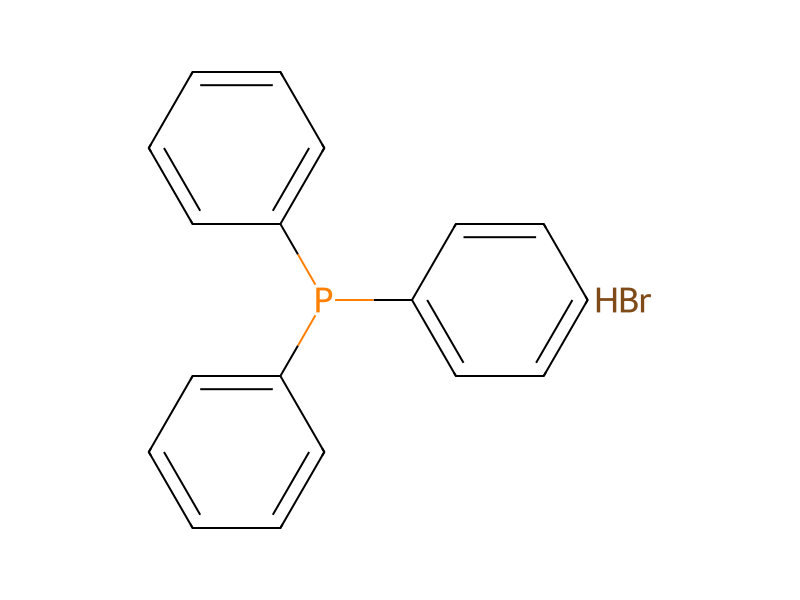


Product 2

Reagents, catalysts & solvents 4




Procedure
The aforementioned biomimetic route is ideally suited for preparing GLY analogs related to the natural biosynthetic pathway. Alternatively, the other inventive embodiment involving the use of a novel Wittig reaction along a non-biomimetic route, is very useful for going directly to the isoflav-3-ene intermediate. Because this route does not entail the use of a thallium reagent, it represents a ‘greener chemistry’ pathway that can also be particularly beneficial for large-scale production processes. The non-biomimetic route is shown in FIG. 4 (Scheme 4) as its distinct and particularly preferred embodiments. The percent yields for each step of Scheme 4 are indicated immediately after the reaction condition: (a) MOMCl, K2CO3, Acetone; (b) BnBr, K2CO3, Acetone, combined yield across both (a) and (b) 71%; (c) BnBr, NaHCO3, Acetonitrile, 80%; (d) I2, Selectofluor™, MeOH, 70%; (e) NaBH4, NaOH, Water:MeOH (1:1), 76%; (f) Reflux, K2CO3, Acetone, 72%; (g) PPh3.HBr, Acetonitrile, RT; (h) Reflux, MeONa, MeOH, combined yield across both (g) and (h) 78% (i) Heat, PPh3.HBr, Acetonitrile:Water; (j) TBDMSCl, NEt3, CH2Cl2, combined yield across both (i) and (j) 69%. Overall yield to produce isoflav-3-ene from commonly available commercial materials is 19%. The first steps of this route involve parallel preparation of a salicylalcohol-related building block and an alpha-iodo-ketone building block. The inventors found the use of sodium bicarbonate in acetonitrile to be optimal for limiting benzylation (see, e.g., P. M. Dewick, Syn. Comm. 1981, 11, 853-857; and W. Y. Zhang, I. Lantos, R. T. Matsuoka, W. Mendelson, K. Webb, L. M. Tucker, L. Liu, G. Procter, PCT Int. Appl. 1996, 40 pp. WO 9619438 A1 1996027 Application: WO 95-US16975 19951222, each of which is hereby incorporated by reference in its entirety) to just the para-position of the aldehyde starting material for salicylalcohol. After observing decomposition under more standard conditions, the optimal way to subsequently reduce the aldehyde was found to be by using sodium borohydride in a solvent system specifically composed of 1:1 aqueous sodium hydroxide:methanol. See, e.g., M. Brink, Acta Univ. Lund. Sect. II 1965, 16, 1-11; W. Nagata, K. Okada, T. Aoki, Synthesis 1979, 5, 365-368; and M. L. Belyanin, V. D. Filimonov, E. A. Krasnov, Russ. J. Applied Chem. 2001, 74, 103-105, each of which is hereby incorporated by reference in its entirety. Furthermore, by evaporating the methanol prior to neutralization with 1 N sulfuric acid during this reaction's work-up, a very convenient isolation of the precipitated product can be achieved in 80% yield. Synthesis of the other building block begins with 2,4-dihydroxy-acetophenone, which is selectively protected with a silyl type of protecting group or by a MOM-group at the para-position, and by a benzyl-group at the ortho-position, followed by alpha-halogenation of the methylketone function. After observing a complex mixture of products using more conventional methods for bromination of the di-protected intermediate (see, e.g., L. C. King, G. K. Ostrum, J. Org. Chem. 1964, 29, 3459-3461; S. Cacchi, L. Caglioti, E. Cernia, Synthesis 1979, 1, 64-66; C. A. Horiuchi, S. Kiji, Bul. Chem. Soc. Japan 1997, 70, 421-426; and A. Fougerousse, E. Gonzalez, R. Brouillard, J. Org. Chem. 2000, 65, 583-586, each of which is hereby incorporated by reference in its entirety), the optimal way to halogenate this ketone was found to be by using 0.5 equivalents of iodine and 0.6 equivalents of Selectfluor™ (see, e.g., M. Jereb, S. Stavber, M. Zupan, Synthesis 2003, 6, 853-858, which is hereby incorporated by reference in its entirety) which provides the iodide in 70% yield after recrystallization from methanol:acetone.
Sources & evidence
- ORD record
- ord-a7c8c5e7f813456db80f6aa8100daf8d
- Source dataset
- uspto-grants-2013_10
- Patent number
- US08563599B2
Reaction notes
Loading…