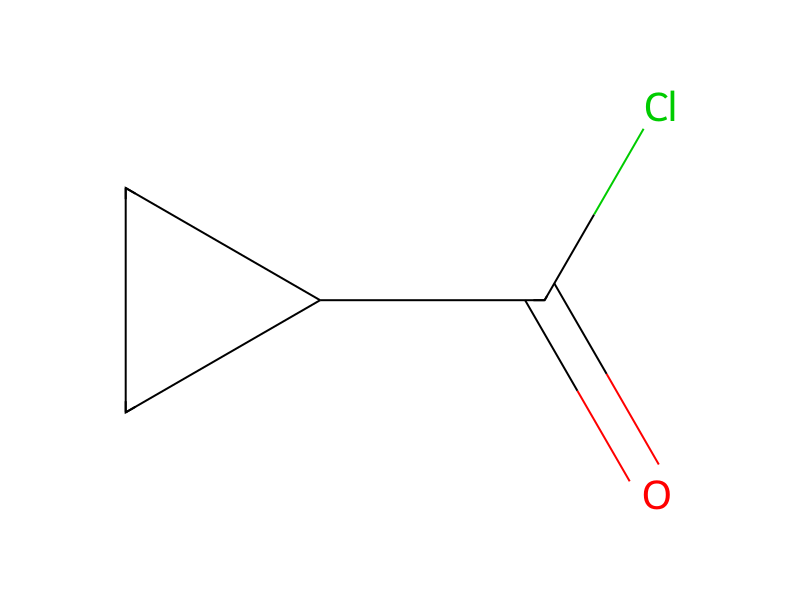
Cyclopropanecarbonyl chloride → Ethyl 4-cyclopropyl-4-oxobutanoate
Reaction equation

I[CH2:2][CH2:3][C:4]([O:6][CH2:7][CH3:8])=[O:5].[CH:9]1([C:12](Cl)=[O:13])[CH2:11][CH2:10]1>C1C=CC=CC=1.CC(N(C)C)=O.C(OCC)(=O)C.[Cu].[Zn].Cl[Pd](Cl)([P](C1C=CC=CC=1)(C1C=CC=CC=1)C1C=CC=CC=1)[P](C1C=CC=CC=1)(C1C=CC=CC=1)C1C=CC=CC=1>[CH:9]1([C:12](=[O:13])[CH2:2][CH2:3][C:4]([O:6][CH2:7][CH3:8])=[O:5])[CH2:11][CH2:10]1Participants
8
Reactant 2

Product 1

Reagents, catalysts & solvents 5





Conditions
- Temperature
- 60 °C
Procedure
A mixture of ethyl 3-iodopropanoate (8 g, 35 mmol) and zinc-copper (4.5 g, 70 mmol) in a mixture of benzene (80 mL) and DMA (8 mL) was heated at 60° C. for 4.5 hours under N2. Pd(PPh3)2Cl2 (1.2 g, 1.8 mmol) was added, followed by addition of cyclopropanecarbonyl chloride (3.7 g, 35 mmol). The mixture was stirred at 60° C. for another 30 minutes. The reaction mixture was diluted with ethyl acetate (300 mL), and washed with 1N HCl (50 mL), satd aq NaHCO3 (80 mL) and brine (30 mL). The organic layer was dried over Na2SO4 and concentrated to afford the ethyl 4-cyclopropyl-4-oxobutanoate (4.2 g), which was used for next step directly without purification.
Workup
- washwashed with 1N HCl (50 mL)
- dry with materialThe organic layer was dried over Na2SO4
- concentrationconcentrated
Sources & evidence
- ORD record
- ord-7fcecf852594480a9984f12e2cad41b5
- Source dataset
- uspto-grants-2013_10
- Patent number
- US08569292B2
Reaction notes
Loading…