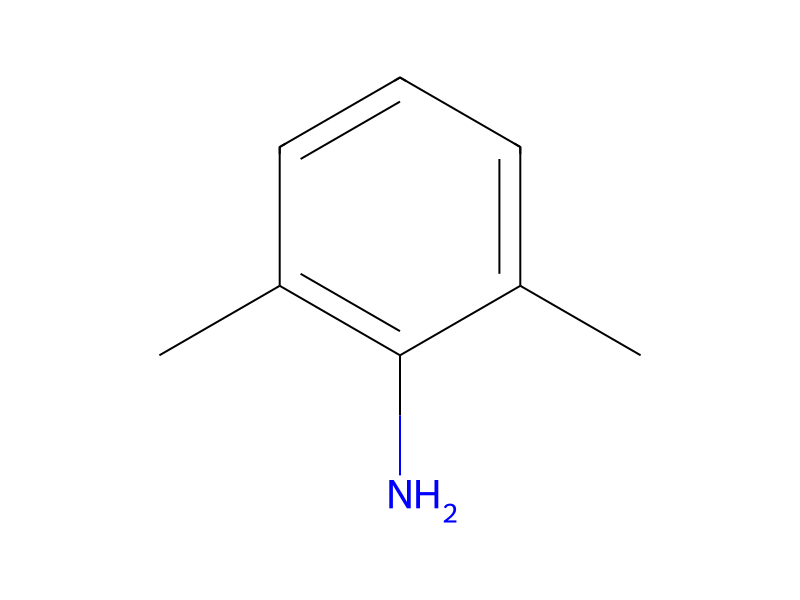
2,6-Dimethylaniline → HCID 12877376, compound
Reaction equation

[CH3:1][C:2]1[CH:8]=[CH:7][CH:6]=[C:5]([CH3:9])[C:3]=1[NH2:4].C(=O)([O-])[O-].[K+].[K+].Cl[CH2:17][C:18]1[N:23]=[CH:22][CH:21]=[CH:20][N:19]=1>CN(C)C=O.[I-].[K+]>[N:19]1[CH:20]=[CH:21][CH:22]=[N:23][C:18]=1[CH2:17][NH:4][C:3]1[C:5]([CH3:9])=[CH:6][CH:7]=[CH:8][C:2]=1[CH3:1]Participants
6





Conditions
- Temperature
- 100 °C
Procedure
48.4 g (0.4 mol) of 2,6-dimethylaniline, 55.3 g (0.4 mol) of potassium carbonate and 0.2 g of potassium iodide were heated to 100° C. in 60 ml of dimethylformamide, and 25.7 g (0.2 mol) of 2-chloromethyl-pyrimidine were then added dropwise. The reaction mixture was subsequently stirred at 100° C. for 5 hours and then poured onto 500 g of ice. It was then extracted three times with 150 ml of methylene chloride each time. The combined organic phases were dried over sodium sulphate and concentrated in vacuo. The residue was distilled under a high vacuum. 30 g (70% of theory) of N-(pyrimidin-2-yl-methyl)-2,6-dimethylaniline were obtained as a colorless oil of boiling point 150° C./0.2 mm Hg. ##STR13##
Workup
- extractionIt was then extracted three times with 150 ml of methylene chloride each time
- dry with materialThe combined organic phases were dried over sodium sulphate
- concentrationconcentrated in vacuo
- distillationThe residue was distilled under a high vacuum
Sources & evidence
- ORD record
- ord-e8e9104a901f41069e118af771b11c6f
- Source dataset
- uspto-grants-1982_05
- Patent number
- US04328029
Reaction notes
Loading…