Ammonia → HCID 12940476, compound
Reaction equation

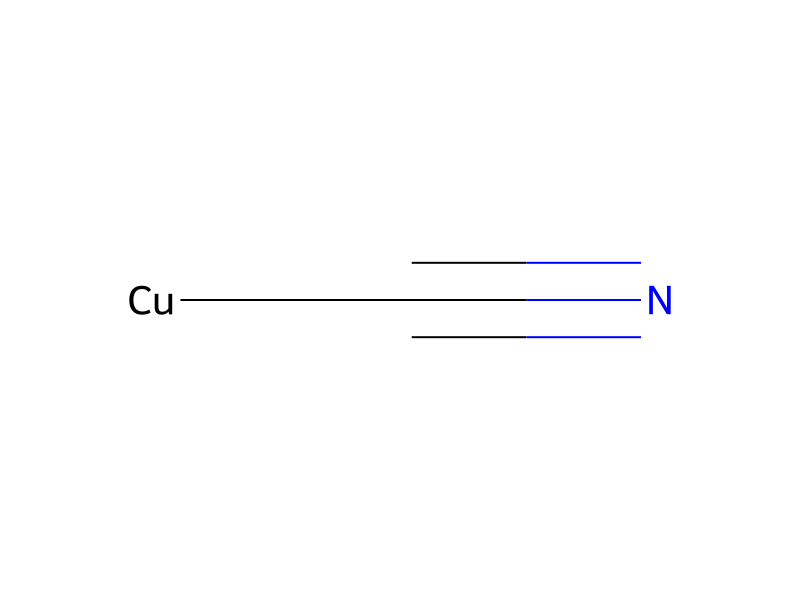
N([O-])=O.[Na+].S(=O)(=O)(O)O.N[C:11]1[C:12]([I:23])=[C:13]([C:17]([I:22])=[C:18](N)[C:19]=1[I:20])[C:14]([OH:16])=[O:15].[NH3:24].[Cu][C:26]#[N:27].[C-:28]#N.[K+].Cl>C(OCC)(=O)C.O.C(O)(=O)C>[C:28]([C:11]1[C:12]([I:23])=[C:13]([C:17]([I:22])=[C:18]([C:26]#[N:27])[C:19]=1[I:20])[C:14]([OH:16])=[O:15])#[N:24]Participants
Reactant 7






Product 1

Reagents, catalysts & solvents 3



Procedure
7 g of sodium nitrite is introduced under stirring into 84 ml of concentrated sulfuric acid held at a temperature of +5° C. The mixture is then maintained at +70° C. until solution has occurred, and then cooled to +5° C. After adding 42 ml of glacial acetic acid dropwise under cooling, 21 g of 3,5-diamino-2,4,6-triiodobenzoic acid is added in incremental portions under agitation in such a way that the internal temperature ranges between 0° C. and +5° C. The batch is stirred for another 2 hours, and the green-colored suspension is poured on 400 g of ice. A mixture is prepared from 500 ml of concentrated ammonia and 320 ml water, and 35.6 g of copper(I) cyanide and 67 g of potassium cyanide are dissolved therein. To this solution, the diazotizing batch is added under strong frothing. The mixture is stirred for 2 hours, and after allowing the batch to stand overnight it is first combined with 500 ml of ethyl acetate, then with excess concentrated hydrochloric acid. After the thus-separated copper salts have been removed by vacuum-filtering and washed out with ethyl acetate, the aqueous phase in the filtrate is separated and extracted several times with ethyl acetate. The ethyl acetate extracts are combined, washed with water, and then dried over sodium sulfate and concentrated. The dark-colored residue is treated with 100 ml of acetone in the hot state; the acetonic solution is filtered off from undissolved components and thereafter concentrated to half the quantity. After stirring for several hours, the crystallized product is vacuum-filtered, washed with ice-cold acetone, and dried at 50° C., thus obtaining 8.5 g (=38% of theory) of 3,5-dicyano-2,4,6-triiodobenzoic acid as a white powder with a decomposition point lying above 280° C.
Workup
- customheld at a temperature of +5° C
- temperatureThe mixture is then maintained at +70° C. until solution
- temperaturecooled to +5° C
- temperatureunder cooling
- customranges between 0° C. and +5° C
- dissolutionare dissolved
- additionTo this solution, the diazotizing batch is added under strong frothing
- stirringThe mixture is stirred for 2 hours
- waitto stand overnight
- customAfter the thus-separated copper salts have been removed
- filtrationby vacuum-filtering
- washwashed out with ethyl acetate
- customthe aqueous phase in the filtrate is separated
- extractionextracted several times with ethyl acetate
- washwashed with water
- dry with materialdried over sodium sulfate
- concentrationconcentrated
- additionThe dark-colored residue is treated with 100 ml of acetone in the hot state
- filtrationthe acetonic solution is filtered off from undissolved components
- concentrationconcentrated to half the quantity
- stirringAfter stirring for several hours
- filtrationthe crystallized product is vacuum-filtered
- washwashed with ice-cold acetone
- customdried at 50° C.
Sources & evidence
- ORD record
- ord-5c537c755f24441893f12100f52dfd4b
- Source dataset
- uspto-grants-1982_05
- Patent number
- US04328202
Reaction notes
Loading…