Hydrochloric Acid → HCID 15521876, compound
Reaction equation

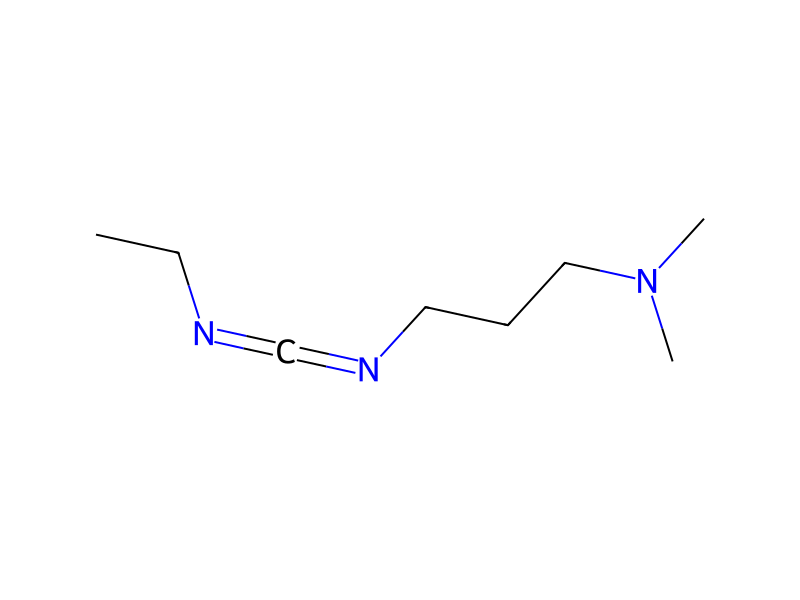
[NH2:1][C:2]1[CH:3]=[C:4]([CH:8]=[CH:9][C:10]=1[N+:11]([O-:13])=[O:12])[C:5]([OH:7])=O.[NH:14]1[CH2:19][CH2:18][O:17][CH2:16][CH2:15]1.ON1C2C=CC=CC=2N=N1.C(N=C=NCCCN(C)C)C.Cl>CN(C)C=O>[NH2:1][C:2]1[CH:3]=[C:4]([CH:8]=[CH:9][C:10]=1[N+:11]([O-:13])=[O:12])[C:5]([N:14]1[CH2:19][CH2:18][O:17][CH2:16][CH2:15]1)=[O:7]Participants
Reactant 5




Product 1

Reagents, catalysts & solvents 1

Procedure
In N,N-dimethylformamide (DMF) (108 ml), 3-amino-4-nitrobenzoic acid [the compound of the formula (1a)] (10.8 g) which was prepared in accordance with a known method (HECHENG HUASUE, page 91, 1995) was dissolved. Further, morpholine (10.3 ml), 1-Hydroxybenzotriazole (HOBt) (9.60 g), and 1-ethyl-3-(3-dimethylaminopropyl)carbodiimide (WSCI.HCl) (13.6 g) were successively added to the solution, and the mixture was stirred at room temperature for 18 hours. The reaction solution was poured into a 1N HCl aqueous solution to precipitate crystals, and the whole was filtrated to obtain the crystals and a filtrate. The filtrate was extracted with ethyl acetate. The resulting organic layer was dried over anhydrous sodium sulfate and concentrated under vacuum. The above crystals and the concentrate were combined to obtain 3-amino-4-nitrobenzoic acid morpholide (12.1 g; yield=81.2%) as yellow crystals.
Workup
- dissolutionwas dissolved
- customto precipitate crystals
- filtrationthe whole was filtrated
- customto obtain the crystals
- extractionThe filtrate was extracted with ethyl acetate
- dry with materialThe resulting organic layer was dried over anhydrous sodium sulfate
- concentrationconcentrated under vacuum
Sources & evidence
- ORD record
- ord-d20d73d267bd4f8181c964d4cc8ea0ad
- Source dataset
- uspto-grants-2001_06
- Patent number
- US06242445B1
Reaction notes
Loading…