Triisopropyl borate → Isoquinoline-4-boronic acid
Reaction equation

Br[C:2]1[C:11]2[C:6](=[CH:7][CH:8]=[CH:9][CH:10]=2)[CH:5]=[N:4][CH:3]=1.C([Li])CCC.C([O:20][B:21](OC(C)C)[O:22]C(C)C)(C)C>O1CCCC1>[CH:5]1[C:6]2[C:11](=[CH:10][CH:9]=[CH:8][CH:7]=2)[C:2]([B:21]([OH:22])[OH:20])=[CH:3][N:4]=1Participants
Reactant 3

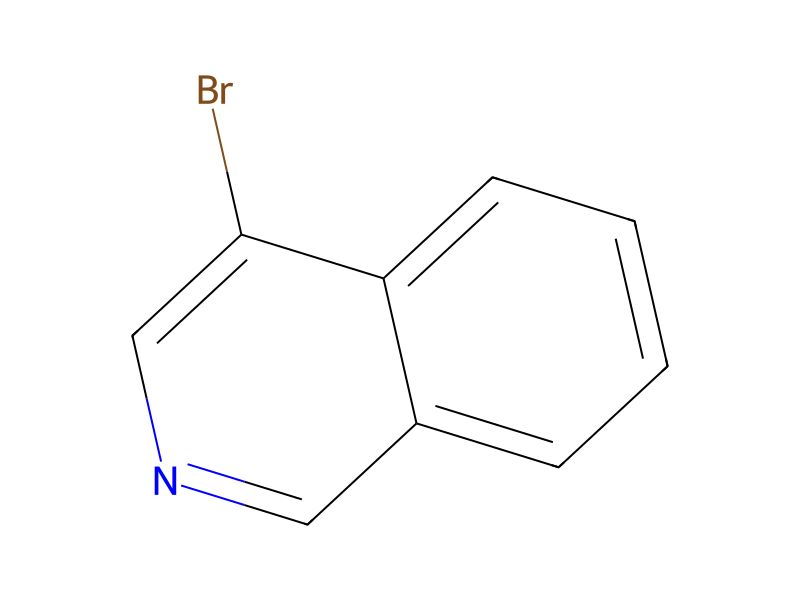

Product 1

Reagents, catalysts & solvents 1

Procedure
A solution of 2.0 gm (9.6 mMol) 4-bromoisoquinoline in 30 mL tetrahydrofuran was cooled to −100° C. To this solution were added dropwise 6.3 mL (10.1 mMol) n-butyl-lithium (1.6 M in hexane) dropwise, and the resultant solution was stirred for 30 minutes. To this solution was then added dropwise a solution of 4.4 mL (19.2 mMol) triisopropylborate and the reaction mixture was then stirred for 18 hours at room temperature. The reaction mixture was then partitioned between ethyl acetate and saturated aqueous sodium chloride. The phases were separated and the aqueous phase extracted well with ethyl acetate. The combined organic phases were washed with saturated aqueous sodium chloride, dried over sodium sulfate and concentrated under reduced pressure. The residue was sonicated in a mixture of hexane:ethyl acetate. The resulting suspension was filtered to provide 0.57 gm (34%) isoquinolin-4-ylboronic acid as a light orange solid.
Workup
- customThe reaction mixture was then partitioned between ethyl acetate and saturated aqueous sodium chloride
- customThe phases were separated
- extractionthe aqueous phase extracted well with ethyl acetate
- washThe combined organic phases were washed with saturated aqueous sodium chloride
- dry with materialdried over sodium sulfate
- concentrationconcentrated under reduced pressure
- customThe residue was sonicated in a mixture of hexane
- filtrationThe resulting suspension was filtered
Sources & evidence
- ORD record
- ord-7b61882ea8034bf29670e9c87f55877e
- Source dataset
- uspto-grants-2001_06
- Patent number
- US06242450B1
Reaction notes
Loading…