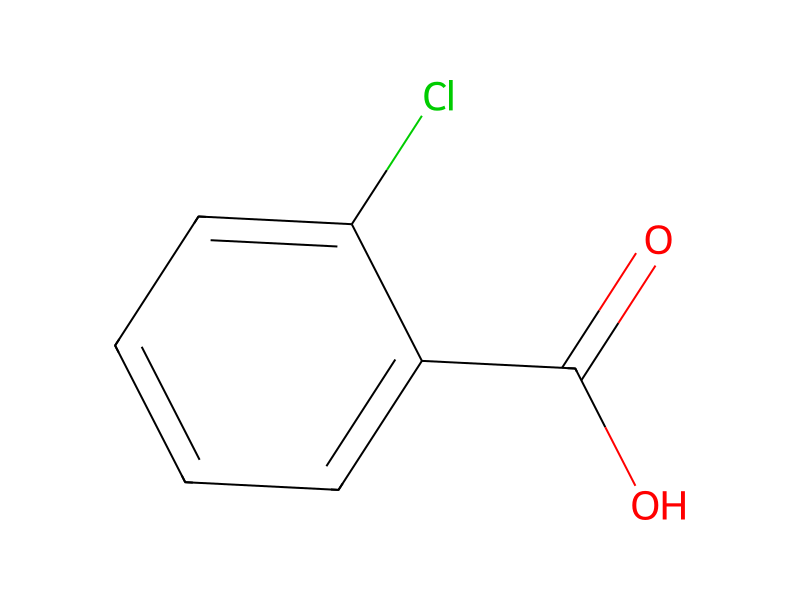
2-Chlorobenzoic Acid → HCID 21189417, compound
Reaction equation

[Cl:1][C:2]1[CH:10]=[CH:9][CH:8]=[CH:7][C:3]=1[C:4](O)=[O:5].[Cl:11][C:12]1[CH:24]=[C:23]([Cl:25])[C:22]([S:26](=[O:29])(=[O:28])[NH2:27])=[CH:21][C:13]=1[C:14]([NH:16][CH2:17][CH2:18][O:19][CH3:20])=[O:15].C1CCN2C(=NCCC2)CC1>O1CCCC1>[Cl:11][C:12]1[CH:24]=[C:23]([Cl:25])[C:22]([S:26](=[O:28])(=[O:29])[NH:27][C:4](=[O:5])[C:3]2[CH:7]=[CH:8][CH:9]=[CH:10][C:2]=2[Cl:1])=[CH:21][C:13]=1[C:14]([NH:16][CH2:17][CH2:18][O:19][CH3:20])=[O:15]Participants
Reactant 3


Product 1

Reagents, catalysts & solvents 1

Procedure
At room temperature, 1.0 g (6.1 mmol) of 2-chlorobenzoic acid are dissolved in 120 ml of tetrahydrofuran and mixed with 1.0 g (6.1 mmol) of N,N′-carbonyldiimidazole. After 30 minutes at room temperature and a further 30 minutes at reflux temperature, 2.0 g (6.1 mmol) of 2,4-dichloro-N-(2-methoxyethyl)-5-sulfamoylbenzamide are added at reflux temperature. After 10 minutes, 0.9 g (6.1 mmol) of 1,5-diazabicyclo[5.4.0]-5-undecene are added and the mixture is kept at reflux temperature for a further 3 hours. The mixture is subsequently evaporated to dryness, the residue is taken up in 60 ml of acetonitrile and the solution is poured into 60 ml of water. The solution is acidified to pH 1 using 2N HCI and the precipitate is separated off, washed with water and dried.
Workup
- additionare added
- temperatureat reflux temperature
- waitAfter 10 minutes
- temperatureat reflux temperature for a further 3 hours
- customThe mixture is subsequently evaporated to dryness
- additionthe solution is poured into 60 ml of water
- customthe precipitate is separated off
- washwashed with water
- customdried
Sources & evidence
- ORD record
- ord-2d4bcc29822847879dcc0d706574dfa9
- Source dataset
- uspto-grants-2001_06
- Patent number
- US06251827B1
Reaction notes
Loading…