Propargyl bromide → HCID 15007143, compound
Reaction equation

[O:1]=[C:2]1[CH2:6][S:5][CH2:4][NH:3]1.[H-].[Na+].[CH2:9](Br)[C:10]#[CH:11].C(=O)(O)[O-].[Na+]>CN(C)C=O.C1(C)C=CC=CC=1>[CH2:11]([N:3]1[C:2](=[O:1])[CH2:6][S:5][CH2:4]1)[C:10]#[CH:9]Participants
7
Reactant 4
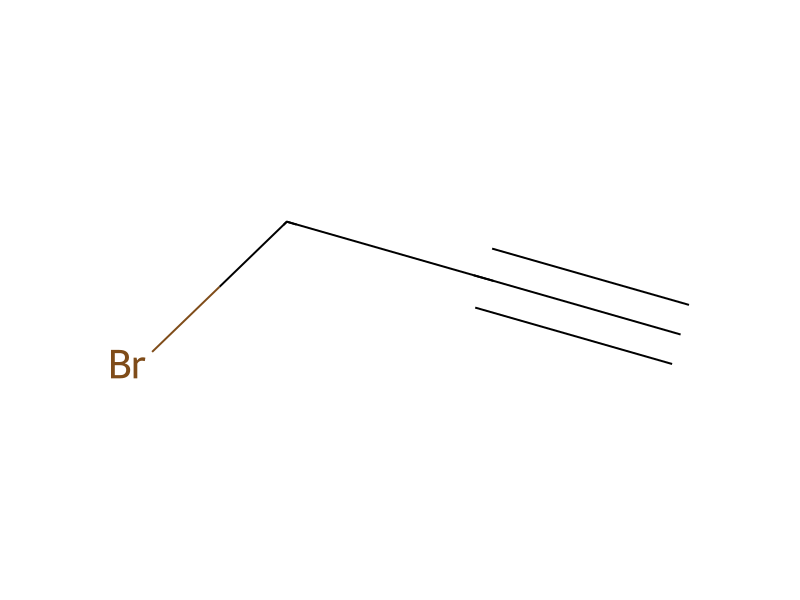



Product 1

Reagents, catalysts & solvents 2


Procedure
To a stirred solution of 10.3 g of 4-oxothiazolidine in 500 ml of anhydrous dimethylformamide under N2 was added 6.0 g of sodium hydride (50% in oil). After 30 min., 15 ml of a solution of 80% propargyl bromide in toluene was added and the mixture was allowed to stir for another hour. The mixture was then poured into saturated aqueous sodium bicarbonate and extracted with ethyl acetate. The combined organic fractions were washed twice with water, then once with brine, dried (MgSO4), filtered and concentrated. The residue was distilled at 0.1/mm Hg, 95°-98° C., to provide 9.248 g of 3-propargyl-4-oxothiazolidine as an oil which solidified upon refrigeration, mp 29°-31°.
Workup
- extractionextracted with ethyl acetate
- washThe combined organic fractions were washed twice with water
- dry with materialonce with brine, dried (MgSO4)
- filtrationfiltered
- concentrationconcentrated
- distillationThe residue was distilled at 0.1/mm Hg, 95°-98° C.
Sources & evidence
- ORD record
- ord-7468f7d168c74f7589e5df81e6b9e5f9
- Source dataset
- uspto-grants-1991_07
- Patent number
- US05034392
Reaction notes
Loading…