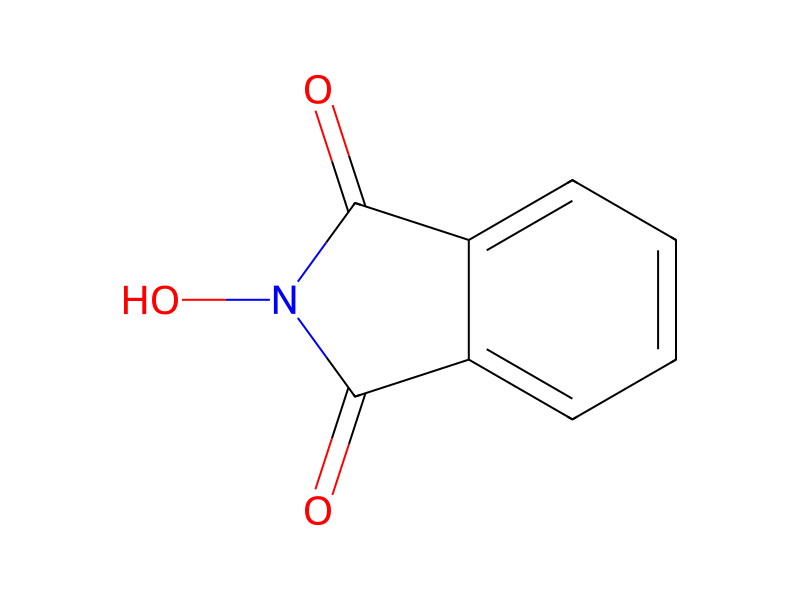
N-Hydroxyphthalimide → HCID 14814200, compound
Reaction equation

[CH3:1][C:2]1([CH3:9])[O:6][C@@H:5]([CH2:7][OH:8])[CH2:4][O:3]1.C1(P(C2C=CC=CC=2)C2C=CC=CC=2)C=CC=CC=1.O[N:30]1[C:34](=[O:35])[C:33]2=[CH:36][CH:37]=[CH:38][CH:39]=[C:32]2[C:31]1=[O:40].CCOC(/N=N/C(OCC)=O)=O>O1CCCC1>[CH3:1][C:2]1([CH3:9])[O:6][C@@H:5]([CH2:7][O:8][N:30]2[C:31](=[O:40])[C:32]3=[CH:39][CH:38]=[CH:37][CH:36]=[C:33]3[C:34]2=[O:35])[CH2:4][O:3]1Participants
Reactant 4



Product 1

Reagents, catalysts & solvents 1

Conditions
- Temperature
- 20 °C
Procedure
To a solution of (S)-2,2-dimethyl-1,3-dioxolane-4-methanol (27 g, 0.2 mol), triphenylphosphine (53.5 g, 0.2 mol) and N-hydroxyphthalimide (33.3 g, 0.2 mol) in dry tetrahydrofuran (500 ml) cooled to 0° C. was added diethylazodicarboxylate (38.5 g, 0.22 mol). After stirring for 18 hours at 20° C. the originally dark red solution turned pale yellow and was then evaporated to dryness under reduced pressure. The residue was loaded onto a silica column in chloroform and eluted with hexane-acetone (3:1), yielding (R)-N-(2,2-dimethyl-1,3-dioxolan-4-ylmethoxy)phthalimide as white plates (31.2 g, 55%), m.p. 100°-2° C. [α]D20 =+15.6° (C 0.98 in methanol); 1R: υmax (nujol) 1790, 1770, 1720, 1600 cm-1 ; 1H NMR: δH (CDCl3), 1.35 (3H, s, CH3), 1.41 (3H, s, CH3), 3.97 (1H, q, J=5.5, 8.8 Hz, CH2ON/CH2OC), 4.17 (2H, m, 1H of CH2ON+1H of CH2OC), 4.32 (1H, q, J=5.5, 10.0 Hz, CH2ON/CH2OC), 4.50 (1H, m, CH), 7.74-7.87 (4H, m, aromatic); m/z 262 (M+-CH3, 50%).
Workup
- customwas then evaporated to dryness under reduced pressure
- washeluted with hexane-acetone (3:1)
Sources & evidence
- ORD record
- ord-851ac0b0ecf94fe6b71e7ce9bf6eadb0
- Source dataset
- uspto-grants-1990_10
- Patent number
- US04965270
Reaction notes
Loading…