Propargyl alcohol → 3-(4-Methylphenyl)prop-2-yn-1-ol
Reaction equation

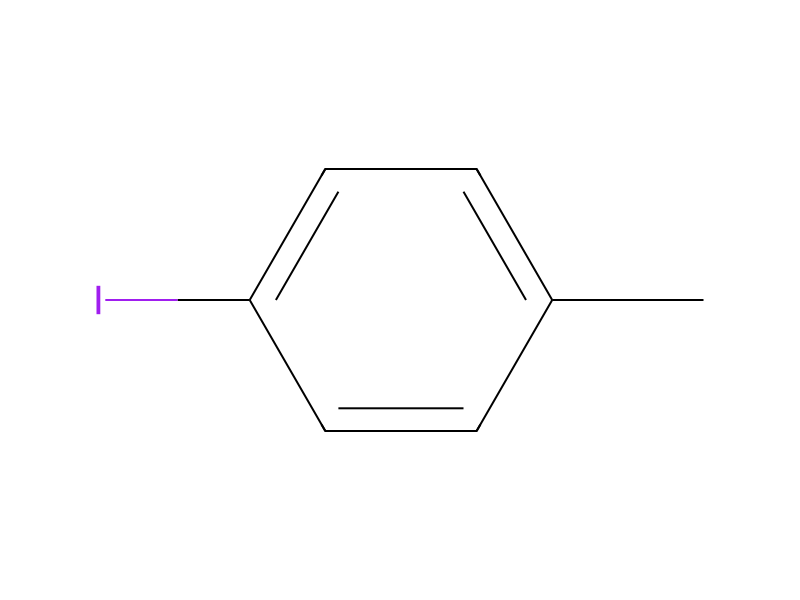
[CH2:1]([OH:4])[C:2]#[CH:3].I[C:6]1[CH:11]=[CH:10][C:9]([CH3:12])=[CH:8][CH:7]=1.C(N(CC)CC)C>C1COCC1.Cl[Pd](Cl)([P](C1C=CC=CC=1)(C1C=CC=CC=1)C1C=CC=CC=1)[P](C1C=CC=CC=1)(C1C=CC=CC=1)C1C=CC=CC=1.[Cu](I)I>[C:9]1([CH3:12])[CH:10]=[CH:11][C:6]([C:3]#[C:2][CH2:1][OH:4])=[CH:7][CH:8]=1Participants






Conditions
- Temperature
- 35 °C
Procedure
Bis(triphenylphosphine)palladium(II) chloride (120 mg; 0.171 mmol) was added to a stirred solution of propargyl alcohol (5.38 g; 95.88 mmol, 1.02 eq), 1-iodo-4-methylbenzene (20.50 g; 94.0 mmol, 1 eq), triethylamine (18.99 g; 188 mmol, 2 eq), and copper iodide (60 mg; 0.32 mmol) in THF (50 mL). The mixture was stirred at 35° C. for 12 h under a nitrogen atmosphere. The mixture was then filtered through a bed of celite and the filtrate was washed with ethyl acetate. The filtrate was then concentrated at 35° C. (vac.=28 in Hg) using a rotary evaporator. The residue was purified using a silica gel column (4:1 heptane/ethyl acetate→2:1 heptane/ethyl acetate) to give the desired product as a light yellow oil (9.62 g; 65.8 mmol; 70%). 1H NMR (400 MHz, CHLOROFORM-d) δ ppm 2.34 (s, 3 H) 4.48 (s, 2H) 7.11 (d, 2H) 7.33 (d, 2H).
Workup
- filtrationThe mixture was then filtered through a bed of celite
- washthe filtrate was washed with ethyl acetate
- concentrationThe filtrate was then concentrated at 35° C. (vac.=28 in Hg)
- customa rotary evaporator
- customThe residue was purified
Sources & evidence
- ORD record
- ord-f6a25dedcd474d8bbe13d03ed0983e31
- Source dataset
- uspto-grants-2012_03
- Patent number
- US08138377B2
Reaction notes
Loading…