Hydrochloric Acid → (2S)-1-((benzyloxy)carbonyl)-4-hydroxypyrrolidine-2-carboxylic acid
Reaction equation

[OH:1][CH:2]1[CH2:6][NH:5][C@H:4]([C:7]([OH:9])=[O:8])[CH2:3]1.Cl[C:11]([O:13][CH2:14][C:15]1[CH:20]=[CH:19][CH:18]=[CH:17][CH:16]=1)=[O:12].C(=O)(O)[O-].[K+].C(=O)([O-])[O-].[K+].[K+].Cl>CC(C)=O.O>[C:11]([N:5]1[CH2:6][CH:2]([OH:1])[CH2:3][C@H:4]1[C:7]([OH:9])=[O:8])([O:13][CH2:14][C:15]1[CH:20]=[CH:19][CH:18]=[CH:17][CH:16]=1)=[O:12]Participants
8
Reactant 5

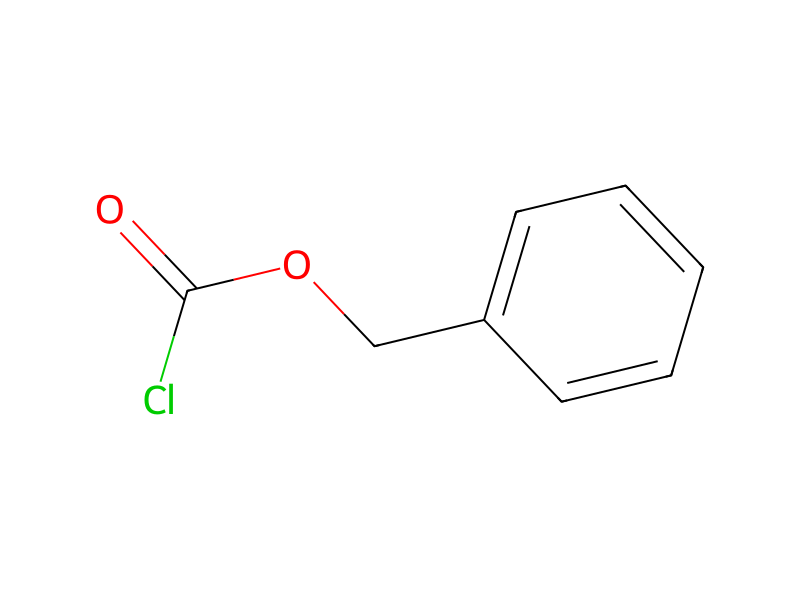



Product 1

Reagents, catalysts & solvents 2


Procedure
26.5 g (0.20 mole) of 4-hydroxy-L-proline and 32.8 ml. (0.23 mole) of benzyl chloroformate are reacted in 200 ml. of water and 100 ml of acetone in the presence of 20 g (0.02 mole) of potassium bicarbonate and 69.2 g (0.50 mole) of potassium carbonate and worked up with 90 ml of concentrated hydrochloric acid as described in Can. J. Biochem. & Physiol. 37, 584 (1959) to obtain N-carbobenzyloxy-4-hydroxy-L-proline. This product is reacted with cyclohexylamine to form the cyclohexylamine salt yield 69 g, m.p. 193°-195°. The salt (34 g) is neutralized with N-hydrochloric acid to obtain 27 g of free acid as a colorless glass [α]D26 -70°, (c, 1% in chloroform).
Sources & evidence
- ORD record
- ord-c973611d606b4168b9b91fc49dfde5fc
- Source dataset
- uspto-grants-1982_01
- Patent number
- US04311705
Reaction notes
Loading…