Diammonium hydrogen phosphate → Tricalcium Phosphate
Reaction equation

[N+]([O-])([O-])=O.[Ca+2:5].[N+]([O-])([O-])=O.[P:10]([O-:14])([O-:13])([OH:12])=[O:11].[NH4+].[NH4+]>>[P:10]([O-:14])([O-:13])([O-:12])=[O:11].[Ca+2:5].[P:10]([O-:14])([O-:13])([O-:12])=[O:11].[Ca+2:5].[Ca+2:5]Participants
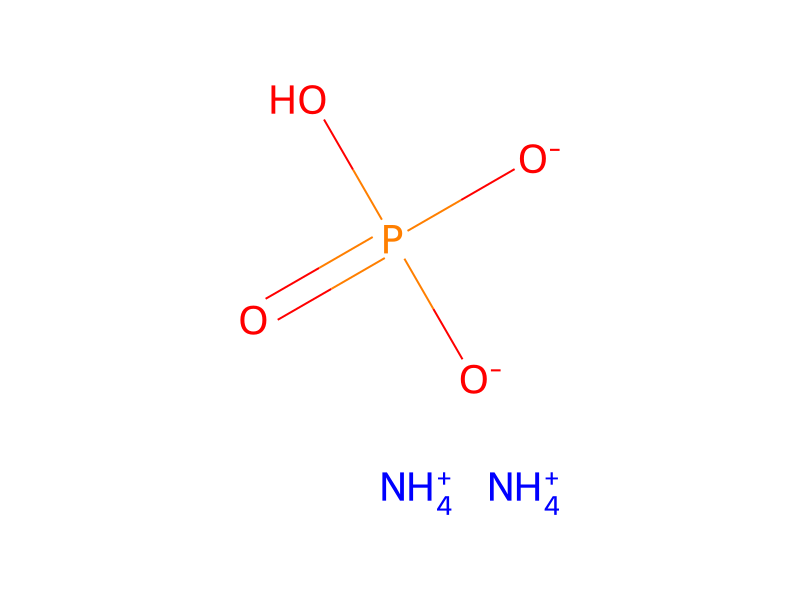


Procedure
First, calcium nitrate and diammonium hydrogen phosphate in a molar ratio of about 1.2-1.5:1 are interacted in aqueous solution at a pH of about 10-12 to produce a gelatinous precipitate of calcium phosphate. Temperature is not critical and the precipitation can be carried out from about 0° C. to 100° C., but is preferably carried out at about room temperature. The gelatinous precipitate thus obtained is separated from the solution by suitable means, for example by centrifugation and decantation of the supernatant. The residual mineral sludge can be washed free of any remaining soluble salts by suspending in distilled water, centrifuging and decanting the supernatant. The residual product is then homogeneously suspended in 1-3 percent (w/w) aqueous ammonium sulfate. Ordinarily, 10-20 ml. of 1-3 percent (w/w) aqueous ammonium sulfate per gram of theoretically expected whitlockite ceramic is employed. The solid is then separated from the solution by centrifugation or vacuum filtration and the resulting wet precipitate is diluted with water to give a pourable slurry which is then cast in accordance with the process of the present invention as described hereinabove.
Sources & evidence
- ORD record
- ord-4e017be1eb554d2cb9e25d3c320229d9
- Source dataset
- uspto-grants-1982_01
- Patent number
- US04312821
Reaction notes
Loading…