Hydrochloric Acid → 5-(Trimethylsilyl)thiazole-2-carboxaldehyde
Reaction equation

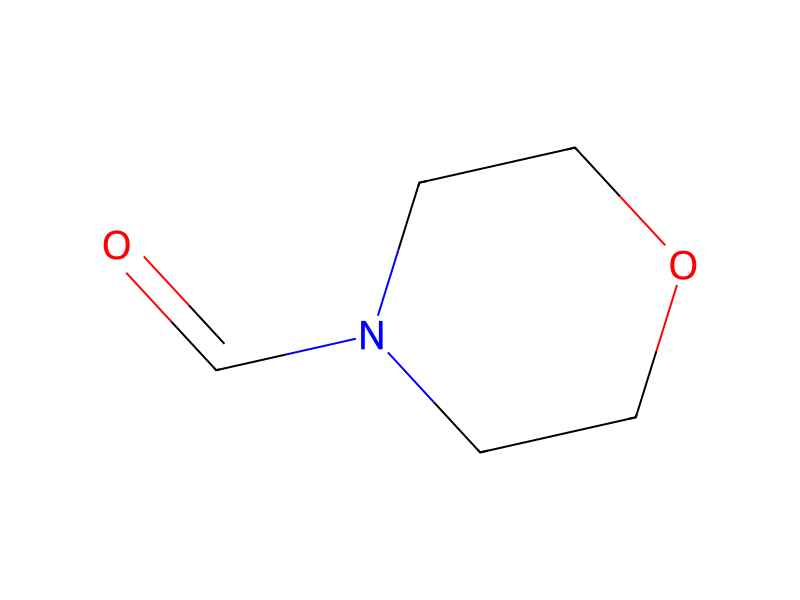
C([Li])CCC.[CH3:6][Si:7]([CH3:14])([CH3:13])[C:8]1[S:12][CH:11]=[N:10][CH:9]=1.[CH:15](N1CCOCC1)=[O:16].Cl>C1COCC1>[CH3:6][Si:7]([CH3:14])([CH3:13])[C:8]1[S:12][C:11]([CH:15]=[O:16])=[N:10][CH:9]=1Participants
6
Reactant 4



Product 1

Reagents, catalysts & solvents 1

Procedure
n-Butyllithium (1.50M in hexane, 39 mmol, 22 ml) was added dropwise at -78° C. to a solution of 5-(trimethylsilyl)thiazole (A. Dondoni et al, J. Org. Chem, 1988, 53, 1748) (5.2 g, 33 mmol) in THF (40 ml). After 30 min. a solution of N-formylmorpholine (4.57 g) in THF (40 ml) was added dropwise over 15 min. The resulting red solution was stirred a further 30 mi. and then allowed to warm to room temperature , dilute d with 4N hydrochloric acid and extracted three times with ethyl acetate. The combined extracts were washed with saturated aqueous sodium chloride, dried over sodium sulphate and evaporated to leave a brown oil (5.5 g). M+ 185; 360 MHz 1H n.m.r (CDCl3) 9.89 (1H, s), 7.95 (1H, s), 0.24 (9H, s).
Workup
- additiondilute
- extractionextracted three times with ethyl acetate
- washThe combined extracts were washed with saturated aqueous sodium chloride
- dry with materialdried over sodium sulphate
- customevaporated
Sources & evidence
- ORD record
- ord-798d997de2cf4a24b17311f08bb588e7
- Source dataset
- uspto-grants-2000_05
- Patent number
- US06063789
Reaction notes
Loading…