2-Acetylhydroquinone → HCID 11322818, compound
Reaction equation

[C:1]([C:4]1[CH:10]=[C:9]([OH:11])[CH:8]=[CH:7][C:5]=1[OH:6])(=[O:3])[CH3:2].S([O-])([O-])(=O)=O.[Ca+2]>C(OCC)(=O)C.C(#N)C.C(O)C1C=CC=CC=1>[C:1]([C:4]1[C:5](=[O:6])[CH:7]=[CH:8][C:9](=[O:11])[C:10]=1[O:3][CH2:1][C:4]1[CH:10]=[CH:9][CH:8]=[CH:7][CH:5]=1)(=[O:3])[CH3:2]Participants
6
Reactant 2
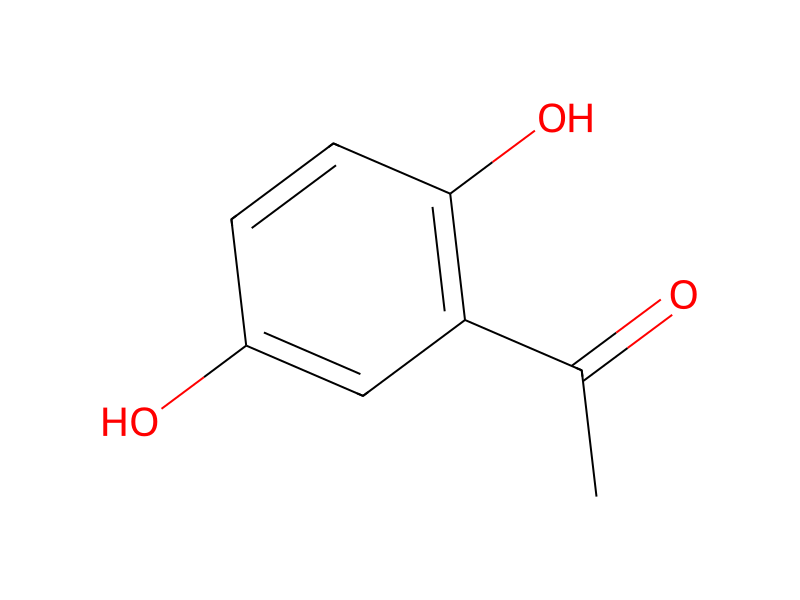

Product 1

Reagents, catalysts & solvents 3



Procedure
To a solution of 4 g of 2-acetyl hydroquinone (I) in 90 ml of ethyl acetate, 100 ml of acetonitrile and 5 ml of benzyl alcohol (III) are added 60 g of crushed calcium sulfate oven dried at 240° C., then 8.5 g of powdered cuprous chloride. It is agitated in gaseous oxygen (at a pressure of one atmosphere) for two hours and thirty minutes at ambient temperature. Then it is diluted with toluene, filtered, the filtrate is evaporated, the residue taken up in a mixture of 120 ml of ether and 80 ml of cyclohexane; by trituration of the resulting mixture followed by a filtration separation of the insoluble matter, a solution is obtained which leads to the expected compound (Yield≃70%) after evaporation of the solvents.
Workup
- customdried at 240° C.
- customthirty minutes
- customat ambient temperature
- additionThen it is diluted with toluene
- filtrationfiltered
- customthe filtrate is evaporated
- additionthe residue taken up in a mixture of 120 ml of ether and 80 ml of cyclohexane
- filtrationby trituration of the resulting mixture followed by a filtration separation of the insoluble matter
- customa solution is obtained which
Sources & evidence
- ORD record
- ord-c711257014814c93b7a67f207396f59f
- Source dataset
- uspto-grants-1984_12
- Patent number
- US04486349
Reaction notes
Loading…