Triphenylphosphine → 5-Fluoro-8-methoxychromane
Reaction equation

[F:1][C:2]1[C:3]([CH2:11][CH2:12][CH2:13][OH:14])=[C:4](O)[C:5]([O:8][CH3:9])=[CH:6][CH:7]=1.C1(P(C2C=CC=CC=2)C2C=CC=CC=2)C=CC=CC=1.CC(OC(/N=N/C(OC(C)C)=O)=O)C>C1COCC1>[F:1][C:2]1[CH:7]=[CH:6][C:5]([O:8][CH3:9])=[C:4]2[C:3]=1[CH2:11][CH2:12][CH2:13][O:14]2Participants
5

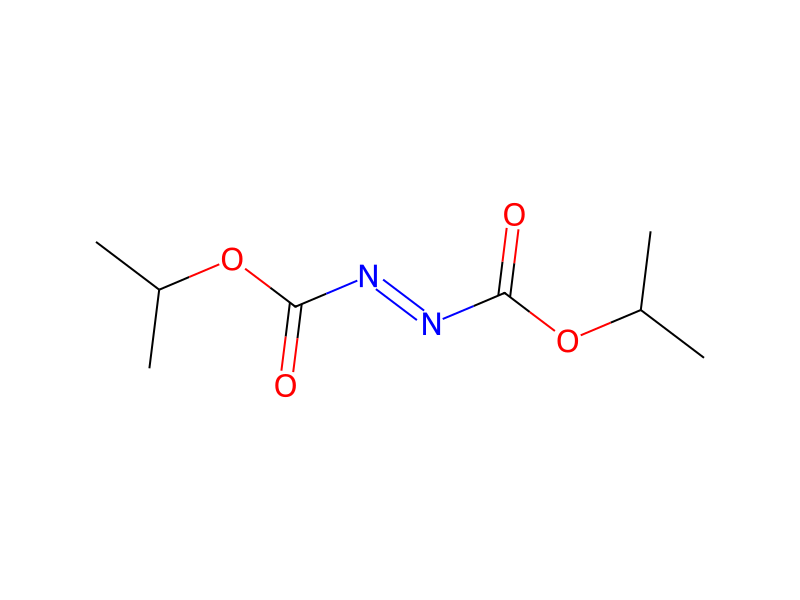



Conditions
- Temperature
- -74 °C
Procedure
After dissolving 4.78 g of 3-fluoro-2-(3-hydroxypropyl)-6-methoxyphenol and 9.4 g of triphenylphosphine in 70 ml of THF under a nitrogen atmosphere, the mixture was cooled to −74° C. Next, 7 ml of DIAD was added to the reaction mixture, which was then raised to room temperature and stirred overnight. The reaction mixture was concentrated and the residue was purified by silica gel column chromatography (ethyl acetate-heptane system) to obtain the target compound (3.6 g) as an oil.
Workup
- temperaturewas then raised to room temperature
- concentrationThe reaction mixture was concentrated
- customthe residue was purified by silica gel column chromatography (ethyl acetate-heptane system)
Sources & evidence
- ORD record
- ord-9d62a0352ff64ff8b6e74796c9176ee0
- Source dataset
- uspto-grants-2010_10
- Patent number
- US07807690B2
Reaction notes
Loading…