Hydrochloric Acid → 1,2,3-triphenylpropane-1,3-dione
Reaction equation

[H-].[Na+].[C:3]1([C:9]([CH2:11][C:12]2[CH:17]=[CH:16][CH:15]=[CH:14][CH:13]=2)=[O:10])[CH:8]=[CH:7][CH:6]=[CH:5][CH:4]=1.[C:18](OC)(=[O:25])[C:19]1[CH:24]=[CH:23][CH:22]=[CH:21][CH:20]=1.Cl>O.C1(C)C=CC=CC=1>[C:19]1([C:18](=[O:25])[CH:11]([C:12]2[CH:13]=[CH:14][CH:15]=[CH:16][CH:17]=2)[C:9]([C:3]2[CH:4]=[CH:5][CH:6]=[CH:7][CH:8]=2)=[O:10])[CH:24]=[CH:23][CH:22]=[CH:21][CH:20]=1Participants
Reactant 4


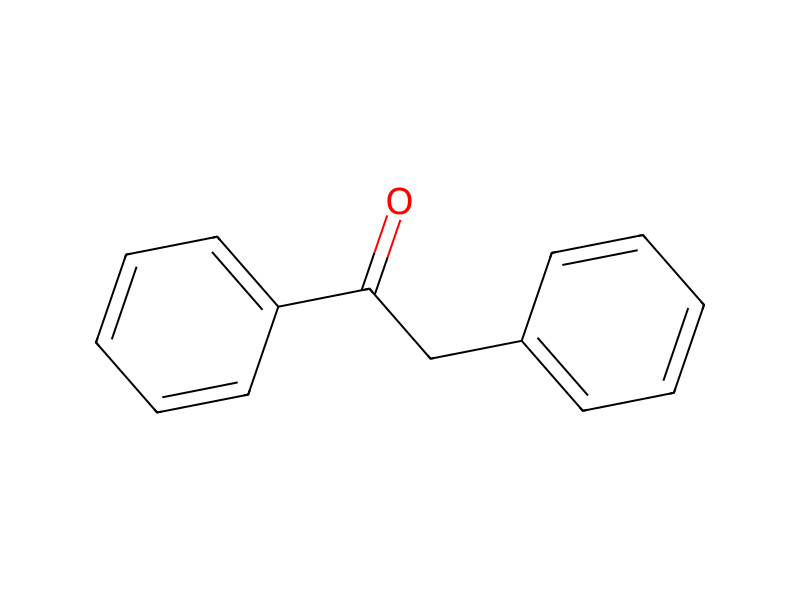

Product 1

Reagents, catalysts & solvents 2


Conditions
- Temperature
- 40 °C
Procedure
In a 500-ml four-necked flask were placed 16.0 g (0.40 mole) of 60% sodium hydride (an oil-added grade), 39.6 g (0.20 mole) of deoxybenzoin, 200.0 g of toluene, and 198.8 g (1.46 moles) of methyl benzoate. The mixture was then heated under reflux with stirring for 15 hours while distilling off methanol. After the reaction was over, the reaction mixture was cooled to 40° C. and 60.8 g (0.60 mole) of concentrated hydrochloric acid and 180.0 g of water were added in drops. The reaction mixture was transferred to a separatory funnel and an organic layer was separated. The organic layer was concentrated under reduced pressure to dryness. The residue was purified by reslurrying with methanol and a solid was recovered by filtration and dried under reduced pressure to give 36.2 g of 1,2,3-triphenylpropane-1,3-dione.
Workup
- customIn a 500-ml four-necked flask were placed
- temperatureThe mixture was then heated
- temperatureunder reflux
- distillationwhile distilling off methanol
- customThe reaction mixture was transferred to a separatory funnel
- customan organic layer was separated
- concentrationThe organic layer was concentrated under reduced pressure to dryness
- customThe residue was purified
- filtrationa solid was recovered by filtration
- customdried under reduced pressure
Sources & evidence
- ORD record
- ord-2ed9e9d5bbf348f49d84226fe523895c
- Source dataset
- uspto-grants-2010_10
- Patent number
- US07816020B2
Reaction notes
Loading…