Hydrochloric Acid → HCID 68646223, compound
Reaction equation

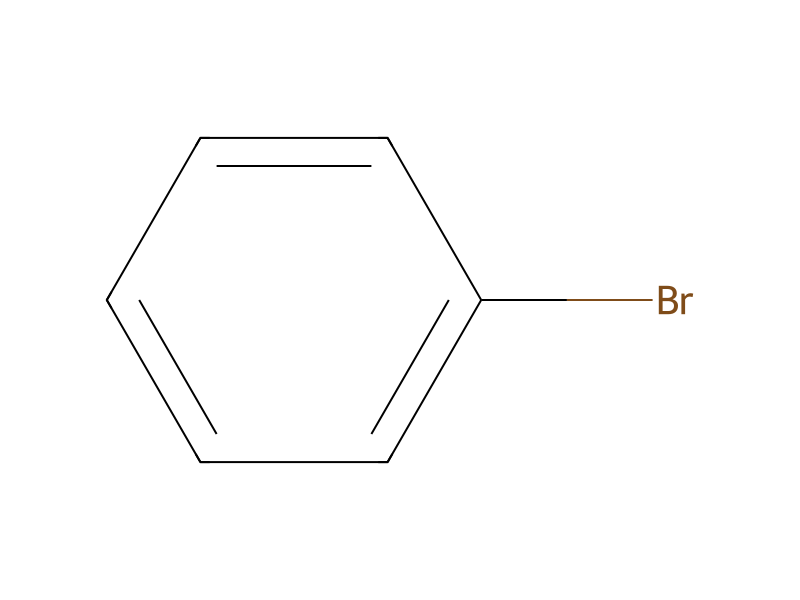
[Mg].II.Br[C:5]1[CH:10]=[CH:9][CH:8]=[CH:7][CH:6]=1.[CH2:11]([O:18][CH2:19][CH2:20][CH2:21][CH2:22][CH2:23]Br)[C:12]1[CH:17]=[CH:16][CH:15]=[CH:14][CH:13]=1.Cl>CCOCC>[CH2:11]([O:18][CH2:19][CH2:20][CH2:21][CH2:22][CH2:23][C:5]1[CH:10]=[CH:9][CH:8]=[CH:7][CH:6]=1)[C:12]1[CH:17]=[CH:16][CH:15]=[CH:14][CH:13]=1Participants
Reactant 5




Product 1

Reagents, catalysts & solvents 1

Conditions
- Temperature
- -5 °C
Procedure
Into a flask containing magnesium turnings (about 750 mg, about 31 mmol), ether (about 10 ml) was added, and then a small amount of iodine (about 1 mg˜about 5 mg) was added, and the resulting mixture was stirred for several min until it was colorless. Bromobenzene (about 100 ml, about 0.9 mmol) was added to the mixture and then heated to thus initiate the reaction. While the mixture was weakly refluxed, a mixture solution of bromobenzene (about 3.2 ml, about 30 mmol) and ether (about 50 ml) was added in droplets thereto for about 2.5 hours. The deeply browned mixture was stirred at ambient temperature for about 3 hours in a nitrogen atmosphere and then cooled in an ice-salt bath at about −5° C. To the mixture, a mixture solution of 5-benzyloxy-1-bromopentane (about 1.54 g, about 6 mmol) and ether (about 10 ml) was added in droplets. The resulting mixture was stirred for about 2 hours, cooled, heated to reflux for about 3 hours, and then cooled at ambient temperature. The above solution was poured onto ice water while being stirred, and hydrochloric acid (about 1 N) was added in droplets thereto. The pH thereof was maintained at about 4. The film was separated, after which the water-soluble film was extracted three times with methylene chloride. The organic layer was dried using MgSO4, filtered and concentrated to thus obtain brown oil, which was then subjected to column chromatography, yielding 5-phenylpentyl benzyl ether. A mixture of 5-phenylpentyl benzyl ether and methanol (about 50 ml) was blended with about 10% Pd/C catalyst, stirred for about 3 hours in a hydrogen atmosphere, and then filtered through a Celite pad. The filtrate was concentrated, thus obtaining 5-phenylpentylalcohol. Using 5-phenylpentylalcohol as a starting material, the same procedure as in Example 1 was performed, thereby obtaining the precursor compound 2 of the above formula.
Workup
- additionwas added
- temperatureheated
- customthe reaction
- temperatureWhile the mixture was weakly refluxed
- stirringThe deeply browned mixture was stirred at ambient temperature for about 3 hours in a nitrogen atmosphere
- stirringThe resulting mixture was stirred for about 2 hours
- temperaturecooled
- temperatureheated
- temperatureto reflux for about 3 hours
- temperaturecooled at ambient temperature
- additionThe above solution was poured onto ice water
- stirringwhile being stirred
- temperatureThe pH thereof was maintained at about 4
- customThe film was separated
- extractionafter which the water-soluble film was extracted three times with methylene chloride
- customThe organic layer was dried
- filtrationfiltered
- concentrationconcentrated to thus obtain brown oil, which
Sources & evidence
- ORD record
- ord-15bc3394e14942e8af54210fc9911a3e
- Source dataset
- uspto-grants-2010_10
- Patent number
- US07816671B2
Reaction notes
Loading…