2-Bromobutane → 2-(sec-butoxy)-1H-isoindole-1,3(2H)-dione
Reaction equation
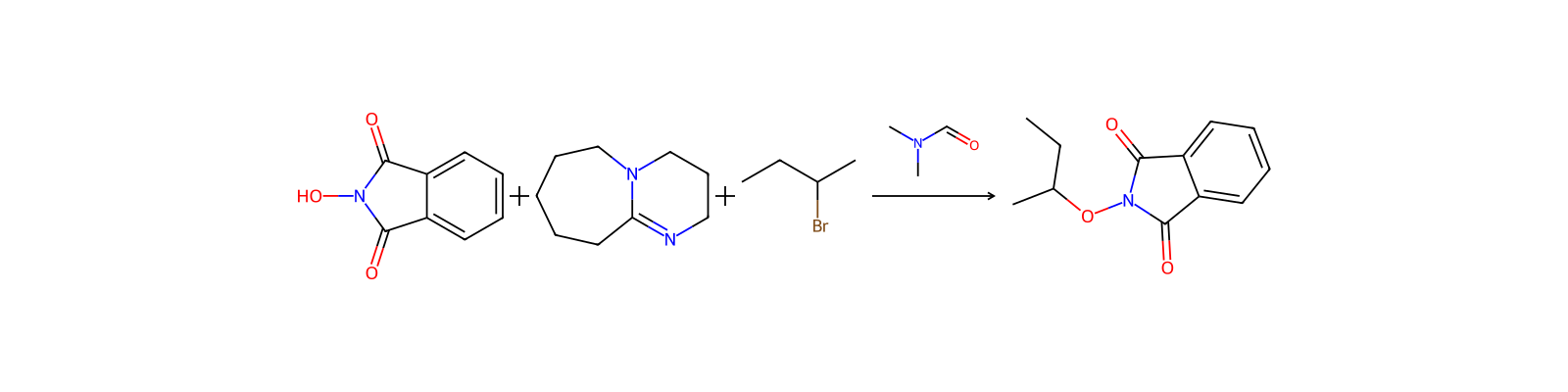
[OH:1][N:2]1[C:6](=[O:7])[C:5]2=[CH:8][CH:9]=[CH:10][CH:11]=[C:4]2[C:3]1=[O:12].N12CCCN=C1C[CH2:17][CH2:16][CH2:15][CH2:14]2.BrC(CC)C>CN(C=O)C>[CH:15]([O:1][N:2]1[C:3](=[O:12])[C:4]2[C:5](=[CH:8][CH:9]=[CH:10][CH:11]=2)[C:6]1=[O:7])([CH2:16][CH3:17])[CH3:14]Participants
Reactant 3



Product 1

Reagents, catalysts & solvents 1

Conditions
- Temperature
- 55 °C
Procedure
N-hydroxylphthalimide (18.4 mmol, 3.0 g) was dissolved in anhydrous DMF (20 mL) under nitrogen. To the stirring solution, DBU (1,8-diazabicyclo[5.4.0]undec-7-ene) (27.6 mmol, 4.13 mL) was injected followed by 2-bromobutane (22.1 mmol, 2.41 mL) and the reaction was warmed to 55° C. After stirring for 18 hour, the reaction was cooled to room temperature and concentrated to a red oil. The reaction was partitioned between ethyl acetate and 1N HCl. The organic layer was washed with saturated aqueous sodium bicarbonate solution, distilled water, brine and dried over magnesium sulfate. The solvent was removed under vacuum providing 3.57 g (89%) of a yellow solid. Rf: 0.8 (2:1 hexanes/ethyl acetate); H1-NMR (CDCl3): δ7.80 (2H,m), 7.73 (2H,m), 4.31 (1H,m), 1.81 (1H,m), 1.64 (1H,m), 1.32 (3H,d), 1.03 (3H,t).
Workup
- temperaturethe reaction was cooled to room temperature
- concentrationconcentrated to a red oil
- customThe reaction was partitioned between ethyl acetate and 1N HCl
- washThe organic layer was washed with saturated aqueous sodium bicarbonate solution
- distillationdistilled water, brine
- dry with materialdried over magnesium sulfate
- customThe solvent was removed under vacuum
Sources & evidence
- ORD record
- ord-368e0e18f6ba41e9bdf4764a6445e0b7
- Source dataset
- uspto-grants-2003_09
- Patent number
- US06613743B2
Reaction notes
Loading…