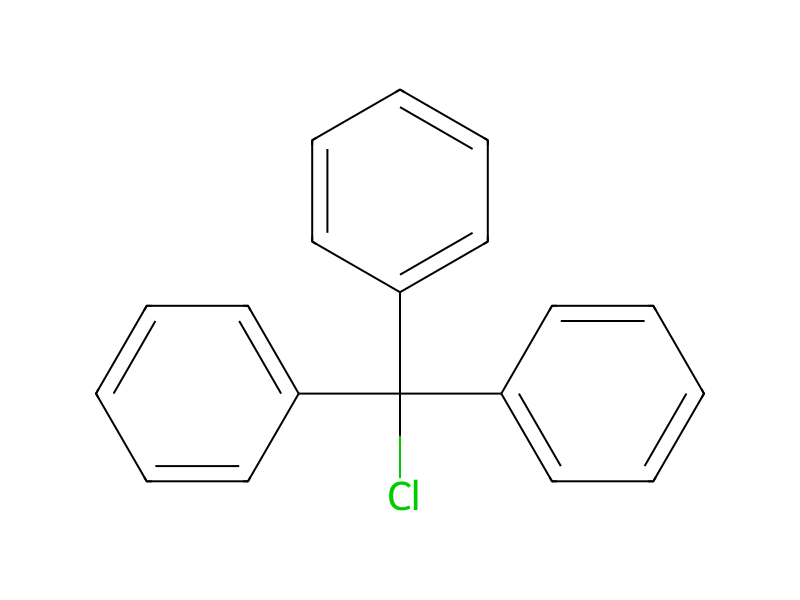
Trityl chloride → (S)-ethyl 3-hydroxy-4-trityloxybutanoate
Reaction equation

[OH:1][C@H:2]([CH2:9][OH:10])[CH2:3][C:4]([O:6][CH2:7][CH3:8])=[O:5].C(N(CC)CC)C.[C:18](Cl)([C:31]1[CH:36]=[CH:35][CH:34]=[CH:33][CH:32]=1)([C:25]1[CH:30]=[CH:29][CH:28]=[CH:27][CH:26]=1)[C:19]1[CH:24]=[CH:23][CH:22]=[CH:21][CH:20]=1>C(Cl)Cl.CN(C1C=CN=CC=1)C>[OH:1][C@H:2]([CH2:9][O:10][C:18]([C:19]1[CH:24]=[CH:23][CH:22]=[CH:21][CH:20]=1)([C:31]1[CH:32]=[CH:33][CH:34]=[CH:35][CH:36]=1)[C:25]1[CH:26]=[CH:27][CH:28]=[CH:29][CH:30]=1)[CH2:3][C:4]([O:6][CH2:7][CH3:8])=[O:5]Participants
6





Procedure
To (S)-ethyl 3,4-dihydroxybutanoate (1.40 g, 9.45 mmol) in methylene chloride (20 ml) were added triethylamine (1.15 g, 11.36 mmol) and DMAP (17 mg, 0.139 mmol) and the solution was cooled in ice bath. Trityl chloride (2.90 g, 10.4 mol) in methylene chloride (15 ml) was dropped to the solution under stirring and then stirred at room temperature over night. The reaction mixture was washed with saturated ammonium chloride and then saturated brine, dried on magnesium sulfate, filtered and condensed in vacuo. The residue was subjected to silica gel chromatography to give (S)-ethyl 3-hydroxy-4-trityloxybutanoate (1.11 g, yield 31%).
Workup
- temperaturethe solution was cooled in ice bath
- stirringstirred at room temperature over night
- washThe reaction mixture was washed with saturated ammonium chloride
- dry with materialsaturated brine, dried on magnesium sulfate
- filtrationfiltered
- customcondensed in vacuo
Sources & evidence
- ORD record
- ord-abdd119dbf614fadb375c09ec1071e2a
- Source dataset
- uspto-grants-2003_09
- Patent number
- US06620977B1
Reaction notes
Loading…