Triphenylphosphine → Triphenylphosphine Oxide
Reaction equation

C([O:3]C(=O)C1C=C(Br)C=NC=1)C.N1C=CC=C(B(O)O)C=1.[O-]P([O-])([O-])=O.[K+].[K+].[K+].[CH:30]1[CH:35]=[CH:34][C:33]([P:36]([C:43]2[CH:48]=[CH:47][CH:46]=[CH:45][CH:44]=2)[C:37]2[CH:42]=[CH:41][CH:40]=[CH:39][CH:38]=2)=[CH:32][CH:31]=1>CC([O-])=O.CC([O-])=O.[Pd+2].O1CCOCC1>[P:36]([C:33]1[CH:32]=[CH:31][CH:30]=[CH:35][CH:34]=1)([C:43]1[CH:48]=[CH:47][CH:46]=[CH:45][CH:44]=1)([C:37]1[CH:42]=[CH:41][CH:40]=[CH:39][CH:38]=1)=[O:3]Participants
Reactant 4


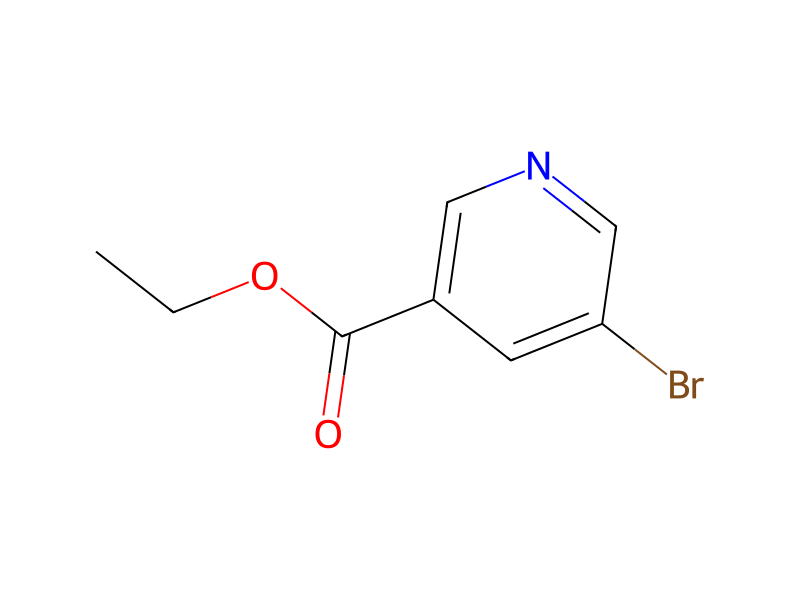

Product 1
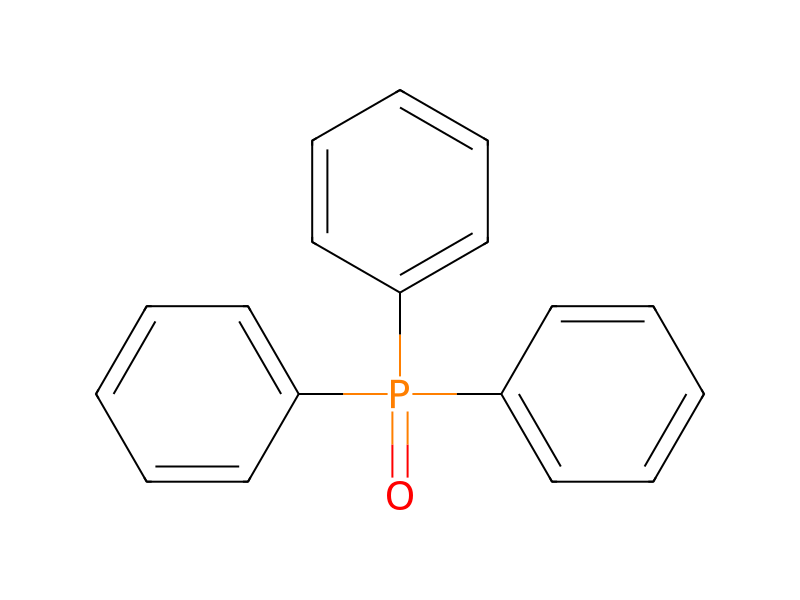
Reagents, catalysts & solvents 2


Procedure
Referring to Scheme 1 (synthesis of B-1, B-2, B-3 and B-4), synthesis of compound 2, to a 500-mL oven-dried round-bottomed flask with a sidearm and condenser, was added ethyl-5-bromonicotinate (38.0 g, 0.17 mol), 3-pyridineboronic acid (22.5 g, 0.18 mol), and anhydrous 1,4-dioxane (220 mL) under argon. An aqueous solution of K3PO4 (2 M, 182 mL) was added, followed by the addition of Pd(OAc)2 (1.86 g, 8.3 mmol) and PPh3 (8.7 g, 33.0 mmol). The reaction was refluxed for 2 h. while a gentle and steady stream of argon was bubbled through the solution. After cooling to room temperature, the POPh3 crystals which formed were filtered from the biphasic reaction mixture. The aqueous layer was extracted with EtOAc (3×200 mL). The combined organic layers were washed with brine (1×200 mL), dried over MgSO4, and evaporated under reduced pressure until ˜50 mL remained. To this crude mixture of 1, was added methanol (25 mL) and water (20 mL). After cooling to 0° C., LiOH (8.0 g, 0.33 mmol) was added, and the reaction was stirred for 30 min. at room temperature. The organics were evaporated under reduced pressure. The remaining basic aqueous phase was diluted with water (50 mL) and washed with EtOAc several times until the EtOAc washes remained colorless. The basic water was acidified with KHSO4 (1M) until pH-4. The white precipitate (compound 2) which formed was collected by filtration, washed with water, acetone, and air dried. Further drying under reduced pressure yielded 20.3 g (61%) of white powder. 1H NMR (CD3OD, 500 MHz) δ 7.61 (ddd, J=8.0, 5.0, 0.77 Hz, 1H), 8.23 (ddd, J=8.0, 2.3, 1.6 Hz, 1H), 8.64 (dd, J=5.0, 1.5 Hz, 1H), 8.65 (t, J=2.0 Hz, 1H), 8.92 (dd, J=2.3, 0.66 Hz, 1H), 9.04 (d, J=2.3 Hz, 1H), 9.17 (d, J=2.0 Hz, 1H).
Workup
- temperatureThe reaction was refluxed for 2 h. while a gentle and steady stream of argon
- customwas bubbled through the solution
Sources & evidence
- ORD record
- ord-213289e6124f482f96d66d020e2b0ec6
- Source dataset
- uspto-grants-2010_11
- Patent number
- US07829341B2
Reaction notes
Loading…